El Calafate Airport (FTE): Arrivals, Transfers & Onward Travel
El Calafate airport (FTE) explained: which flights serve it, how to get to town, the glacier and El Chalten, car rental, and practical arrival tips.
By Patagonia Tourism Guide · First published 13 Aug 2026 · Updated 1 Aug 2026
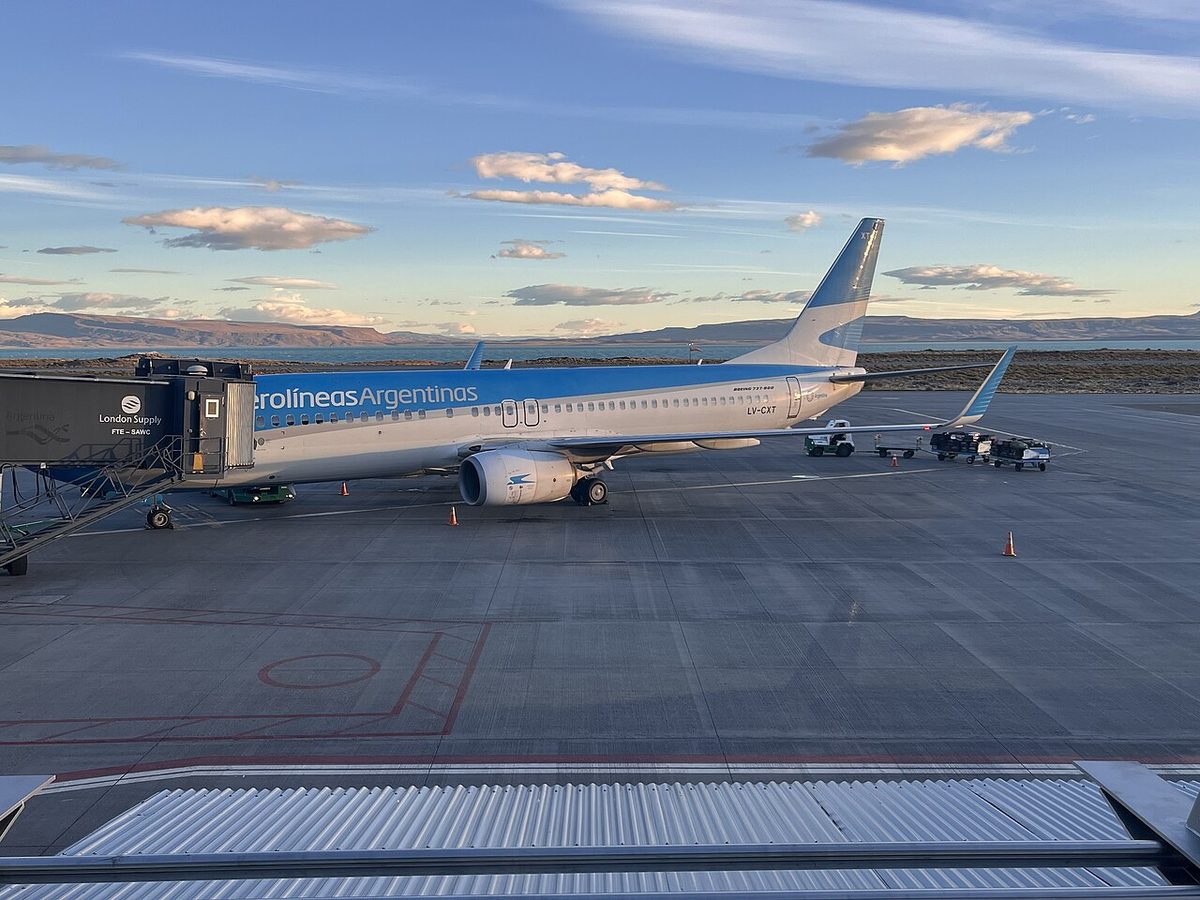
0 — 2 km Fig. 1 · El Calafate airport (Comandante Armando Tola International, FTE), the gateway to Los Glaciares in Patagonia · Photo: Boeing737 arm / CC BY-SA 4.0 via Wikimedia Commons
The first time I flew into El Calafate airport, I spent the descent with my face against the window, watching the brown Patagonian steppe roll out forever and the turquoise edge of Lago Argentino appear like someone had spilled paint. Then the plane landed, the wind hit, and I had a very practical question: how do I actually get from here to my hotel, and then to the ice?
That gap, between the romance of arriving in Patagonia and the logistics of a small airport in the middle of the steppe, is what trips people up. So let me close it for you.
El Calafate airport is Comandante Armando Tola International Airport (code FTE), about 21 to 23 km east of town. There is no public city bus, so you reach El Calafate by shared shuttle, taxi, private transfer, or rental car, roughly a 20 to 45 minute trip. From town you carry on to Perito Moreno Glacier or El Chalten by bus, tour, or car.
This guide is for anyone flying into Argentine Patagonia’s south and trying to sort the practical chain: which flights land here, how to get from the airport to your hotel, how to reach the glacier and El Chalten afterward, and the little things, like cash and the lack of Uber, that nobody tells you until you’re standing in the arrivals hall. It’s the arrivals-and-onward companion to the El Calafate and Perito Moreno Glacier guide, which is the hub for everything you’ll actually do once you’re here.
El Calafate Airport at a Glance
Here’s the fast version: the airport, then the three legs of the journey most travelers care about. Times and prices shift with the season, the operator, and the Argentine peso, so treat these as planning estimates and reconfirm close to your trip.
Route
Best option
Approx time
Approx price (verify)
Airport to El Calafate town
Shared shuttle (Ves Patagonia)
30-45 min
around ARS 11,000 one-way
Airport to El Calafate town
Taxi / remis
20-25 min
around ARS 33,000 (cash)
Airport to El Calafate town
Private transfer
20-25 min
varies, book ahead
Airport to El Calafate town
Rental car
~20 min
from around USD 45-60/day
Town to Perito Moreno Glacier
Tour, regular bus, or car
~1.5 hrs each way
varies by option
Airport or town to El Chalten
Bus / shared transfer
~3 hrs
around USD 20 one-way
Swipe to see all columns
Table 1
If you remember one thing: there is no public bus from the airport into town, and there is no Uber in El Calafate. You will use a shuttle, a taxi, a pre-booked transfer, or a rental car. All four are easy. None of them require you to have arranged anything before you land, though a pre-booked transfer is the calmest option if you’re arriving tired or late.
About El Calafate Airport (FTE)
Comandante Armando Tola International Airport opened in November 2000, replacing the old Lago Argentino Airport that used to sit much closer to town. It was designed by the Uruguayan-Canadian architect Carlos Ott, the same name behind the Opera Bastille in Paris, which is a fun bit of trivia to drop when your terminal turns out to be more handsome than you expected for a town of this size.
It carries the IATA code FTE and the ICAO code SAWC, and you’ll see “FTE” on every booking site and baggage tag, so that’s the one to memorize. It sits at about 197 meters of elevation on the open steppe, with the official address given as Camino al Aeropuerto, km 23.
According to Wikipedia’s airport entry, FTE is the westernmost Argentine airport served by scheduled flights, and it functions as the main gateway to Los Glaciares National Park. That’s exactly why you’re flying here: this single runway in the middle of nowhere is the front door to Perito Moreno Glacier and, for many people, to El Chalten and Fitz Roy as well.
It’s a compact, single-terminal airport, not a sprawling hub. Inside you’ll find an ATM in the arrivals hall, a café (Coffee is in the Air), a Mamuschka chocolate shop near check-in, a small drugstore and gift shop, and a paid lounge (W Premium Lounge) upstairs between the boarding gates. The whole thing is walkable end to end in a couple of minutes, which makes arrivals and departures refreshingly low-stress once you know the drill.
One honest note on reliability: like a lot of Patagonian infrastructure, FTE’s schedule can wobble with weather and the occasional operational hiccup, and Argentina’s airline landscape changes faster than most. As of 2026 the airport is operating with robust daily service, but flight times and routes are worth reconfirming with your airline, especially in the shoulder and winter months.
Which Flights Serve El Calafate Airport?
The overwhelming majority of travelers reach FTE through Buenos Aires, and that’s the route to build your trip around.
Aerolíneas Argentinas is the dominant carrier here, flying from Buenos Aires (both Aeroparque/AEP and, seasonally, Ezeiza/EZE) plus a handful of other Argentine cities. The low-cost airlines Flybondi and JetSmart also run the Buenos Aires routes, which is where you’ll often find the cheapest fares if you’re flexible and travel light.
The Buenos Aires to El Calafate flight runs several times a day in season and takes roughly 3 hours 10 minutes to 3 hours 20 minutes. It’s a real domestic hop across the length of the country, not a quick puddle-jump, so factor it into your arrival-day energy.
Beyond Buenos Aires, the route map is thinner and more seasonal, but these connections do exist and can save you a backtrack:
Bariloche, Córdoba, and Trelew, generally on Aerolíneas Argentinas and often seasonal. Frequencies are limited, so don’t assume a daily flight.
Santiago de Chile, a seasonal international route operated by Sky Airline in some summers.
A practical warning: the cross-Patagonia routes (Ushuaia, Bariloche, Trelew) are far less frequent than the Buenos Aires corridor, and seasonal routes can vanish in the off-season. If your plan depends on one of them, book early and have a backup. For the full picture of getting into the region and how the airports connect, see how to get to Patagonia, and for sequencing your stops, the Patagonia itinerary planner.
This is the question everyone actually searches, so let’s be thorough. The airport is about 21 to 23 km east of El Calafate, a drive of roughly 20 to 25 minutes on a straight, paved road across the steppe. There is no public bus linking the two, and there is no Uber or Cabify in El Calafate. You have four sane options.
Shared shuttle (the budget pick)
A shared minibus is the cheapest way into town, and it’s genuinely fine. The main operator is Ves Patagonia, with 19-seat minibuses that have room for luggage and even skis or bikes. You buy your ticket at the company’s counter in the arrivals hall (it’s been at Counter 4), tell them your hotel, and they drop you at or very near your door.
The official airport site lists the Ves Patagonia airport-to-Calafate fare at around ARS 11,000 one-way, but reconfirm, because Argentine prices move quickly. Shuttles leave coordinated with flights, typically around 30 minutes after each arrival, with the last service in the evening (often around 10 PM). The tradeoff is time: because the minibus makes several hotel stops, the trip stretches to 30 to 45 minutes rather than the 20 a taxi would take.
Choose the shuttle if you’re solo or a couple, watching the budget, and not in a rush. If your hotel is on Avenida del Libertador, the main street, you’ll be dropped almost at the door.
Taxi or remis (the fast pick)
There’s an official taxi and remis stand right outside arrivals, and you don’t need to book anything. The established local company is Taxi Condor, with cars meeting each flight. The official airport site lists the airport-to-Calafate fare at around ARS 33,000 as a final cash price, but always confirm the fare before you get in, since prices change and card payments sometimes carry a surcharge.
A taxi seats up to four with luggage and takes the direct 20 to 25 minutes. Split between three or four people, it can work out similar to the shuttle per head, and it’s faster and door-to-door. If you’re traveling solo and want to save, look around the exit; there are often other arrivals happy to share a cab and split the fare into town.
Private transfer (the peace-of-mind pick)
A pre-booked private transfer is the option I recommend if you’re arriving on a dawn flight, traveling with family, or simply don’t want to think. You book ahead, and a driver waits in arrivals with a sign bearing your name, then takes you straight to your hotel. If your flight is delayed, the good operators track it and adjust.
It costs more than a taxi and obviously requires booking in advance, but the calm of stepping off a long travel day and seeing your name on a card is worth a lot. Local agencies and your hotel can both usually arrange one; contact them at least a day or two ahead, more in the December-to-February high season.
Rental car (only if you actually need it)
There are plenty of rental desks at the airport (more on the specifics below), so picking up a car on arrival is easy. But be honest with yourself about whether you need one. For a standard two-night glacier stop, you probably don’t, because tours and the regular bus cover Perito Moreno comfortably and a car mostly sits parked. A rental makes sense if you’re staying longer, want to reach the glacier ahead of the tour buses, are a family or group, or you’re road-tripping the wider region. I’ll come back to this.
Getting to Perito Moreno Glacier from the Airport
Here’s a thing that surprises people: you generally do not go straight from the airport to the glacier.
Perito Moreno sits about 80 km west of El Calafate town via Ruta Provincial 11, roughly a 1.5-hour drive. Since the airport is about 21 to 23 km east of town, the glacier is well over 100 km from the airport itself. There’s no scheduled bus running airport-to-glacier, and the regular glacier bus departs from the town bus terminal, not from arrivals.
So the normal, sane flow is: fly in, transfer to your hotel in town, sleep, and visit the glacier the next day. That gives you a full, unhurried day at the walkways rather than a frantic dash off a delayed flight.
If you’re determined to maximize a short trip, you do have two ways to reach the glacier more directly:
A private transfer can take you from the airport toward Perito Moreno with optional stops, but it’s a long first day and you’d still need to sort accommodation afterward.
A rental car picked up at the airport lets you drive to the park on your own schedule, which suits early risers and photographers.
Even then, I’d sleep in town first. A once-in-a-lifetime glacier day built on a same-day arrival is fragile: a delayed flight, slow luggage, and the drive can quietly erase it. For the full breakdown of tours, the regular bus, the rental-car option, and the current national park fees, see how to visit Perito Moreno Glacier, and for the bigger experience picture, the El Calafate and Perito Moreno guide.
This is where El Calafate airport quietly does something useful that most airports don’t: you can go straight to El Chalten from arrivals, without detouring through town.
El Chalten, the trekking village beneath Fitz Roy, is about 200 km north, a drive of roughly 3 hours up Ruta 40 and then RP-23. Several bus companies, including Marga/Taqsa, Chaltén Travel, and Cal Tur, run this route, and crucially, some services either start at the airport or make a scheduled stop at the airport to collect arriving passengers before continuing north. Chaltén Travel, for example, lists multiple daily El Calafate departures, and shared transfers run roughly every couple of hours timed to flight arrivals, dropping you door-to-door at your El Chalten lodging.
Expect to pay around USD 20 each way (a bit less for a round trip), but hedge that and reconfirm, and book ahead in high season, when seats fill fast.
One honest caveat I’ll borrow from local writers: whether the airport-stop bus suits you depends entirely on your flight time. If your arrival lands you with a four-hour wait for the next northbound service, that’s a long sit in a small terminal. A pre-booked shared or private transfer that meets your specific flight can be smoother, and worth the small premium if you want to go straight to the mountains.
If your plan is to hike, this direct connection is a gift, because it lets you skip a night in El Calafate entirely and get to Fitz Roy faster. For the full logistics, including reverse trips and timing, see El Calafate to El Chalten, and for the trails themselves, the guide to hiking around Fitz Roy.
The El Calafate Bus Terminal
If you’re traveling onward overland, you’ll get to know the Terminal de Ómnibus, El Calafate’s bus station. It matters because, with the exception of those handy airport-stop services, most long-distance buses leave from here, not the airport.
The terminal sits at Antoine de Saint-Exupéry 87, up a small rise about 500 meters from the main street. It’s roughly an 8-minute walk from the center (uphill, into the wind, with a suitcase, so a short taxi or remis is forgivable). It’s the departure point for buses to El Chalten, Perito Moreno Glacier, Puerto Natales in Chile (around 5 hours, for Torres del Paine), and Río Gallegos, plus connections deeper into Argentina and Chile.
Inside you’ll find ticket offices for the main companies, including Cal-Tur, Taqsa/Marga, Chaltén Travel, Always Glaciers, Andesmar, Bus-Sur, and Zahaj. There’s a cafeteria, a taxi stand, and, usefully, luggage storage, which is gold if you have a few hours between checkout and a bus and want to wander town unburdened. Ticket windows generally run from early morning to around 10 PM, but verify current hours.
The practical rhythm for most arrivals is simple: airport to your hotel, then walk or taxi to the terminal for your onward bus. For how this stop fits into a wider route, the Patagonia itinerary planner lays out the sequences.
Car Rental at El Calafate Airport
If you decide a car is right for your trip, El Calafate airport makes it easy. The official airport site lists rental desks for Hertz, Europcar, Budget/Avis, Localiza, Alamo, Sixt, Always, Dubrovnik, Chaltén Travel Rent a Car, and others, all in the arrivals sector, so you can pick up keys steps from baggage claim. Daily rates on the aggregators tend to start around USD 45 to 60, though that swings hard with season and demand.
A few things to know before you commit:
You’ll need a credit card for the security deposit, and some desks operate 24/7 while others open around flight times.
Roads to Perito Moreno and El Chalten are paved, but venture off the main routes and you’ll meet gravel (ripio); a little experience helps, and it affects insurance.
In winter, park roads can require chains or studded tires for snow and ice.
Parking in the compact town center can be fiddly.
Most glacier and lake excursions, the Mini Trekking, the boat tours, already include their own transport, so a car often duplicates what you’ve paid for.
My take: for a two-night Perito Moreno stop, skip the car and use shuttles, the regular bus, and tours. Rent if you’re staying three or four nights, beating the crowds to the glacier, traveling as a family, or stitching together a longer road trip. I dig into the car-or-not question more in the El Calafate itinerary guide, and the regional transport strategy lives in hostels, refugios and estancias compared, which covers how your base affects whether you need wheels.
A handful of small things make landing at FTE smoother. These are the details I wish someone had handed me before my first arrival.
Bring cash in Argentine pesos. There’s an ATM in the arrivals hall, but it can have a queue or run dry, and Argentina’s currency situation rewards travelers who carry some pesos for the transfer, tips, and the odd surcharge. Cards work in many places, but cash is faster and avoids card fees on taxis.
There is no Uber. I’ll say it again because people don’t believe it: no Uber, no Cabify, no ride apps. Your options are the official taxis and remises at the exit, or a pre-booked transfer. Don’t stand in arrivals refreshing an app.
Don’t plan to walk. It’s 21 to 23 km to town along a road with no sidewalk, exposed to Patagonian wind that can be ferocious. This is not a walkable airport, full stop.
Dress for the wind, even in summer. The steppe is cold and blustery far more often than the brochure photos suggest. Keep a warm layer in your carry-on so you’re not digging through a checked bag the moment you step outside. The hiking and camping essentials covers what to pack for the climate.
Save your hotel’s address and phone, offline. Download the Google Maps area before you fly so it works without a signal, and have your accommodation’s exact address written down for the driver. It removes a surprising amount of friction.
Book transfers ahead in high season. From December to February and around holidays, shuttles and transfers fill up. A day or two of notice is usually plenty, but don’t leave a late-night arrival to chance.
Departure Tips from El Calafate Airport
Leaving is mostly the reverse, with a couple of wrinkles.
Arrange your return ride the day before. If you used a shuttle or transfer in, book the return the same way; Ves Patagonia and the transfer operators run airport-bound services timed to departures, but the last shuttle of the day leaves relatively early in the evening, so check the schedule against your flight. A taxi is always available as a backup.
Give yourself buffer for an early flight. Many Buenos Aires departures leave in the morning, and El Calafate’s weather and the occasional operational delay mean you don’t want to be cutting it fine. Aim to be at the terminal in good time; it’s small and quick to move through, so the cost of arriving early is just a coffee at Coffee is in the Air.
Spend your last pesos and stock up. The Mamuschka chocolate shop near check-in is a genuinely good place to grab gifts, and it’s a reasonable use of leftover cash before you leave the country.
Confirm your flight the night before. Given how much Argentina’s schedules can shift, a quick check of your flight status the evening before saves nasty surprises. If you’re connecting in Buenos Aires, remember that domestic Aeroparque (AEP) and international Ezeiza (EZE) are different airports across the city, with a transfer of an hour or more between them, so build in time.
Final Thoughts
El Calafate airport is one of those places that feels remote and slightly improbable when you land, a single runway with the steppe stretching out and the Andes on the horizon, and then turns out to be wonderfully simple to deal with once you know the moves.
The whole thing comes down to a short chain. Fly in, almost always via Buenos Aires. Get to town in 20 to 45 minutes by shuttle, taxi, transfer, or rental car, with no Uber and no public bus in the mix. Sleep, then visit Perito Moreno the next day, or, if hiking is your goal, jump on one of the genuinely useful airport-stop buses straight to El Chalten.
If I were arriving tomorrow with one piece of advice for myself, it’d be this: don’t overcomplicate the airport, and don’t underestimate the wind. Carry some pesos, book a transfer if you’re tired, keep a warm layer handy, and save the real planning energy for the glacier and the trails. That’s where Patagonia actually happens. The airport is just the door, and now you know how to open it.
El Calafate airport (FTE) is about 21 to 23 km east of El Calafate town, a drive of roughly 20 to 25 minutes on a paved road across the steppe. There’s no public bus, so you’ll reach town by shared shuttle (around 30 to 45 minutes with stops), taxi, pre-booked transfer, or rental car.
How do I get from El Calafate airport to my hotel?
You have four options: a shared minibus shuttle (Ves Patagonia, bought at the arrivals counter, drops at your hotel), an official taxi or remis from the stand outside, a pre-booked private transfer with a name sign, or a rental car. There is no public bus and no Uber, so pick one of these four.
How much is a taxi from El Calafate airport?
The official airport site lists the Taxi Condor fare from the airport to El Calafate at around ARS 33,000 as a final cash price, though prices change quickly in Argentina and cards may carry a surcharge. Always confirm the fare before getting in. A shared shuttle is cheaper, at around ARS 11,000 one-way.
Is there Uber in El Calafate?
No. Uber, Cabify, and other ride-hailing apps do not operate in El Calafate. Your only options from the airport are the official taxis and remises at the exit, a pre-booked private transfer, the shared shuttle, or a rental car. Don’t rely on an app; arrange a taxi or transfer instead.
Can you go straight from El Calafate airport to Perito Moreno Glacier?
Not by scheduled bus. The glacier is over 100 km from the airport, and the regular glacier bus leaves from the town terminal, not arrivals. You can reach it directly by private transfer or rental car, but most travelers transfer to a hotel in town first and visit the glacier the next day to avoid building a tight day on a delayed flight.
How do I get from El Calafate airport to El Chalten?
Several companies (Marga/Taqsa, Chaltén Travel, Cal Tur) run buses to El Chalten, about 3 hours north, and some make a scheduled stop at the airport to collect arrivals. Shared transfers also run timed to flights. Fares are around USD 20 each way; book ahead in high season. Check that the next departure suits your arrival time.
What airlines fly to El Calafate?
Aerolíneas Argentinas is the main carrier, flying mostly from Buenos Aires (Aeroparque and seasonal Ezeiza) plus Ushuaia, Córdoba, Trelew, and Bariloche. Low-cost airlines Flybondi and JetSmart also serve the Buenos Aires routes. Sky Airline runs a seasonal Santiago de Chile route in some summers. Most travelers connect through Buenos Aires.
How long is the flight from Buenos Aires to El Calafate?
The flight from Buenos Aires to El Calafate takes roughly 3 hours 10 minutes to 3 hours 20 minutes. It’s a full domestic flight across the length of Argentina, not a short hop, and it runs several times a day in season. Remember that Buenos Aires has two airports, Aeroparque (AEP) and Ezeiza (EZE), often used for different routes.
Do I need a car in El Calafate?
For a typical two-night stop focused on Perito Moreno, no. Tours and the regular bus cover the glacier, and a car would mostly sit parked. A rental makes sense for longer stays, families, beating the tour crowds to the glacier, or a wider road trip. Plenty of rental desks sit in the airport arrivals hall if you decide you want one.
Sources
This guide draws on official airport, tourism, and transport sources, with prices and times hedged because they change often. Reconfirm details with the operator or airport before you travel.