Driving in Patagonia: Gravel Roads, Wind, Fuel, Tires and Recovery Plans
Driving in Patagonia safely: gravel technique, wind and doors, Argentina vs Chile road rules, rental damage cover, fuel range and what to do when it goes wrong.
By Patagonia Tourism Guide · First published 24 Oct 2026
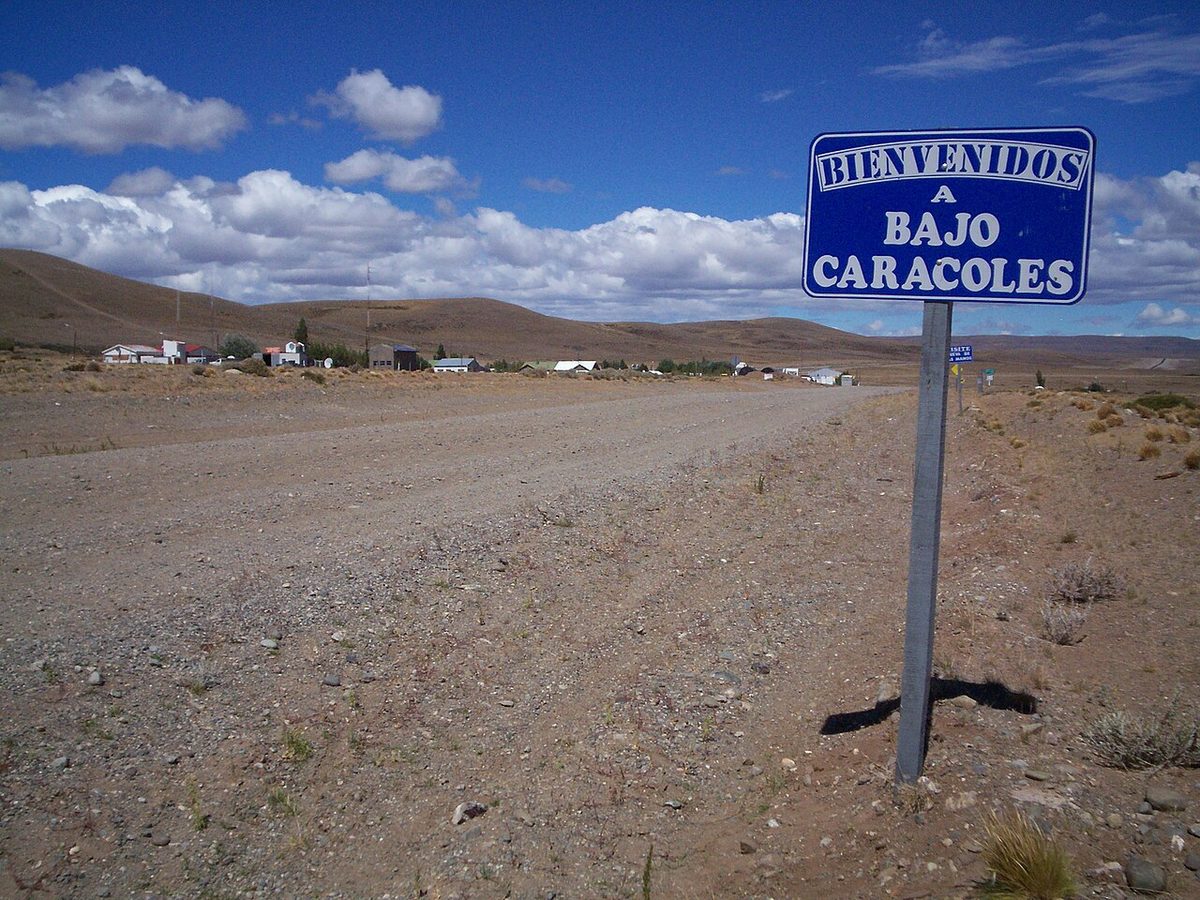
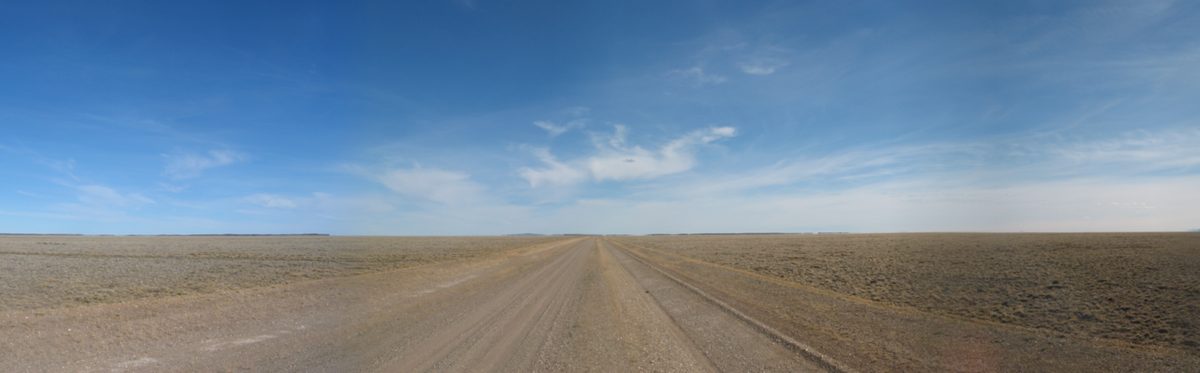
0 — 2 km Fig. 1 · The gravel shoulder of Ruta 40 at the Bajo Caracoles turn-off, with the hamlet's welcome sign and a few buildings on the steppe · Photo: Ulises Icardi / CC BY-SA 4.0 via Wikimedia Commons
Driving in Patagonia is safe for a careful driver, and the careful part is specific. Slow down on gravel long before it feels necessary. Hold the door when you open it. Treat every guanaco as the first of six. Be parked before dark on rural roads. Carry a spare you have actually looked at, the papers the police can ask for, and a plan for the stretch where the phone shows no bars. And know that the rules change when you cross the Andes: Argentina allows no alcohol at all and wants your headlights on day and night on national routes, while Chile tolerates a small amount and only asks for lights from dusk.
None of that is complicated. What catches people out is that the distances turn small mistakes into long afternoons. A cut tyre 20 minutes from a town is a nuisance. The same cut tyre on an empty gravel stretch, with the spare already used, is a lost day and possibly a large bill.
This page is the operational one. It covers how to drive on ripio, what the wind does to cars and doors, the law on both sides of the border pinned to the statutes themselves, what rental cover tends to leave you paying for, fuel and signal planning, and a recovery plan for when something breaks. Road rules, rental terms and emergency numbers were checked in October 2026 against Argentina’s and Chile’s published traffic laws, government pages and the rental companies’ own sites.
If you are still at the stage of deciding whether to drive at all, or how to shape the route, start with the wider Patagonia road trip guide and the comparison of Patagonia road trip routes. This page assumes you have a car booked, or nearly booked, and want to bring it back in one piece.
Driving in Patagonia at a glance
Most of what goes wrong on Patagonian roads comes from five things: speed on loose gravel, wind, animals, darkness and distance. Traffic, on the other hand, is light outside the towns, and the main routes are increasingly paved. The risks are real but predictable, which means you can plan for nearly all of them.
The short version:
Gravel is a different surface, not a worse road. The legal limit still applies on ripio, but it is a ceiling. Sensible gravel speeds are far lower, and the reasons are physics, not caution.
The wind is a hazard you check for, especially when opening doors, passing trucks and driving high-sided vans.
Animals are on the road, mostly guanacos and sheep, and they are hardest to see at dawn and dusk.
The rules flip at the border. Argentina is zero alcohol, lights on at all times on national routes, and an extinguisher plus triangles in the car. Chile allows up to 0.3 g/L, requires lights from half an hour after sunset, and has strict duties after a crash.
Rental cover has holes, and a rollover can carry a much higher deductible than an ordinary dent.
Fuel, signal and daylight all run out. Plan the day around range, check road status in the morning and arrive before dark.
A dry way to put the border point: the same driver, the same car and the same small glass of wine with lunch can be within the Chilean limit and illegal once you are over the line into Argentina. If you are driving between Puerto Natales and El Calafate or doing any other cross-border loop, learn both sets of rules before you set off.
The rules of the road in Argentina and Chile
Both countries drive on the right and use kilometres. That is where the similarity ends. Argentina’s rules come from the national traffic law, Ley 24.449, which binds national routes everywhere and which the provinces apply on their own roads. Chile’s come from the Ley de Tránsito, Ley 18.290, whose consolidated text is published by the Library of Congress (BCN). The table below sets them side by side. The paperwork for taking a rental car over the border is a separate subject with its own page: see the cross-border permit for a rental car.
Rule
Argentina (Ley 24.449)
Chile (Ley 18.290)
Alcohol limit
Zero: driving with any alcohol in the blood is prohibited (art. 48a, as amended by Ley 27.714, 2023)
0.3 g/L or less is not impairment; above 0.3 and below 0.8 is “under the influence”; 0.8 or more is “estado de ebriedad”, a crime (arts. 109, 193, 196)
Alcohol in the car
Covered by the zero rule for the driver
Drinking inside a vehicle is banned for the driver and passengers (art. 110)
Headlights
Low beams or daytime running lights on national routes, day and night, whatever the light (art. 47a)
From half an hour after sunset to half an hour before sunrise, and whenever the weather requires (art. 72)
100 km/h on roads with one lane each way; 120 on roads with two or more lanes each way (art. 145)
Through towns
60 km/h on a route crossing an urban area unless signed otherwise; streets 40, avenues 60 (art. 51)
50 km/h in urban areas (art. 145)
Documents in the car
Licence, vehicle identification card (cédula), proof of current insurance (paper or digital), plates (art. 40)
Licence; the municipal circulation permit and the compulsory accident insurance (SOAP) certificate must be with the car (art. 51)
Mandatory kit
Fire extinguisher and portable warning triangles (art. 40f)
Fire extinguisher, emergency devices and a spare wheel in good condition with the tools to fit it (art. 75); the emergency devices are at least two triangles and a high-visibility vest (DS 22 as amended by DS 164/2014)
Children and seatbelts
Under-10s ride in the back; occupants wear seatbelts where the car has them (art. 40g, 40k)
Seatbelts compulsory in front seats, and in rear seats of light vehicles built from 2002 (art. 75); children under 12 not allowed in the front seat of a car
After a crash
Call 911
Report any crash with damage at once to the nearest police (art. 168); failing to stop and help after a crash with injuries is a crime (art. 195)
Swipe to see all columns
Table 1
Alcohol: zero in Argentina, 0.3 in Chile
Argentina went to zero nationally in 2023. Ley 27.714 rewrote article 48(a) of the traffic law so that driving any vehicle with a blood alcohol level above zero milligrams per litre is prohibited, and it took effect when it was published in the Boletín Oficial on 3 May 2023. It applies on national routes everywhere, which in Patagonia means RN40, RN3 and the other big roads. The practical advice is simpler than any map of provincial rules: if you are driving in Argentina, drink nothing. That includes the glass of Malbec at an estancia lunch an hour before you set off.
Chile draws the line differently. A breath result of 0.3 g/L or less is not treated as impairment. Above 0.3 and below 0.8 g/L you are “bajo la influencia del alcohol”, which carries a fine of one to five UTM (Chile’s monthly tax unit) and a three-month licence suspension, rising if you cause damage or injury. At 0.8 g/L or more you are in “estado de ebriedad”, which is a criminal offence with a prison term in the lowest band of presidio menor, a fine of two to ten UTM and a two-year suspension the first time. If drunk driving causes death or very serious injury, the reform known as Ley Emilia means the sentence must be served in custody for at least a year before any alternative to prison can apply. Carabineros can breath-test any driver, and refusing the test brings its own fine and suspension. Separately, nobody in the car may drink alcohol inside it, passengers included.
The trouble with a 0.3 threshold is that you cannot feel it, and nobody can tell you how many drinks gets you there. Treat Chile the way you treat Argentina and the question never comes up. Chile’s road-safety commission, CONASET, publishes plain-language guidance on the alcohol rules if you want the official explanation.
Speed limits, and why the legal limit is not your gravel speed
On paper, Argentina allows cars 110 km/h on rural roads and Chile 100 km/h on single-carriageway rural roads, which describes nearly every road in Patagonia. Those limits do not change because the surface is gravel. A national route in Argentina that happens to be ripio still carries the 110 km/h ceiling unless a sign says otherwise.
That is a legal statement, not driving advice. On loose stone a car has a fraction of its tarmac grip, and 110 km/h on gravel is far too fast for a rental car. The section on ripio below gives speeds that make sense for the surface. Signed limits are lower in many places: through towns, at roadworks, on detours and in protected areas. On the roads of Península Valdés, for instance, the posted limit is 60 km/h. In national parks on both sides of the border, obey the posted park limits, which exist because animals use the road too.
Two Argentine details matter for campervan drivers. Motorhomes are capped at 90 km/h on rural roads, and a car towing a caravan at 80. And there is a minimum: 40 km/h on roads and semi-motorways, which is worth knowing if you are tempted to crawl along a paved stretch at sightseeing pace. Pull over properly instead.
Argentina also has speed cameras on national routes. The national road-safety agency, ANSV, publishes the list of radars it has authorised, and an ANSV audit of national routes started from 526 authorised speed cameras, found 124 fixed radars missing from their authorised sites and more than 150 operating without authorisation. The practical point for a rental driver is that any fine goes to the car’s owner, who will usually pass it on to you.
Headlights: always on in Argentina
Article 47(a) of Argentina’s law requires low beams or daytime running lights on national routes, day and night, whatever the light and visibility. A car with its lights off at noon is an easy reason for a checkpoint to wave you over. Chile only requires lights from half an hour after sunset until half an hour before sunrise, and whenever the weather calls for them.
Run them all day in both countries anyway. On gravel the dust cloud behind an oncoming car hides it until the last moment, and lights cut through dust far better than paintwork does. It costs nothing, and it removes a reason to be stopped.
Documents and kit the car must carry
In Argentina, article 40 lists what makes a car legal to drive: your licence, the vehicle’s identification card, proof of current insurance (a phone screen is acceptable), plates, and an approved fire extinguisher and portable warning triangles. Under-10s must sit in the back and everyone wears a seatbelt where the car has them. Rental cars should come with all of this. Check at pickup that the extinguisher and two triangles are actually in the boot, because a police officer can ask to see them and “the agency forgot” is not a defence.
In Chile the car must have its plates, the municipal circulation permit and the certificate for the SOAP compulsory accident insurance, and you must carry your licence. The UK government’s advice for Chile adds that drivers must have their passport and proof of tourist status, such as the tourist card or the entry stamp, with them in the vehicle. Chilean law also requires a fire extinguisher, emergency devices and a spare wheel in good condition with the tools to change it, and the regulation on emergency devices specifies at least two triangles and a high-visibility vest. Argentina’s national law does not list a vest, but keep the vest if the car has one.
Keep the paper set together in the door pocket or glovebox: licence and permit, passport, the vehicle registration, insurance proof, the rental contract and, if you are crossing, the border permit.
Checkpoints: Gendarmería, Carabineros and the barrier from the north
Police checkpoints are routine on the main routes in both countries. In Argentina you will meet the Gendarmería Nacional and provincial police at fixed posts. In Chile it is Carabineros, who can breath-test any driver. Slow down, lights on, window down, papers ready, and answer simply. Having the documents in one place is what keeps a stop short.
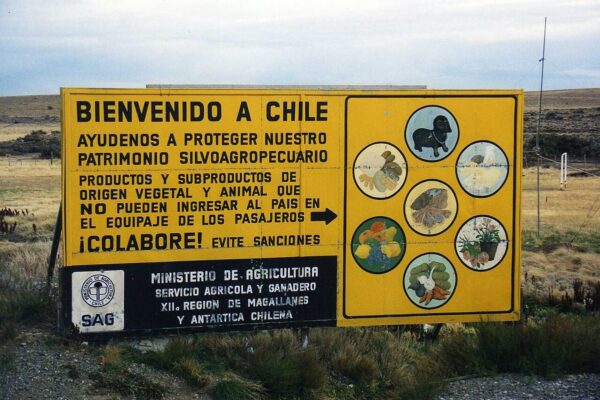
If you drive into Patagonia from the north of Argentina, expect a sanitary inspection of fruit, vegetables and meat at SENASA’s barrier on the main routes; check SENASA’s own pages for what you can carry. Crossing into Chile brings the much stricter SAG declaration for food of plant and animal origin, which is covered in the guide to Chile–Argentina border crossings.
Do you need an International Driving Permit?
Legally, most visitors can drive in both countries on their home licence. In practice, carry an International Driving Permit too if your country issues one. Here is why both statements are true.
Argentina’s transport ministry sets out the rule for foreign visitors: carry a MERCOSUR identity document or your passport showing your entry, plus a valid licence. A national licence from a country that signed the 1949 Geneva or 1968 Vienna road traffic conventions authorises you to drive for up to a year from entry, and licences or international permits under the 1943 Washington convention are also accepted. Chile’s law, article 5, lets foreign nationals staying as tourists drive for the length of their tourist authorisation on their current home licence, provided it is equivalent to a Chilean Class B, and the court may ask for an official translation of it.
Governments read their own citizens’ situation more strictly. The UK government says UK drivers need both the 1949 version of the IDP and their UK licence with them in the car in Argentina, and that you cannot buy an IDP outside the UK. For Chile it says a UK photocard licence can be used for three months, and that older paper licences may need an IDP.
Then there are rental desks and roadside police officers, who are neither treaty lawyers nor obliged to read your licence in a language they do not know. Enterprise’s El Calafate airport branch, for example, requires a valid home licence and recommends an IDP if the licence is not in Latin or English characters.
The verdict: an IDP costs little, it is the official translation a Chilean judge or a provincial police officer may want, and it ends a conversation at a checkpoint in seconds. Get the 1949-convention version from your home country before you travel, because you cannot buy one in Argentina or Chile. Passport and entry rules themselves are covered in Patagonia entry requirements.
How to drive on ripio: gravel technique for Patagonian roads
Ripio is the Spanish word you will hear for gravel, and much of what makes driving in Patagonia different happens on it. Long stretches of the Carretera Austral are still unpaved, side roads into the parks on both sides are gravel, and parts of the far south of RN40 are too; for which stretches are still ripio, see Ruta 40 section by section and driving the Carretera Austral. This section is about how to drive the stuff, wherever you meet it.
The core idea is a grip budget. On tarmac your tyres have plenty of grip to share between braking, steering and accelerating. On loose stone they have a fraction of it, and the stones themselves act like ball bearings. Every input you make spends some of that budget. Braking and turning at the same time can spend all of it, and that is the moment a car starts to slide.
Practical speeds on gravel
The table gives the speeds that work for most drivers in an ordinary rental car. It is advice, not law: the legal limits are in the rules section above, and they are far higher.
Surface
Sensible speed in a rental car
Why
Wide, graded, dry ripio with firm wheel tracks
Around 60 km/h, a little more on long straights with clear sight lines
Grip is fair, but a loose patch or an animal can appear faster than you can stop
Narrow, corrugated or wet ripio
40-60 km/h
Washboard makes the tyres skip and lose contact; puddles hide potholes
Deep loose stone grabs the wheels; you cannot see what is over the crest
Paved road with gravel shoulders
Within the limit, but slow for oncoming trucks
The stone shower comes off their wheels, not yours
Swipe to see all columns
Table 2
A real-world check on those numbers: Estancia Nibepo Aike gives its road from El Calafate as 56 km of gravel taking about an hour and a half, an average of under 40 km/h on a well-used tourist ripio road. Google’s driving times on gravel are usually optimistic for that reason. Budget your day from realistic averages, not from the map app.
Do all your braking in a straight line before a corner, then steer smoothly through it with a light, steady throttle. Braking hard in the middle of a gravel bend is the classic way to start a slide. Hold the wheel with both hands and a relaxed grip, because the steering will tug as the front wheels find loose patches.
Graders push loose stone into ridges, or berms, along the centre and the edges of the road, and traffic wears two firm wheel tracks between them. Stay in the tracks. If your outside wheels drift into the edge berm at speed, the deep gravel grabs them and pulls the car towards the ditch. Drivers then overcorrect, the car swings the other way, and that sequence is a common way for rollovers on gravel to begin. If you do find yourself in the berm, ease off the throttle, keep the steering gentle and let the car slow before steering back out.
Washboard, dust and wet gravel
Corrugations, called “serrucho” in Argentina and “calamina” in Chile, are regular ridges across the road that shake the whole car. Some drivers try to “float” over them at speed. The car may feel smoother, but the tyres are touching the road less, which means less grip for braking and steering. Slow down instead and accept the rattle.
Dust is a visibility problem. When a car ahead is throwing a cloud, drop back until you can see through it. Never overtake into dust, because an oncoming vehicle can be hidden inside it. With your own lights on, you are easier to see from the other side.
Wet ripio is greasy, and puddles hide potholes. Brake earlier, take corners slower, and go through standing water gently to see what is under it. After a grader has passed, expect soft, deep stone that behaves almost like sand. The road looks better and drives worse.
Passing, being passed and trucks
Argentina’s law expects you to warn the vehicle ahead before overtaking in rural areas, with a flash of the lights or the horn, and requires the driver being overtaken to keep right and, if necessary, slow down (art. 42). On gravel that last part matters more than ever.
When a truck or bus comes towards you, slow down and move right as far as is safe, and let it pass before you speed up again. Stone chips often happen in the second it takes to meet another vehicle at speed. When something wants to overtake you, ease off and let it go: the stone shower lasts far less time if they get past quickly. Follow other vehicles at a distance long enough that the stones their tyres throw land short of you, which on gravel means several seconds, not the usual two.
Do you need a 4×4?
For most summer trips on graded gravel, no. Ground clearance and decent tyres matter more than four-wheel drive. A 4×4 helps on rougher side roads, in snow and mud, and on the worst unpaved stretches, and rental contracts can restrict where a car may be driven. The decision is really about which company and which car, so it lives with choosing and booking a rental car.
Windscreens, tyres and the rental small print
Gravel damages cars in predictable ways: chipped and cracked windscreens, cut tyres, scraped underbodies and the occasional door bent by the wind. The question is who pays, and the answer is in your rental contract rather than in any general rule.
Start with the official line. The UK government’s advice for Chile says that if you hire a car you should get appropriate insurance, and that windscreen repair can be expensive, so consider including windscreen damage cover.
Then look at how one company frames its damage waiver. Enterprise’s El Calafate airport branch sells an optional CDW-TP that waives your liability for damage or theft after a deductible of up to USD 4,500. For total loss or rollover (“vuelco”) the deductible rises to up to USD 9,000, depending on the vehicle class. The waiver is subject to “actions detailed in the rental contract” that void it, third-party liability is included under Argentine law, and the branch warns that most insurance policies bought outside Argentina do not cover Argentina. The difference between the ordinary and the rollover deductible is exactly why gravel technique is about money as well as safety.
Two other operator terms are worth knowing. Avis’s cross-border conditions for Chilean rentals going into Argentina make CDW mandatory, require a police report in Argentina or Chile for the insurance to apply after an incident, and say that no replacement vehicle is provided for incidents in Argentina. National Car’s Chilean roadside package covers towing not related to an accident and tyre inflation, with the car towed if there is no inflated spare, but the renter remains responsible for tyre damage caused by driver negligence.
What companies exclude varies, and the only version that counts is the one in your contract. Ask, at the desk and before you sign:
Item
What to ask
What to photograph at pickup
Windscreen and glass
Is glass covered under the waiver, or only with an add-on?
Every chip and crack, close up, with the dashboard in frame
Tyres and wheels
Are tyres and rims covered? What counts as negligence?
All four tyres and the spare, including sidewalls and tread
Underbody
Is damage to the sump, exhaust and underbody covered on gravel?
The sills and bumpers from low down
Unpaved roads
Are any roads or areas excluded, and is that written on the contract?
The contract page that lists them
Rollover and total loss
Is there a separate, higher deductible?
n/a: write the figure on your copy
Doors
Is wind damage to doors and hinges covered?
Door edges and hinges, especially on the driver’s side
Police report
Do they need a police report for any damage claim?
n/a: note the requirement
Swipe to see all columns
Table 3
Get the answers in writing, on the contract or in an email, not in a friendly verbal “don’t worry about it”. Then film a slow walk around the car with the time stamp on, including the roof and the spare. Check that the spare is a full-size, inflated wheel and that the jack and wheel brace are there; Chilean law requires the spare and the tools. If you want to cover the deductible itself, check whether your travel insurance covers the rental excess and read its wording on gravel roads and glass.
A small stone chip can spread into a crack on cold mornings and corrugated roads. If you pick one up early in the trip, ask the rental company whether to get it treated in the next town before it grows across the driver’s line of sight. Tyre repair shops are common in Patagonian towns: look for a “gomería” in Argentina and a “vulcanización” in Chile.
On tyres more generally, the failure to fear is a sidewall cut from sharp stone. A tread puncture can often be plugged. A sidewall cut usually cannot, which turns the spare into your last wheel. Argentina’s law also prohibits driving on tyres with defects or without the legal tread depth (art. 48l), so a badly worn spare is a problem on two counts. On long empty stretches some drivers carry a second spare; ask the rental company whether it can supply one.
Wind: crosswinds, campervans and car doors
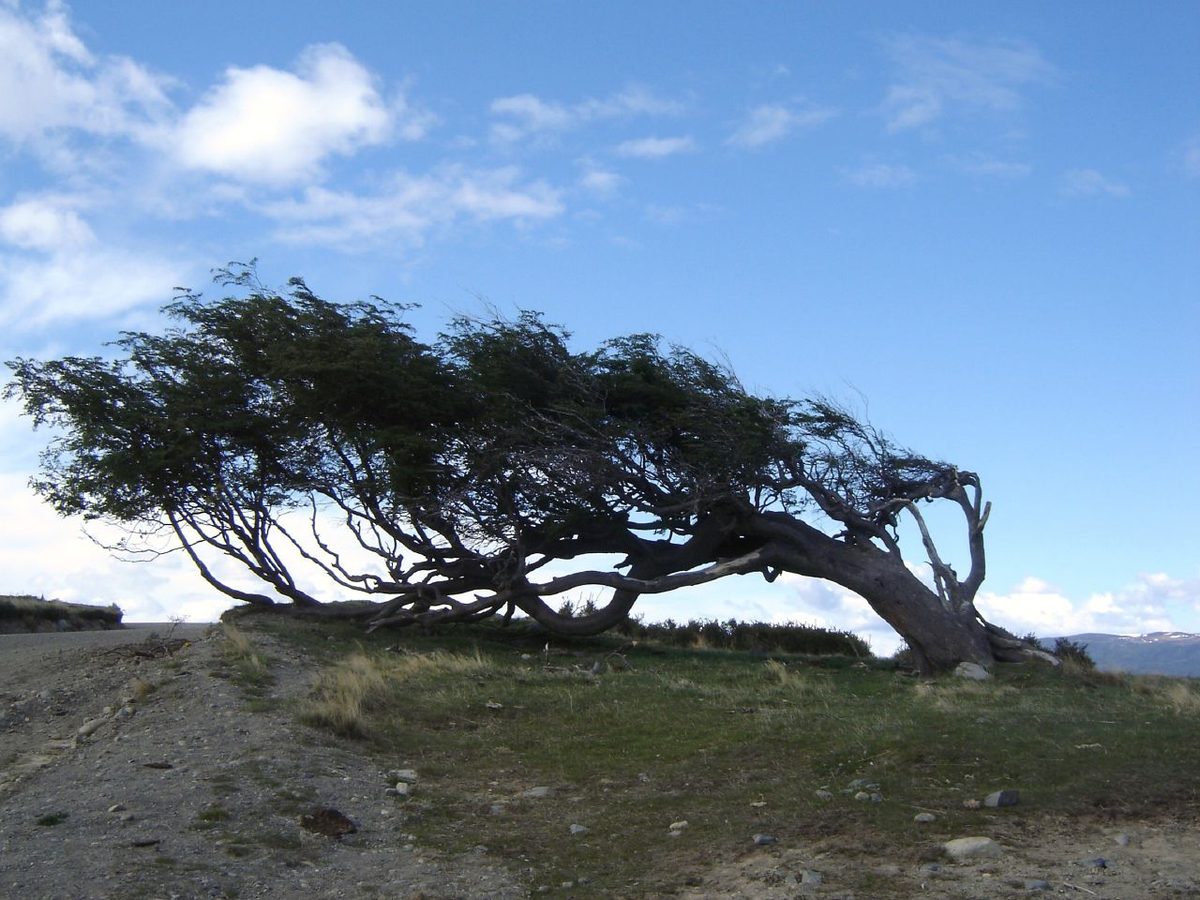
Patagonian wind is not just strong, it is gusty. The road can be calm for a kilometre and then hit you sideways as you pass a gap between hills, cross a bridge, round a lakeshore or meet a truck coming the other way. The open steppe of eastern Santa Cruz and Chubut, the drive from El Calafate to El Chaltén and the paved road from Punta Arenas to Puerto Natales all have reputations for it.
Driving in a crosswind
Slow down and keep both hands on the wheel. A gust pushes the car sideways and the instinct is to yank it back, which is how drivers end up on the wrong side of the road or in the gravel berm. Steer into it smoothly and let the car settle. Expect the strongest gusts where the landscape funnels the wind, and when a truck or bus passes, because it blocks the wind for a moment and then releases it.
On gravel, wind and berms combine badly. A gust that moves the car half a metre to the side can put the outside wheels into loose stone, so slow down further when the wind is up on ripio.
Campervans and high-sided vehicles suffer most, because the side of the van acts as a sail. The legal cap of 90 km/h for motorhomes in Argentina is already well above what feels sensible in a strong crosswind. Drivers of campervans should plan shorter days when the forecast is wild, and be prepared to sit out the worst of it in a sheltered spot.
Wind also eats fuel. A long headwind on the steppe can cut your range noticeably, which is one more reason to fill up whenever you can.
Chile’s traffic law forbids opening a car door, or getting out, without first making sure it causes no danger to anyone. In Patagonia the wind is usually the danger you are checking for. A door caught by a gust can fold forward on its hinges, and a bent door is a classic and expensive rental damage claim.
Park with the nose into the wind where you can. Before you open the door, hold the handle and the door frame firmly, or brace the door with your body as it opens. Tell passengers to wait until you say it is safe, and never let a child open a door at a viewpoint. Open the boot carefully too, and hold it on the way down. Hats, maps and phone holders leave the car at speed if you open a window or door to a strong gust.
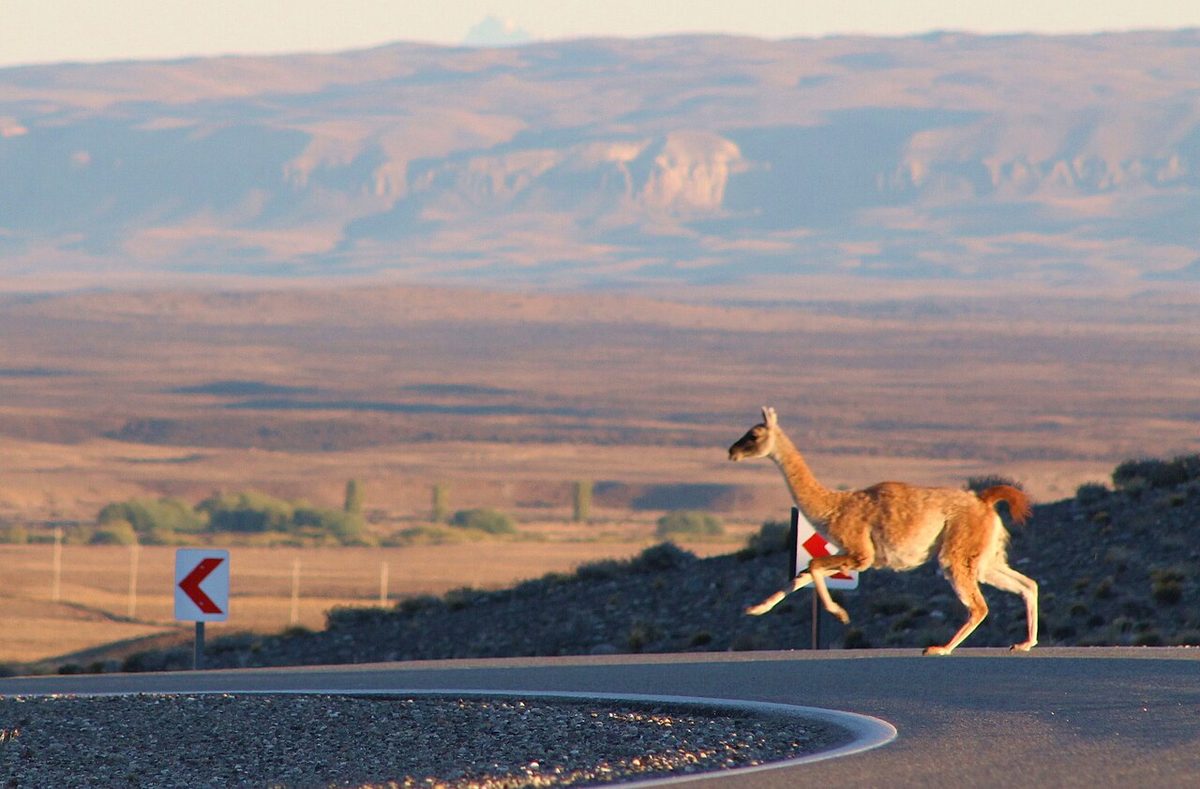
Much of Patagonia is open range or loosely fenced estancia land, so animals share the road. Guanacos are the big ones: they move in groups and jump fences, so one crossing means more are probably following. Sheep wander onto the tarmac and scatter unpredictably. Rheas, known as ñandú or choique, run alongside cars and then cut across. Foxes and hares are common at night, horses and cattle turn up near settlements, and on parts of the Carretera Austral there is a small chance of meeting a huemul, the endangered Andean deer.
Animals also die on these roads. A CONAF-backed study reported by Radio Agricultura in 2023 counted 429 native animals killed by vehicles between 2010 and 2018 on roads in or through Chile’s protected areas, with guanaco and huemul among the species affected, and CONAF urged drivers to respect posted speed limits in parks.
The technique is the same everywhere. Scan the verges, not only the road. Slow down as soon as you see animals near the road, whichever way they seem to be facing. Dawn and dusk are when animals move most and are hardest to see, which is another reason not to drive in the dark.
If an animal steps out in front of you on gravel, brake firmly in a straight line and do not swerve hard. A hard swerve on loose stone can easily roll the car, and a rollover is far worse for everyone, including your bank balance, than hitting an animal while braking straight. Sheep usually clear if you slow right down and wait.
If you do hit an animal, stop somewhere safe with the hazard lights on and put the triangles out. Check everyone in the car first. Do not try to move a large injured animal yourself. Photograph the scene and the damage, call the police (911 or 101 in Argentina, Carabineros on 133 in Chile, where you must report any crash with damage to the nearest police), and then call the rental company’s emergency line. Expect it to treat the damage as a collision under your deductible, and ask.
Watching wildlife from the car is one of the joys of the drive. When you stop to do it, pull fully off the road and follow the guidance on watching wildlife responsibly.
Night driving, ice and snow
The shortest rule on this page: do not drive rural roads in Patagonia after dark. There is no street lighting, animals are on the road, gravel hides potholes that headlights barely show, and if something goes wrong, help is a long way off. Plan every day so you arrive with light to spare, and leave a buffer for photo stops, roadworks and a puncture.
Daylight varies enormously with the season. In Ushuaia it runs from more than 17 hours in summer to just over seven in winter. In late spring and summer the long evenings make it easy to stay off the roads at night. In autumn and winter the safe driving window shrinks to the middle of the day, and distances that look like a comfortable day in January become a race against dusk in June.
Ice and snow
From late autumn through winter, and in occasional storms in the shoulder months, ice and snow are part of driving here, especially in the Andes, in the far south and on Tierra del Fuego. Black ice forms in shaded sections and on bridges, and it is worst early in the morning. Drive gently, with smooth inputs and long stopping distances. If the car carries chains, practise fitting them once in a car park before you need them on a cold verge.
Some routes have their own winter advice. The Seven Lakes road between San Martín de los Andes and Villa La Angostura is open all year, but weather can restrict access and the Bariloche tourism office recommends snow chains in winter; see the Seven Lakes route. In Tierra del Fuego and other winter areas, check Vialidad Nacional’s road status and your rental company’s winter terms before setting out, to see whether winter tyres or chains are required on the sections you plan to drive and whether the contract allows them in winter at all.
Border passes in the Andes close in storms, sometimes for days. The UK government notes that winter weather between June and September sometimes temporarily closes high crossings. If a road or pass closes, turn back to the last town; do not wait it out in the car on an exposed pass. For the season as a whole, see Patagonia in winter.
Fuel without running dry
Fuel planning in Patagonia is about range, not about finding the cheapest pump. The gaps between towns can be long, small stations sometimes run out or lose power, and headwinds and gravel increase consumption. A later guide on this site will cover stations route by route; the principles here apply wherever you drive.
Know your car’s real range. Ask at the desk what the tank holds and what the car typically does to a full tank, then take a good chunk off for wind, gravel, a loaded car and detours. Fill up whenever you pass fuel on a remote stretch, even with half a tank left. The wider Patagonia road trip guide calls this the half-tank rule, and it is the single best habit on these roads. Before a long empty section, ask locally whether the next station is open and has fuel.
Learn the words. In Argentina petrol is “nafta” and diesel is “gasoil” or “diésel”. In Chile petrol is “bencina”, sold by octane number, and diesel is “petróleo diésel” or just “diésel”. The fuel type is usually printed inside the filler flap or on the key tag; check it at pickup, because putting the wrong fuel in a hire car is a fast way to lose a day and a deposit.
Jerrycans
A spare can of fuel makes sense on the longest empty stretches, but it is a question for your rental company first. Many forbid fuel containers in the cabin or have their own rules, and some supply a can. In Argentina, stations are wary of filling anything other than a rigid, approved container with a sealing cap, so a flimsy can or a water bottle may simply be refused. Carry a can outside the passenger compartment if the vehicle allows, and never in a hot, closed cabin. Whether you can take fuel in a can across the border is a question for the rental company and customs; check before you load it.
Shortages do happen. In October 2023 a protest blockade on Ruta 22 at Arroyito, following a blockade at the Plaza Huincul refinery the day before, left Bariloche’s stations short of fuel, with long queues. That kind of disruption is rare, but it is another reason to keep the tank high.
Paying for fuel
Cards are accepted at stations in the main towns. In Argentina you may be asked for photo ID when you pay by card, so keep your passport handy. Small remote stations can be cash-only, or can lose their card connection, so carry some local cash in both countries. ATMs in small places can be out of order or empty, and withdrawal limits and fees on foreign cards vary by bank, so check yours and withdraw in a bigger town before you go. The full picture is in cash and cards in Patagonia.
No signal: coverage gaps, satellite SMS and navigation
Long rural stretches in both countries have no mobile coverage at all. That covers much of the steppe, many park roads and side valleys, and long sections of the southern Carretera Austral. Coverage also varies by network, so a local SIM from one company may work where another shows nothing. Look at the operators’ own coverage maps for your route before you buy a SIM.
The safe assumption is that you will be out of signal when something goes wrong, and to plan for that.
Download offline maps for both countries before you leave home or while you have wifi; most navigation apps let you save whole regions. Carry a paper road map as backup. Expect map apps to underestimate journey times on gravel and occasionally to suggest roads that are closed or not suitable for a hire car.
Tell someone your route and expected arrival time before every long empty stretch: your hotel, the estancia you are heading to, or someone at home. A written note with the route and ETA, left at the reception desk, is a simple safety net.
Satellite SMS in Chile
In Chile, Entel offers satellite messaging direct to the phone through Starlink’s Direct to Cell network. According to Entel’s own page, it lets compatible phones send and receive SMS and use compatible apps where there is no terrestrial mobile coverage, across continental and island Chile and at sea up to 12 nautical miles, except Antarctica. It needs a compatible 4G phone on the latest operating system, with roaming and VoLTE switched on, used outdoors with an unobstructed view of the sky, and coverage varies with location and how many people are using it. Entel presents it as part of its own mobile plans. Chilean press reported in 2025 that coverage may be reduced in border zones.
Do not count on it with a foreign SIM or a tourist eSIM. Before you travel, ask your own mobile provider whether your phone and plan can use any satellite service in Chile, or check Entel’s page if you are buying a local SIM. Treat it as a useful extra rather than the plan.
For remote driving, the real backup is a dedicated satellite messenger or personal locator beacon, which works independently of any phone network. If you are planning several days of empty roads, consider renting or bringing one.
Emergency numbers and road-status lines
Write these on paper, along with the rental company’s 24-hour number and your policy number, and keep the sheet in the glovebox. A dead phone battery should not cost you the numbers.
Need
Argentina
Chile
General emergency
911
Use the specific numbers below
Police
911 or 101
133 (Carabineros)
Ambulance / medical
911
131
Fire
911 or 100
132
Other
103 civil defence; 106 nautical and lake emergencies
Road status
Vialidad Nacional “Estado de rutas” page; helpline 0800-222-6272 or 0800-333-0073; 140 for emergencies on concession routes
Ask Carabineros or the local tourism office for regional roads
Border pass status
Vialidad’s “Estado de rutas” page shows international passes
pasosfronterizos.gov.cl (Unidad de Pasos Fronterizos)
Rental breakdown
The 24-hour number on your contract
The 24-hour number on your contract
Swipe to see all columns
Table 4
In Argentina, use 911 for a medical emergency. The 107 number used in Buenos Aires is not a nationwide ambulance line. Check Vialidad Nacional’s road-status page every morning you plan to drive a national route, and before every border crossing.
When something goes wrong: a recovery plan
Most Patagonian driving problems follow a small number of patterns. Thinking through each one before you go means that if it happens, you already know the first three things to do.
A single flat tyre on gravel
Get fully off the road on a straight stretch where approaching drivers can see you; Argentine law allows stopping on the shoulder only in an emergency, and this is one. Hazard lights on, triangles out well behind the car, passengers out on the side away from traffic. Change to the spare. Then get the damaged tyre repaired or replaced at the next town’s gomería or vulcanización before you continue into the next empty stretch. Driving on with no usable spare is the decision that turns a puncture into a crisis.
A second flat, or a cut tyre and no spare
This is the scenario the rest of your preparation is for. You have the rental emergency number on paper, someone knows your route and ETA, and the cabin has water, food and warm layers. Stay with the car, which is easier to find than a person. Flag down a passing vehicle; traffic on remote roads is light, but local drivers do stop. In Chile, try satellite SMS if your phone and plan support it; anywhere, use a satellite messenger if you carry one.
Expect a long wait for help. Ask at pickup what roadside assistance the contract includes, and where the tow truck would come from. In remote areas the tow truck can have a very long way to come.
Sliding off into a ditch, with no one hurt
Do not spin the wheels; it digs the car deeper into loose gravel. Check underneath for fuel or oil leaks. Call the rental company’s emergency line and follow its instructions. In Chile, any crash with damage must be reported at once to the nearest police, and anyone who leaves the scene without doing so is presumed to be at fault. Photograph everything, including the road surface and any signs.
A crash with injuries
Call 911 in Argentina, or 131 for an ambulance and 133 for Carabineros in Chile. Put the triangles out and make the scene safe. Do not move injured people unless they are in immediate danger. In Chile, failing to stop, give whatever help you can and report a crash with injuries is a crime carrying a prison sentence and a lifetime driving ban. Stay at the scene.
On insurance paperwork in Chile, the law says a simple sworn statement to the insurer is enough to claim on own-damage or third-party insurance, with no police document required. Your rental company may still want one: Avis’s cross-border terms, for instance, require a police report for the insurance to apply. Ask for the police record (constancia) anyway.
Hitting an animal
Follow the crash steps above: stop safely, hazards and triangles, check people, photograph, call police and the rental company. Report it in Chile as you would any crash with damage.
Running out of fuel
Prevention is the whole answer: the half-tank habit and an approved can where the rental allows it. If it happens, stay with the car, turn on the hazards, and flag down a passing driver for a lift to the next station or a few litres from their own can.
Weather closes the road or pass
Turn back to the last town while you can. Do not wait in the car on an exposed pass or in rising snow. Check Vialidad’s page or pasosfronterizos.gov.cl for updates, and build buffer days into any route that crosses the Andes. On the Carretera Austral, a missed ferry can have the same effect; the Carretera Austral ferries page sets out the crossings.
A “helpful stranger” at a puncture
The UK government describes a distraction theft in Chile where a car’s tyre is deliberately punctured, a person approaches to help, and a second person steals belongings from the car while the driver is distracted. It also warns that hire cars are broken into at viewpoints and petrol stations, and that thefts from unattended hire cars are common in Argentina, frequently in Bariloche. Lock the car every time you leave it, keep bags out of sight, take valuables with you at viewpoints, and if strangers offer help at a puncture, keep someone with the car and the doors locked.
Near the border in Magallanes: stay on the road
The UK government warns that there are minefields in Chile’s Region XII, near the border with Argentina, and that some are laid right up to the edge of highways. Signs and fences can be old, damaged and hard to spot. Stay on marked roads and established pull-offs. Do not wander off the verge near the border to take a photo or answer the call of nature, and obey every warning sign.
Pre-trip checklist for driving in Patagonia
Print this or save it offline.
At home:
Home licence plus a 1949-convention International Driving Permit if your country issues one; passport.
Travel insurance that covers the rental excess, with its wording on gravel roads and glass read.
Cross-border permit ordered in good time if you are crossing.
Offline maps downloaded for both countries; a paper map.
A plan for no-signal stretches: a satellite messenger, or at least a routine of leaving your route and ETA with someone.
At the rental desk:
A video walk-around of the car, including glass, all tyres, the spare and the underbody edges.
A full-size, inflated spare, plus the jack and wheel brace.
Fire extinguisher and two triangles in the car; a vest if supplied.
Registration, insurance proof (and the SOAP certificate in Chile), the rental contract and the 24-hour emergency number on paper.
Written answers on glass, tyres, underbody, unpaved roads, the rollover deductible and whether a police report is needed.
The roadside assistance terms, and where a tow would come from.
How the lights, hazards and fuel cap work, and what fuel the car takes.
Every driving morning:
Today’s distances and fuel range checked; next fuel confirmed locally.
Vialidad or pasosfronterizos.gov.cl checked.
A plan to arrive before dark, and your route and ETA left with your host.
Water, snacks and warm layers in the cabin, not just in the boot.
Zero alcohol if you are driving in Argentina, and ideally in Chile too.
FAQ
Is it safe to drive in Patagonia?
Yes, for a careful driver. The risks are speed on gravel, wind, animals on the road, darkness and the long distances between help, rather than heavy traffic. Slow down on ripio, arrive before dark, keep the tank high and carry a usable spare. Theft from hire cars at viewpoints and petrol stations is the main crime risk, so lock up and keep bags out of sight.
Can you drink and drive in Argentina?
No. Since Ley 27.714 was published on 3 May 2023, Argentina’s national traffic law prohibits driving with any alcohol in the blood at all. It applies on national routes everywhere, including RN40 and RN3. If you are driving in Argentina, drink nothing.
What is the drink-drive limit in Chile?
A breath result of 0.3 g/L or less is not treated as impairment. Above 0.3 and below 0.8 g/L is “under the influence”, with a fine and a three-month licence suspension. At 0.8 g/L or more it is a crime, with a prison term, a fine and a two-year suspension on a first offence. Drinking alcohol inside a vehicle is banned for passengers as well as the driver.
Do I need an International Driving Permit for Patagonia?
Most home licences are legally accepted in both countries: in Argentina for up to a year from entry if your country signed the Geneva or Vienna conventions, and in Chile for the length of your tourist stay. Carry a 1949-convention IDP anyway. The UK government says UK drivers need one in Argentina, and it serves as an official translation if a court or police officer asks.
Do I have to drive with headlights on in Argentina?
Yes, on national routes, day and night, whatever the light. Chile only requires them from half an hour after sunset to half an hour before sunrise and in bad weather, but running them all day in both countries makes you easier to see in gravel dust.
What is the speed limit on Ruta 40?
For cars, 110 km/h in rural areas unless a sign says otherwise, and 60 km/h where the route passes through a town. Motorhomes are limited to 90 km/h. On gravel the legal limit is a ceiling, not a target: around 60 km/h is sensible on good ripio and much less on loose or corrugated stretches. In Chile, the limit on rural roads with one lane each way is 100 km/h.
What should a rental car in Argentina carry?
By law, a fire extinguisher and portable warning triangles, plus the vehicle’s identification card, proof of insurance and plates, and you need your licence. Check the extinguisher and triangles are in the boot before you drive away.
What do I do if I hit a guanaco?
Stop somewhere safe, switch on the hazards and put out the triangles. Check everyone in the car, photograph the scene, and call the police (911 or 101 in Argentina, 133 in Chile, where you must report any crash with damage) and then the rental company. Don’t try to move a large injured animal yourself. Next time, brake in a straight line rather than swerving hard on gravel.
Is there phone signal on Patagonian roads?
Not on long rural stretches. Download offline maps, tell someone your route and arrival time, and consider a satellite messenger. In Chile, Entel’s satellite SMS works outside terrestrial coverage for compatible phones on its plans; check with your own provider before relying on it with a foreign SIM.
Does rental insurance cover the windscreen and tyres?
It depends entirely on the contract, and a standard damage waiver often leaves gaps. Ask in writing whether glass, tyres and the underbody are covered, and whether rollover has a higher deductible: at Enterprise’s El Calafate branch it is up to USD 9,000, against up to USD 4,500 for ordinary damage. The UK government advises considering windscreen cover in Chile.
Final thoughts
Patagonian roads reward drivers who give themselves time. Drive gravel at the speed of the surface, not the sign, treat the wind and animals as constant possibilities, and be parked before dark. Learn both countries’ rules before you cross, then keep the paperwork, the spare and the emergency numbers where you can reach them. If you do those things, the drive becomes what it should be: long, empty roads through wide-open country. For routes, sample itineraries and where to sleep, go back to the main Patagonia road trip guide.