Rental Car Border Permits in Patagonia: What to Ask Before Booking
What Chilean and Argentine rental firms charge to take a car across the border, the free customs form behind it, deposits, 30-day caps and what to ask.
By Patagonia Tourism Guide · First published 26 Oct 2026
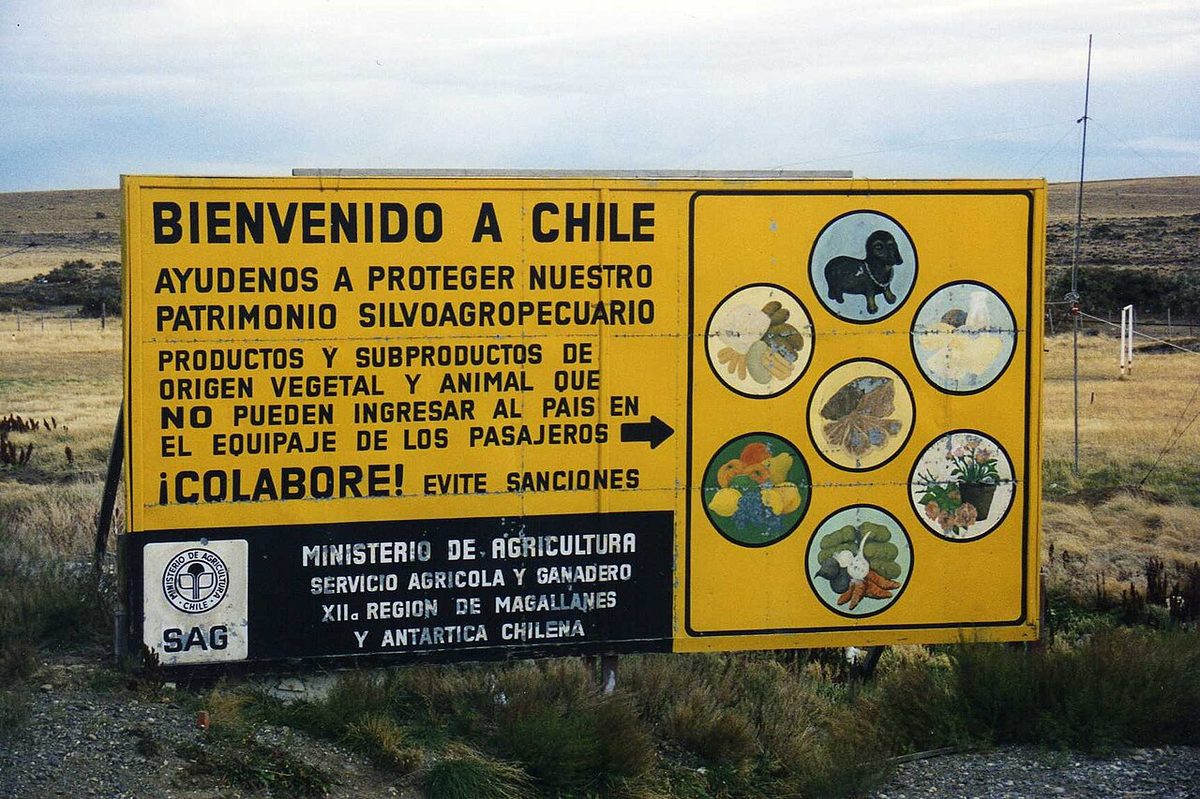
0 — 2 km Fig. 1 · A yellow SAG Bienvenido a Chile sign in Magallanes asking travellers not to bring in plant or animal products · Photo: Leonora (Ellie) Enking / CC BY-SA 2.0 via Wikimedia Commons
The rental car border permit Patagonia road trips depend on is not a government fee. It is your rental company’s product, wrapped around a customs form that the state issues for free. Chile’s customs service lets a registered rental company take a car into Argentina for up to 90 calendar days on a single form, with as many crossings as you like while it is valid, at no cost. The companies then sell the permit as a package: CLP 120,000 plus tax at Avis Chile, CLP 129,000 to 338,000 plus IVA at Econorent depending on the length of the trip, and CLP 250,000 plus IVA at Hertz Chile, according to their own published terms in October 2026. Two of them cap the trip at 30 days. Several add a hold of USD 2,000 or more to your card.
So yes, you can drive a rental car between Chile and Argentina in Patagonia. You just can’t decide to do it at the border, and the price, the time limit, the deposit and what is covered on the other side all depend on which company you book with. This page sets out what each one publishes, what the paperwork actually is, and the questions to put to the rental desk in writing before you pay.
Fees, notice periods and conditions here were checked in October 2026 against the rental companies’ own terms pages and the customs authorities of both countries. Rental terms change without notice, so treat every figure as that company’s published term for that month, and ask for a written quote before you book. For the bigger picture of self-driving the region, start with the Patagonia road trip and border crossings guide. If you are still deciding whether to rent at all, choosing and booking a rental car in Patagonia covers that ground.
What the border permit actually is
When a rental desk says “permit”, it means a bundle. Hertz Chile’s terms put it most plainly: once your request is approved, you receive “notarized permit, mandatory insurance, and Customs form for departure”. That is three documents, each with its own job, plus a layer of company conditions on top.
Layer
Chilean rental going to Argentina
Argentine rental going to Chile
Customs form
The FU Rent a Car (Formulario Único), generated online by the registered rental company in Chilean customs’ rent-a-car system. Free. Two printed copies: one for the company, one for you to present at the crossing
A temporary export form issued by the registered Argentine rental company under Argentina’s customs rules for rental cars between the two countries (RG 3311/2012)
Owner’s authorisation
A notarised authorisation (autorización notarial). Hertz Chile hands one over with every approved permit
Issued by the company with the other papers; ask what your company includes
Insurance for the other country
Third-party liability valid in Argentina, built into the permit price at Hertz Chile and Econorent
Hertz Argentina’s terms say its coverages extend to driving in Chile, under the policy’s own terms
Company conditions
Fee, notice period, extra deposit, maximum days, drivers, what cover changes abroad
The same, set per company and sometimes per branch
Swipe to see all columns
Table 1
The customs layer is the one that makes the whole thing work, and the one you can’t touch. Chile’s customs service (Servicio Nacional de Aduanas) runs a dedicated procedure for rental cars leaving temporarily for Argentina. Only companies that have registered themselves and their fleets with customs can request it. The tourist can’t apply, which is why there is nothing to buy at the border and why an informal or private rental can’t legally cross on a rental form. Customs also enrols each vehicle individually, and the form is processed only when a particular car is going to cross. Not every car on the lot is eligible, which explains why some companies limit the permit to certain categories.
A handful of Spanish terms turn up on booking pages and in emails from the rental desk, and it helps to recognise them:
Permiso internacional, permiso para salir a Argentina, cruce de frontera: the company’s name for the product.
Formulario Único (FU) Rent a Car: the Chilean customs form.
Autorización notarial or permiso notarial: the notarised owner’s authorisation.
Seguro obligatorio de responsabilidad civil or seguro Mercosur: third-party liability cover for the other country.
Garantía: the security deposit, held on your credit card.
Drop off or devolución en otra oficina: the one-way fee.
Días hábiles or horas hábiles: business days or business hours, which exclude weekends and public holidays.
Chile to Argentina: what Chilean customs allows
The Chilean customs authorisation, published on the government’s ChileAtiende portal, does more than most travellers assume. It lets a registered rental company take a car out “por un plazo máximo de 90 días corridos”, that is up to 90 calendar days. It is recognised by both countries at the border posts. It allows multiple trips while it is valid, so a loop that crosses into Argentina, comes back to Chile and crosses again is covered by one form. And under “¿Cuál es el costo del trámite?” the answer is three words: “No tiene costo.”
There is one important limit. If the rental contract or the international insurance policy runs out sooner than 90 days, the form expires on the earlier date. Your permit can never outlast your rental agreement, which is the legal reason late returns cause so much trouble (more on that below).
To issue it, customs needs the rental contract, a valid international insurance policy and, if the car belongs to someone other than the rental company (a leasing firm, say), a notarised authorisation. The company prints two copies. Yours is the one you hand over at the crossing, so check it is in the folder before you drive away from the desk.
This system has been running since December 2012. When customs announced it in January 2013, 53 Chilean rental firms had registered, 25 of them in Punta Arenas, and customs counted about 4,000 rental trips to Argentina a year averaging 18 days. With partial closures announced at the Puerto Natales airfield between January and March 2027, more travellers may end up flying into Punta Arenas and collecting their car there. If that is you, the Punta Arenas to Puerto Natales drive is about three hours on paved road.
What customs allows and what your rental company allows are two different things. Customs permits 90 days. Avis Chile and Econorent each publish a 30-day maximum outside Chile. That cap is the company’s own condition, not the law, and it is one of the first things to ask about if your trip is long.
Rental car border permit Patagonia costs: the companies compared
These are the conditions each company publishes on its own terms page, read in October 2026. “IVA” is Chile’s VAT, 19% in October 2026, and it goes on top of every Chilean fee shown “+ IVA”. Where a company does not publish a figure, the table says to ask, and you should ask for it in writing.
Company
Allowed to
Notice (own terms)
Permit fee (own terms)
Maximum time out
Extra deposit
Return in the other country
Avis Budget Chile
Argentina only
72 business hours
CLP 120,000 + tax
30 days; extensions need approval
Rate card: minimum CLP 3,000,000 guarantee for international departures
30 days, though a 31-60 day price is also listed: ask which applies
USD 2,000 on top of the rental guarantee
Ask in writing
Hertz Chile
Argentina
24 business hours
CLP 250,000 + IVA
Ask in writing
Fixed CLP 1,500,000
Extra charge, quoted at booking
Mitta (Chile)
Argentina
72 business hours
Ask for a written quote (bands of 1-15, 16-30 and 30-45 days)
The permit’s own term
USD 2,000 equivalent, kept in full if the car is late back
Ask in writing
Hertz Argentina
Chile, Uruguay, Brazil
72 business hours recommended
Ask for a written quote
Ask in writing
Raised, “in some cases more than double”
USD 3,000 within 200 km of the border, USD 5,000 beyond
Avis Argentina
Chile and Brazil
7 working days
ARS 206.611,57 from Patagonian branches (VAT treatment not stated: ask)
Ask in writing
Ask in writing
Allowed from some branches, fee on top
Swipe to see all columns
Table 2
Avis Chile, Hertz Chile and Mitta all make the permit non-refundable once it is paid or issued, and Econorent takes it in advance by credit card. Hertz Argentina’s terms say its permit cost can’t be refunded once issued either, and that a cancellation within 24 hours of pickup gets no refund of the permit.
Avis Budget Chile
Avis’s cross-border conditions are short and firm. The permit is “granted only for Argentina”, subject to Avis’s approval, and must be requested at least 72 business hours before pickup by email to [email protected], with a passport and licence for each driver. The rental must be prepaid, CDW is compulsory, and the permit costs CLP 120,000 plus tax on top of everything else. It is valid for a maximum of 30 days. Date changes have to be made at least five days before the original crossing date. Pickup trucks with bars (“X class”) can’t cross at all, and the car can’t be returned in Argentina.
Avis’s rate-card page adds a minimum guarantee of CLP 3,000,000 for rentals with an international departure. That is a large hold on a credit card limit, and it is the figure to plan around, not the permit fee.
Econorent
Econorent publishes the most detailed price list of the Chilean firms, tiered by the number of days you will spend outside Chile: CLP 129,000 + IVA for 5 to 15 days, CLP 209,000 + IVA for 16 to 30 days and CLP 338,000 + IVA for 31 to 60 days. Econorent’s own approximations are USD 181, 293 and 473. The price includes the compulsory third-party liability insurance for driving in Argentina. Ask at least four business days before pickup by emailing [email protected] with your reservation number, exit and return dates, ID or passport and licence. It is paid in advance by credit card and handed over at pickup.
Two things in Econorent’s terms deserve a careful read. First, the same page that lists a 31-60 day price also says the maximum stay outside the country is 30 days, so if your trip is longer than a month, get Econorent to confirm in writing which rule applies to your booking. Second, the permit comes with an extra USD 2,000 guarantee, a maximum of two drivers, and the condition that the car comes back driven by one of them.
Hertz Chile
Hertz Chile has the shortest published notice period, 24 business hours before the rental starts, and the highest published fee: CLP 250,000 plus IVA. That price, in Hertz’s words, “includes the insurance required by Mercosur, which exclusively covers damages caused to third parties”. The cross-border security deposit is fixed at CLP 1,500,000 and, according to the terms, is not reduced by buying extra insurance. Payment is in advance, with no refund if you don’t rent or don’t travel.
Hertz Chile is also the only one of the Chilean companies here whose terms name returning the car in Argentina as a paid option, at an extra charge you have to ask for at booking (+56 600 300 3040 or [email protected]).
Mitta
Mitta’s terms describe its permit as letting you “drive a MITTA vehicle in Argentina with accident coverage”. You need to ask at least 72 business hours ahead, it is non-refundable once issued, and the papers are the notarial permit, the compulsory insurance and the customs form allowing multiple exits. The permit comes in bands of 1-15, 16-30 and 30-45 days, and the terms say the prices differ by band without publishing them, so request a written quote for your dates.
The condition that stands out is the extra guarantee: the Chilean-peso equivalent of USD 2,000, collected in full if the car is still in Argentina after the return date “for any other reason (whether due to force majeure or not)”, border closures included. Only some categories qualify (C, D, E, G, Y, YI, J, J1, K and K1), and only on rentals of one day or more. At Mitta’s Coyhaique, Puerto Natales and Punta Arenas branches the ordinary deposit is already at least UF 20 plus VAT plus the rental cost, and higher with the Argentina permit. At the Central Bank’s UF value for 20 October 2026, UF 20 is about CLP 824,000.
What it adds up to
Take the published fees, add 19% IVA, and a typical southern loop looks like this before you have paid for a single day of rental:
Trip
Company
Permit with IVA
Extra hold on your card
10 days out of Chile
Avis Budget Chile
CLP 120,000 + tax
Minimum guarantee CLP 3,000,000
10 days out of Chile
Econorent
CLP 153,510
USD 2,000 on top of the rental guarantee
10 days out of Chile
Hertz Chile
CLP 297,500
CLP 1,500,000, fixed
20 days out of Chile
Econorent
CLP 248,710
USD 2,000 on top of the rental guarantee
45 days out of Chile
Econorent
CLP 402,220, if Econorent confirms the trip is allowed
USD 2,000 on top of the rental guarantee
Swipe to see all columns
Table 3
These are agency list prices from October 2026, before rental days and insurance. Convert at the day’s rate when you book. The hold matters as much as the fee: it ties up your card limit for the whole trip, and paying in pesos and card holds explains how that plays out with foreign cards. For where the permit sits in a whole-trip cost, see the Patagonia trip budget.
Smaller local firms can register with customs too (in 2013, 25 of the 53 registered firms were in Punta Arenas). If you rent from a local agency in Punta Arenas, Puerto Natales or El Calafate, get the fee, deposit, maximum days and coverage abroad in an email before you pay anything.
What your cover does and doesn’t do on the other side
The insurance inside the permit covers other people. It does not cover the rental car. Hertz Chile says its permit insurance “exclusively covers damages caused to third parties”, and Econorent describes its own as the compulsory civil liability cover for driving in Argentina. Damage to the car itself still falls under your rental’s own collision damage waiver, and that is where cover tends to shrink once you cross.
The published terms list the gaps:
Theft. Econorent says its basic cover leaves the car without protection against theft once it crosses the border. Avis’s rate-card page says the basic cover does not protect against theft in Argentina even if you buy extra cover, while its cross-border PDF says coverages and deductibles apply in both countries. With two Avis documents pointing different ways, ask Avis to state your theft cover in Argentina in writing.
Higher deductibles. Econorent’s CDW deductible is UF 10 + IVA for partial damage in most of Chile but UF 30 + IVA for incidents in the Aysén (XI) and Magallanes (XII) regions and in Argentina. Several of its cheaper add-ons don’t apply in those regions or in Argentina at all; its SLDW extends cover to Argentina with a USD 750 + IVA partial-damage deductible. In other words, in Patagonia the excess rises before you even reach the border.
Roadside assistance. Mitta includes none in Argentina, and its GPS units have no Argentine maps. Econorent includes none unless you buy SLDW or SPLDW.
Replacement car. None in Argentina at Avis, Hertz Chile or Econorent. Hertz Chile’s service in Argentina is limited to towing the car and taking the occupants “to a safe location”; anything after that is on you.
Paperwork after an incident. Avis requires a police report, in whichever country it happens, for cover to apply. Econorent requires incidents in Argentina to be reported to the local authority.
If you already carry travel insurance that covers rental excess, check whether its excess cover applies in both countries and to a car hired in the other one. And because damage cover on many contracts depends on staying on paved roads in an ordinary car (Hertz Chile prohibits two-wheel-drive cars on unpaved roads), read driving on Patagonian gravel before you plan a route that leaves the tarmac.
Argentina to Chile: renting in El Calafate, Bariloche or Ushuaia
Collecting a car on the Argentine side and driving into Chile works the same way in principle, under Argentina’s customs rules for rental cars travelling between the two countries (RG 3311/2012 as originally published). The registered Argentine company issues a form for that car and contract, and while it is valid the car may leave and re-enter Argentina as many times as needed. Under that text the car has to come back within 90 calendar days, plus any extension granted, and sooner if the contract or insurance ends first. The original resolution also lists what to show at the border: ID or passport, driving licence, rental contract and the car’s registration document, the cédula verde. Your rental company supplies the vehicle papers, so check they are all in the glovebox.
Fewer Argentine companies publish their cross-border prices, so you will usually be asking.
Hertz Argentina
Hertz Argentina’s usage policy says its cars may leave the country only with Hertz’s prior written authorisation, normally for Chile, Uruguay and Brazil. The permit “no podrá emitirse una vez iniciado el período de alquiler”: it cannot be issued once the rental has started, so add the “Cruce de frontera” option when you book and request it at least 72 business hours ahead (11 7090 4000, [email protected]). Guarantees rise on cross-border rentals, “en algunos casos superan el doble” of the usual amount. The terms send you to the reservations desk for the fee and for category and location restrictions (“consultar restricciones y valores según locación”), so ask for a written quote for your branch and dates.
The most useful line in Hertz Argentina’s terms is a short table in section 13.9. For a trip to Torres del Paine, the authorised route is El Calafate, Esperanza, Cancha Carrera, crossing at Don Guillermo. For Puerto Natales, it is El Calafate, Esperanza, Río Turbio, crossing at Dorotea. The note under the table says any deviation from the authorised route may affect the insurance cover. If your plan involves any other road into Chile, a different crossing, or carrying on from Natales to Punta Arenas, ask Hertz before booking whether that route is authorised and get the answer in writing. The same policy bans passenger cars (sedans, hatchbacks and 4×2 SUVs) from dirt or ripio roads where the terrain could damage the car. For the road itself, Puerto Natales to El Calafate covers the drive, and the border crossing hours, documents and SAG rules page covers both posts.
In winter, Hertz Argentina says snow chains will be required at the pass when crossing to Chile in winter or in snow, and they have to be rented as an extra. Abroad, towing, taxis, lodging, tolls and unapproved repairs are your cost. For the season itself, read driving in Patagonian winter.
Avis Argentina
Avis’s Argentine rental conditions list a flat Chile crossing fee of ARS 206.611,57 from its Patagonian branches, including Bariloche, Esquel, San Martín de los Andes, Comodoro Rivadavia, Río Gallegos, El Calafate, Río Grande and Ushuaia. It wants seven working days’ notice, copies of your passport and licence emailed to [email protected] in advance, your intention to cross stated in the reservation, and CDW/LDW on the booking. The page doesn’t say whether VAT is included, so ask. Rentals starting in Río Grande or Ushuaia that cross into Chile carry a minimum of seven days and are limited to car classes G and N.
SOAPEX: the question to ask about Chilean insurance
An Argentine rental car entering Chile is a foreign-plated vehicle, and Chile has a compulsory personal-accident insurance for foreign-plated vehicles called SOAPEX. It covers people (death, injury and medical costs), not damage to the car. What matters to you is whether your rental company’s policy already satisfies Chile’s requirement or whether you need to buy SOAPEX separately. Hertz Argentina’s terms say only that its coverages extend to driving in Chile. Ask your Argentine company, in writing, whether its policy for Chile meets Chile’s compulsory insurance rule for foreign-plated vehicles, and if not, where they expect you to buy SOAPEX and what it costs. If anyone suggests buying a separate “carta verde” certificate, put that to the rental company first: the permit package is where a rental’s insurance for the other country should come from.
You will also see Hertz Argentina’s terms quote ARCA’s rules for rental cars travelling to Mercosur member states, including an “Autorización para Circular en el MERCOSUR”. If that confuses you, ask Hertz which documents it hands over for a trip into Chile specifically.
Tierra del Fuego: why a drive to Ushuaia needs a permit for Chile
The road to Ushuaia from mainland Argentina runs through Chile. From southern Santa Cruz, Argentina’s own Tierra del Fuego travel page sends you across the Strait of Magellan by ferry (at Primera Angostura or Segunda Angostura) and back into Argentina at San Sebastián. That has two consequences for a rental car.
From El Calafate or Río Gallegos, you leave Argentina at Integración Austral, the Río Gallegos to Punta Arenas crossing, drive through Chile and over the Strait, then re-enter Argentina at San Sebastián. That is two border crossings each way and four on the round trip, and your Argentine rental needs a permit for Chile even if you never stop there. Hertz Argentina’s terms say so in as many words: when an Ushuaia itinerary crosses Chilean territory, “será obligatorio tramitar previamente el permiso internacional”. Tell Hertz before the rental that you are heading to Ushuaia; depending on the season it may assign a car with winter tyres. Hertz Argentina also flags restrictions on rentals that start in Ushuaia.
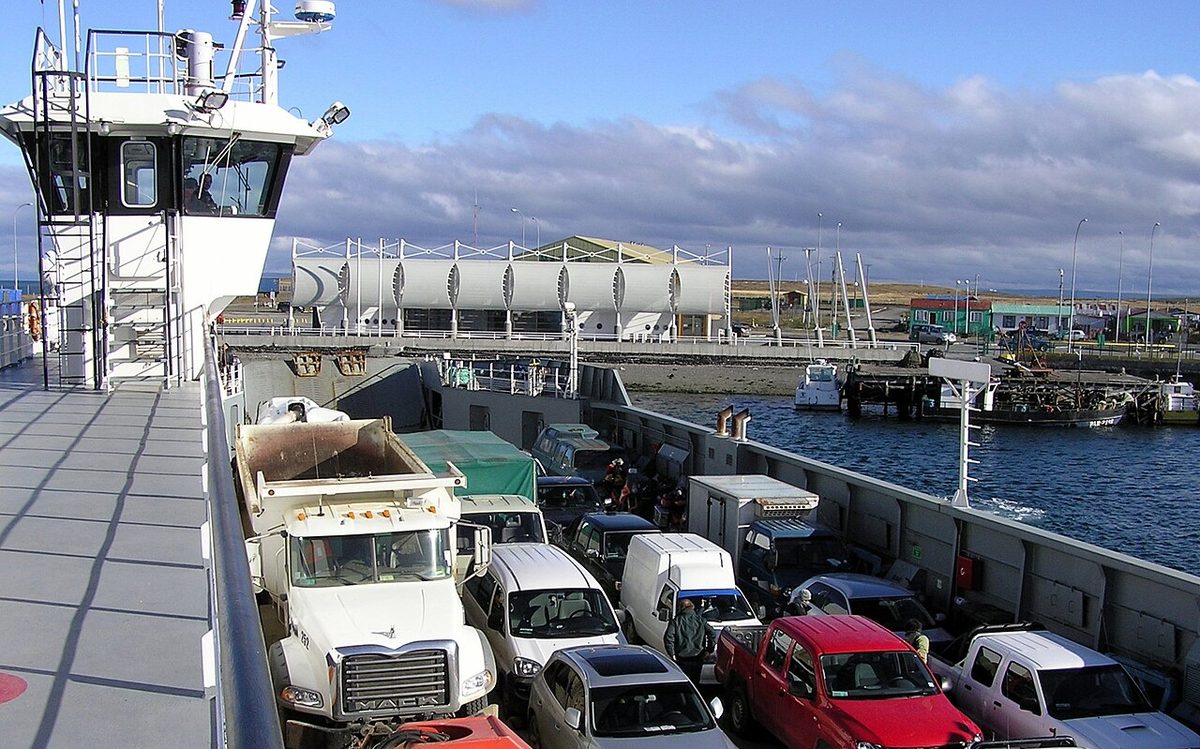
From Punta Arenas in a Chilean car, it is simpler: you stay in Chile across the Strait (TABSA runs the Primera Angostura crossing and the Punta Arenas to Porvenir ferry, both bookable for cars) and cross into Argentina once, at San Sebastián. One crossing each way, and you need the Argentina permit.
Two practical checks before you commit. First, ask whether the contract allows the car on the Strait of Magellan ferry, because none of the companies’ published terms mention ferries either way. Second, look at the post hours: Argentina’s border-centre pages give Integración Austral as opening at 08:00 with exit closing at 21:45, and San Sebastián opening at 08:00 with exit closing at 21:40. A late ferry or a long queue can leave you on the wrong side overnight. For the island itself, see Ushuaia and Tierra del Fuego.
The published minimums run from 24 business hours to seven working days:
Company
Published minimum notice
Hertz Chile
24 business hours before the rental starts
Avis Budget Chile
72 business hours before pickup
Mitta
72 business hours
Hertz Argentina
72 business hours (recommended), and never after the rental has started
Econorent
4 business days before pickup
Avis Argentina
7 working days
Swipe to see all columns
Table 4
Treat those as the point of no return, not a plan. Business hours skip weekends and public holidays, so a Friday-afternoon request for a Monday pickup is already late at most of these companies. Not every car in a fleet is enrolled for crossing, and if the one assigned to your booking isn’t, the company needs time to swap it. And at Hertz Argentina, once you have driven away without the permit, it is too late.
The rhythm that works: ask for the permit in the same email as the booking, with your exact dates, drivers and the crossing you plan to use. Confirm about a week before pickup that it has been issued for that car, those dates and those drivers. Then, at the desk, don’t leave until you are holding the customs form, the notarised authorisation and the insurance certificate. A paid permit left in a drawer at the rental office is no use at a border post hours down the road. If you are lining up the whole trip, what to book first puts the car and permit in order with the rest.
One-way across the border: rare, and priced accordingly
Dropping a Chilean rental in Argentina, or the other way round, is the request rental desks refuse most often, and the reason starts with customs law rather than company policy. Argentina’s rules describe rental cars crossing on condition that they return to their own country within the agreed period. If a renter leaves the car on the other side, the company has to send an employee with a notarised authorisation to drive it home, or find a new renter whose contract exists only to return it. Either way, someone pays for that trip, and it shows in the fees.
Here is what the companies publish:
Avis Budget Chile: returns in Argentina are not allowed.
Hertz Chile: returns in Argentina carry an additional charge, quoted when you book.
Hertz Argentina: leaving the car in another country costs USD 3,000 within 200 km of the border and USD 5,000 beyond, subject to availability and the pickup branch’s authorisation.
Avis Argentina: some branches allow a return in Chile, with both the crossing fee and a one-way fee charged. Its rate card lists ARS 225.000 from El Calafate or Río Gallegos to Puerto Natales or Punta Arenas, ARS 600.000 from Ushuaia or Río Grande to Punta Arenas, and no returns at all from Ushuaia or Río Grande to Puerto Natales.
The direction matters: from the published terms, Argentina to Chile with Avis is possible at a listed price, while Chile to Argentina with Avis is not. Domestic one-ways aren’t cheap either. Hertz Chile’s own table lists CLP 1,265,000 + IVA from Puerto Montt airport to Punta Arenas airport and CLP 1,870,000 + IVA from Santiago airport to Punta Arenas airport. Mitta charges by the distance between branches.
Most travellers end up choosing one of three shapes:
A loop from one base. Collect in Punta Arenas or Puerto Natales, drive to El Calafate and El Chaltén, and come back. This is what the permit is designed for, and the multiple-trip customs form covers it.
Two rentals and a bus across the border. Rent a Chilean car for Torres del Paine, take the bus from Puerto Natales to El Calafate, and pick up an Argentine car there for El Chaltén and the glacier. No permit, no cross-border hold, no theft-cover gap. Once you add the permit, the IVA and the extra deposit, it often costs less and is less to manage. Compare timetables in crossing by bus instead, and see picking up at El Calafate airport for the Argentine end.
A paid one-way. Avis Argentina’s listed fees make Argentina-to-Chile drops a realistic option. Beyond that, it is a written quote from Hertz on either side, and it is worth it mainly for long trips that can’t loop back.
What happens if you cross without it, come back late or get stuck
Without the permit you won’t get out of the country with the car. Customs requires the form at the post, and only the rental company can generate it. Hertz Chile lists leaving national territory without a prior international permit among its prohibited uses. Crossing on a permit that doesn’t match the trip (an unlisted driver, different dates) puts you outside the contract, and cover with it.
Coming back late is where it gets expensive. Under Argentina’s rules, a breach can expose not only the rental company but also the contract holder and authorised drivers to sanctions under the Customs Code. The companies pass that risk straight to you:
Company
If the car is late back or stuck abroad (own terms)
Avis Budget Chile
All repatriation costs up to the car’s commercial value; fines and costs “may exceed USD $25,000”; abandoned in Argentina, a minimum of USD 10,000; costs of border closures charged to the deposit
Hertz Chile
The contract stays open until the car is received at a Hertz office in Chile; towing, customs fines and extra days charged to you
Mitta
The USD 2,000 extra guarantee collected in full, whether or not it is force majeure; contract stays open until the car reaches a Mitta office in Chile
Econorent
Ask in writing; the USD 2,000 extra guarantee is on top of the rental guarantee
Hertz Argentina
USD 3,000 if the car is stranded within 200 km of the border, USD 5,000 beyond, plus all recovery costs, including when the pass is closed on your return
Swipe to see all columns
Table 5
The pattern is consistent. A closed pass is your problem, not the company’s. Build a spare day into any itinerary that has to recross by a fixed date, keep enough fuel and food for a night on the wrong side, and in winter plan around the crossings least likely to close. Which passes close, and when, belongs to the border crossing guide. If something looks likely to make you late, call the rental company before the return date, not after; Avis’s terms specifically ask you to notify it immediately.
Hertz Chile and Mitta both refuse the Argentina permit to Argentine nationals unless they prove more than a year of permanent residence in Chile, with a consular certificate. Other companies may apply the same rule, so ask.
The reason lies in Argentina’s customs rules for rental cars, as originally published in RG 3311/2012. An Argentine citizen who has lived abroad for more than a year may bring a Chilean rental into Argentina for up to 90 days, with no extension. One who has lived abroad for less than a year may bring it in only on condition that it goes back to Chile within 48 hours. Check with the rental company how this applies to you, because the rule follows your nationality, not the passport you show at the desk. If you hold an Argentine passport alongside another one, say so when you book rather than at pickup.
Questions to ask before you book
Send these to the rental company in writing and keep the replies. Each one comes from a clause in a company’s published terms that has a real cost if you find out late.
Can this car category cross, and to which country? Avis Chile bars pickup trucks with bars, Mitta lists eligible categories, and customs enrols each vehicle individually.
What exactly will you hand me at pickup? You want the customs form, the notarised authorisation and the insurance certificate for the other country, as Hertz Chile lists them.
What is the permit fee for my exact dates, is IVA or VAT on top, and does it change with the number of days? Econorent and Mitta price by band; Mitta, Hertz Argentina and most local agencies only quote on request.
What is the maximum time the car can spend outside the country? Avis Chile and Econorent publish 30 days, though customs allows 90. If your trip is longer, get the exception in writing.
How many crossings does the permit allow? Chilean customs allows multiple trips while the form is valid. Ask whether your company’s form or conditions say anything different.
Which crossings and roads am I allowed to use? Hertz Argentina authorises specific routes to Torres del Paine and Puerto Natales and says a deviation may affect cover. Ask any company for the authorised route if you plan an unusual crossing.
How much extra will you hold on my card, and when is it released? USD 2,000 at Econorent and Mitta, a fixed CLP 1,500,000 at Hertz Chile, a minimum CLP 3,000,000 on Avis Chile’s rate card, and “in some cases more than double” at Hertz Argentina.
Which of my coverages work in the other country, and what is the deductible there? Ask specifically about theft, which Econorent’s basic cover excludes in Argentina.
Is there roadside assistance or a replacement car on the other side? At most of these companies, no.
Who may drive, and must the same driver bring the car back? Econorent allows two drivers and requires one of them to drive it back; Avis wants the customer to accompany the car back into Chile.
Do you accept Argentine or dual nationals for the permit?
Can I return the car in the other country, and what is the fee in writing?
What happens if the pass is closed on my return date? Get the company’s answer, then build in a buffer day anyway.
Is the permit refundable if my plans change, and until when can I change dates? Avis Chile, Hertz on both sides and Mitta publish it as non-refundable; Avis Chile wants date changes five days before the crossing.
For Ushuaia: does the permit cover transiting Chile, will the car have winter tyres, and is it allowed on the Strait of Magellan ferry?
In winter: will you supply chains, and at what cost? Hertz Argentina says they are required at the pass in winter or snow.
Is this car allowed on gravel? Hertz Chile bans two-wheel-drive cars from unpaved roads; Hertz Argentina restricts passenger cars on ripio.
Argentine rental going into Chile: does your policy satisfy Chile’s compulsory insurance for foreign-plated cars, or do I need SOAPEX?
A short email covers most of it. Something like this, sent with the booking:
Hello. Reservation [number]: [car category] from [pickup branch] on [date] to [return branch] on [date]. Request: a cross-border permit to [Argentina/Chile], leaving on [date] at [crossing] and returning on [date] at [crossing]. Drivers: [names], passports and licences attached. Please confirm in writing: the permit fee for these dates including tax, the extra deposit, the maximum days allowed outside the country, which coverages apply there (including theft) and their deductibles, whether roadside assistance applies abroad, and that this car is enrolled to cross. Thank you.
And in Spanish, for desks that answer faster in their own language:
Hola. Reserva [número]: [categoría] desde [sucursal] el [fecha] hasta el [fecha]. Solicitud: permiso para salir a [Argentina/Chile], saliendo el [fecha] por [paso] y volviendo el [fecha] por [paso]. Conductores: [nombres], adjunto pasaportes y licencias. ¿Me pueden confirmar por escrito el valor del permiso con impuestos, la garantía adicional, los días máximos fuera del país, qué coberturas aplican allá (incluido robo) con sus deducibles, si hay asistencia en ruta, y que el vehículo está habilitado para cruzar? Gracias.
At the border with a rental car
A crossing means migration and customs on each side, plus SAG when you enter Chile, and the car adds a few papers to the usual ones. At migration, show your passport. At customs, hand over your copy of the customs form along with the rental contract and, if asked, the vehicle registration and insurance certificate. Keep the whole folder together and on the passenger seat, not in the boot. Entering Chile, every adult fills in the free SAG declaration for plant and animal products, and the car will be inspected, and bags can be inspected by hand, X-ray or detector dogs, so finish the fruit before the post. The full sequence, hours and food rules for each crossing are in the border crossing hours, documents and SAG rules guide.
On the way back, the same customs form is what lets the car re-enter its home country. Don’t throw it away on the far side, and don’t let it go back into the rental company’s envelope until the car is returned.
Yes, with the rental company’s permit, arranged before pickup. Avis Chile and Econorent publish Argentina as the only destination, and Hertz Chile and Mitta issue an Argentina permit. You can’t arrange it at the border, because only a registered rental company can generate the customs form.
How much is a rental car border permit in Patagonia?
As published by the companies in October 2026: CLP 120,000 + tax at Avis Chile, CLP 129,000 to 338,000 + IVA at Econorent depending on the days spent abroad, and CLP 250,000 + IVA at Hertz Chile. Avis Argentina lists ARS 206.611,57 for a crossing into Chile from its Patagonian branches. Mitta and Hertz Argentina quote on request. Add the extra deposits, which are often the bigger number.
How far in advance do I need to request it?
The published minimums run from 24 business hours at Hertz Chile to four business days at Econorent and seven working days at Avis Argentina. Ask when you book, and confirm a week before pickup that it has been issued.
Is the permit the same as insurance?
No. It bundles a customs form, a notarised authorisation and third-party liability cover for the other country. Damage to the rental car itself still depends on your rental’s own cover, which can shrink once you cross, with no theft protection in Argentina at Econorent and higher deductibles in Aysén, Magallanes and Argentina.
Can I drop a Chilean rental car in Argentina?
Not at Avis Chile. Hertz Chile charges an extra fee quoted at booking. Most people loop back to the starting country or use two rentals with a bus between them. Going the other way, Avis Argentina lists fees for returning some cars in Chile.
Do I need a permit to drive from El Calafate to Ushuaia?
Yes. The road leaves Argentina at Integración Austral, crosses the Strait of Magellan in Chile and re-enters Argentina at San Sebastián, so an Argentine rental needs a permit for Chile. Hertz Argentina’s terms make it compulsory for Ushuaia itineraries that cross Chilean territory.
How many times can I cross with one permit?
Chile’s customs form allows multiple trips while it is valid, for up to 90 calendar days or until the rental contract or insurance ends, whichever comes first. Your company’s own cap, 30 days at Avis Chile and Econorent, still applies.
What happens if the border is closed on my return date?
You carry the cost. Mitta collects its USD 2,000 extra guarantee in full, Hertz Argentina charges USD 3,000 or 5,000 depending on how far the car is from the border, and Avis Chile warns that fines and costs may exceed USD 25,000. Leave a spare day before any fixed return.
Can Argentine citizens rent a car in Chile and cross?
Not at Hertz Chile or Mitta, unless they prove more than a year of permanent residence in Chile. Argentine customs rules also limit how long an Argentine living abroad can keep a Chilean rental in Argentina, so tell the company your nationality when you book.
Final thoughts
The permit is a solvable problem as long as you deal with it at booking rather than at the desk. Pick the company whose cap, deposit and cover match your route, not just the cheapest daily rate, and get every answer in writing. If the numbers stop making sense, two rentals and a bus between them is a perfectly good way to see both sides. For the whole trip around the car, go back to the Patagonia road trip and border crossings guide, and if your route heads north into Chile’s fjords, the Carretera Austral road trip guide covers the crossings up there.
Fees, notice periods and conditions checked in October 2026 against the rental companies’ own terms and the customs authorities of Chile and Argentina.