Patagonia in October and November: Spring Travel Guide
Patagonia in October and November: honest spring weather, the wind, what's open in Torres del Paine, fewer crowds, lower prices, wildflowers and whales.
By Patagonia Tourism Guide · First published 2 Jul 2026 · Updated 1 Aug 2026
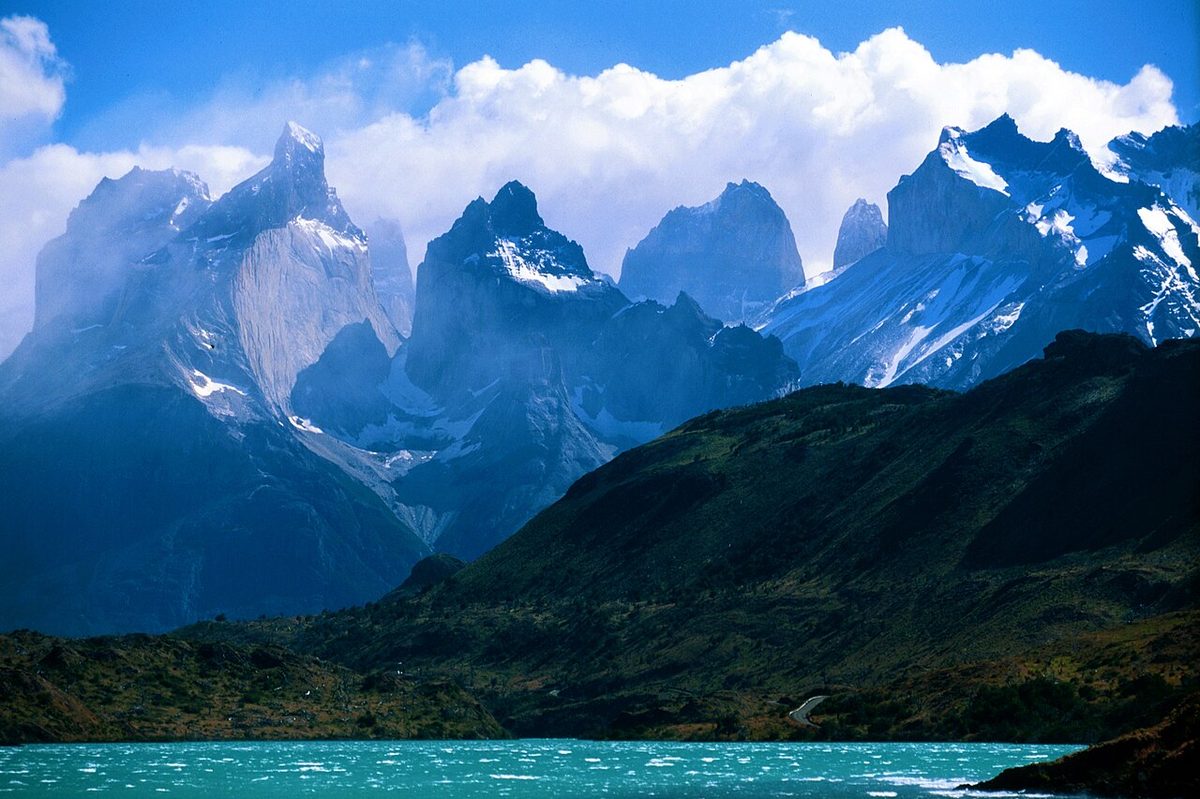
0 — 2 km Fig. 1 · Snow-streaked granite towers of Torres del Paine under spring skies in Patagonia in October · Photo: Winky from Oxford, UK / CC BY 2.0 via Wikimedia Commons
I have a soft spot for Patagonia in October. It is the month the region wakes up: lodges unlock their doors, the first trekkers shoulder their packs, and the wind starts doing that thing where it reminds you who is in charge.
It is also a month that rewards the right traveler and frustrates the wrong one. So before you book a flight on the promise of “spring,” let me walk you through what October and November actually feel like on the ground, what is open and what is not, and whether this shoulder season fits the trip you are dreaming about.
Patagonia in October is spring shoulder season: cooler than summer, much quieter, noticeably cheaper, with lengthening daylight and the first wave of trails and refugios reopening. The trade-offs are real wind, changeable weather, lingering snow on high routes, and a few services still ramping up. November is warmer, busier and even windier. Both reward flexibility.
This guide is for travelers weighing a spring trip and willing to accept a little uncertainty in exchange for fewer crowds, lower prices, wildflowers, and excellent wildlife. If you want the broadest possible context first, start with my pillar on the seasonal guide to Patagonia, then come back here to go deep on October and November specifically.
October vs November in Patagonia at a glance
Spring does not arrive on a fixed date in Patagonia. It creeps in from the north and the coast first, and the deep south is last to get the memo. October and November are genuinely different months, so here is the quick comparison I wish every “spring in Patagonia” article led with.
October
November
Season feel
Early spring; south still cool and thawing
Late spring; clearly tipping toward summer
Daytime highs (approx)
Around 10-15 C (50-59 F), cooler in the deep south
Around 13-18 C (55-64 F); the far south nearer 12-14 C
Nights
Can still hit around 0 C (32 F)
Cold, around 2-4 C (36-39 F)
Daylight
Roughly 13-14 hours, lengthening fast
Roughly 15-16 hours
Wind
Building, but often gentler than midsummer
One of the windiest months of the year
Crowds
Low; you may have viewpoints to yourself
Rising, still well below peak summer
Prices
Among the lowest of the season
Low-to-moderate; climbing toward December
What is opening
Many Torres del Paine refugios open early-to-mid month
Almost everything open; backpacking season underway
Wildlife highlight
Southern right whales at their best; penguins arriving
Hikers wanting spring with more services and longer days
Swipe to see all columns
Table 1
If you only take one thing from this table: October is the quieter, cheaper, more weather-uncertain month, and November is the stronger all-round hiking month that still beats the January crush. I will unpack both below.
Spring weather in Patagonia, and the wind
Let me set expectations honestly, because “spring” sounds gentler than Patagonia actually is.
In October, daytime highs in the popular southern hubs sit somewhere around 10 to 15 C (50 to 59 F), and nights can still drop to around freezing. The further north you go toward the Lake District, the more spring-like it feels. The further south toward Torres del Paine, El Calafate and Ushuaia, the more you are dealing with a landscape that is only just thawing. As kimkim puts it bluntly, in southern Patagonia spring does not really arrive until November, with October highs lingering in the low 50s Fahrenheit.
November warms things up. Highs climb to roughly 13 to 18 C (55 to 64 F) in the milder spots, though the deep south stays cooler. Crucially, the days get long. By late November you can have 15 to 16 hours of usable daylight, which changes everything about how much ground you can cover and how many weather windows you get in a single day.
Now the part nobody should bury: the wind. Patagonia’s famous westerlies, the “Roaring Forties,” ramp up through spring and peak roughly in November and December. In Torres del Paine, November is often cited as the windiest month of the year, with average wind speeds around 37 kph (23 mph) and gusts that can, on a bad day, exceed 100 kph. I have been knocked off balance on exposed ridgelines in November. It is not dangerous if you respect it, but it is real, and it shapes your day.
Here is the upside that surprises people: October frequently brings calmer air than midsummer. Quasar Expeditions and other operators make the same point, that summer delivers the strongest gusts and an October trip often misses the worst of it. That relative calm is gold for photography and for boat trips to the calving faces of Grey or Perito Moreno glaciers. So there is a genuine trade: October is cooler and less “open” but often less brutal in the wind; November is warmer and busier but blowier.
Rain and snow are the other variables. Eastern Patagonia (the Argentine steppe, El Calafate, the Atlantic coast) is drier and more stable. The further west you go toward the Andes and the Chilean fjords, the wetter it gets. Expect the classic “four seasons in a day”: sun, cloud, gusts, a squall of rain or wet snow, then calm, sometimes all on one walk. Layers are not optional here.
The practical takeaway is simple. Dress for wind first, temperature second. A genuinely windproof, waterproof shell, warm mid-layers, gloves and a buff will do more for your comfort than obsessing over the forecast. For the full kit list and safety notes, see my Patagonia hiking, camping, gear and safety guide, and for the month-by-month numbers, the Patagonia weather by month breakdown.
This is the question that makes or breaks a spring trip, so let me be specific and then tell you to verify it anyway.
Torres del Paine
Torres del Paine is the destination where opening dates matter most, because the W Trek and O Circuit depend on refugios and campsites that run on a season. The good news: the park’s main trekking infrastructure typically comes online through October on a staggered schedule. Based on operator listings for recent seasons, several refugios and campsites open around October 1 (think Central, Grey, Paine Grande and Chileno), while a couple open a little earlier, around mid-September. The full network is generally humming by late October into November.
The W Trek is the more forgiving of the two big routes in spring. Worldly Adventurer, an expert source I trust, notes that self-guided trekking in the park, including the W without a tour, is generally permitted from October to April, with guides required outside that window. That makes October the first plausible month for many independent W hikers. The O Circuit, the longer loop around the back of the massif, usually opens later than the W, often around November, because the remote campsites and the John Gardner Pass need the season to mature. If the O is your dream, build your dates around its opening, not the other way around.
Two honest caveats. First, “open” does not mean “summer easy.” Early-season trails can hold snow, mud and ice, especially higher up and on the back side of the circuit. Second, CONAF and Pases Parques rules and dates genuinely change year to year. Before you commit, check the current notices on the CONAF Torres del Paine page and confirm refugio availability with operators. My breakdown of the park’s sectors and trails and the dedicated W Trek and O Circuit guide walk through the booking sequence in detail.
El Chalten and Los Glaciares
If you want the lowest-stress spring hiking, El Chalten is your friend. Visit Argentina positions its ideal season as October to April, and because the town’s day hikes do not run on a refugio-reservation system like Torres del Paine, you are mostly limited by weather and your own legs, not by what has opened. The classic trails to Laguna de los Tres (the Fitz Roy viewpoint), Laguna Capri and Laguna Torre are walkable in spring, with the usual caveat that snow can linger on the final, steeper climbs early in October.
El Calafate and Perito Moreno Glacier are essentially year-round, and they make a brilliant anchor in uncertain weather. If Fitz Roy hides behind cloud, the glacier delivers regardless. Give El Chalten extra nights so you have a weather buffer; one day is a gamble in any month. See my notes on trekking from El Chalten for trail sequencing.
The far south and the road trips
Ushuaia and Tierra del Fuego start to make sense from late October into spring, with longer days and most bus routes running. The Carretera Austral in Chile is a different animal: it is best from roughly November through April, and the shoulder months can still mean ferry-schedule gaps, gravel, rain and limited services. October is early for a serious Carretera Austral run; November is the start of its window if you are flexible. If you are weighing dates against the calendar more broadly, the pillar’s choosing a month for the trails section lines up trail by trail.
October versus November: which spring month should you pick?
I get asked this constantly, so here is how I actually decide.
Choose October if your priorities are quiet, cost and wildlife, and you can flex around weather. You will likely have famous viewpoints nearly to yourself, you will pay shoulder-season prices, and you catch the best of the whale season on the Atlantic coast. The trade is that the deep-south mountains are still cool and thawing, some high routes hold snow, the O Circuit may not be open, and a few services are only just spinning up. October is a gamble if you have a short trip built around one dream hike, and a delight if you have time and patience.
Choose November if hiking is the heart of your trip and you want spring with more support. By November almost everything is open, the backpacking season in Torres del Paine is properly underway, daylight stretches to 15 or 16 hours, and trails are more reliably clear. Sources like Pura Aventura even reckon November brings noticeably more sunny days and more stable trail conditions than October. The catch is the wind, which peaks now, plus rising prices and crowds as the calendar marches toward December.
My personal rule: if I am going mainly to hike the W or the O and I want the shoulder season, I lean November. If I am going for whales, wildflowers, photography, solitude and a lighter budget, and I am happy to let the mountains be moody, I love October. And if I can only do early October with a tight itinerary, I keep my plans loose and treat any clear, calm day as a gift rather than an expectation.
October and November sit in the pre-summer shoulder, which means fewer people and lower prices across most of the region. In October especially, you can be among the first visitors of the season at marquee spots, walking trails that will be shoulder to shoulder come January. Operators describe accommodation as still cheaper than high season, and the whole experience feels less like a queue and more like a place you have to yourself.
That said, “quieter” does not mean “show up and wing it.” A few realities to plan around:
Torres del Paine refugios and campsites still sell out in spring, especially weekends and the increasingly popular November dates. Book the trek-defining pieces three to six months ahead. The same goes for the W and O logistics in general.
Small-town lodging in El Chalten, El Calafate, Puerto Natales and Ushuaia is limited, so popular places fill even off-peak.
Toward the end of November, availability tightens noticeably as December demand arrives. Swoop and other operators flag that even late October starts to fill.
So the spring move is to lock the scarce, season-critical items early (treks, in-park stays, rental cars) and stay flexible on the rest. For the full booking order, lean on the sample Patagonia itineraries, which sequences what to reserve first.
If budget is a major driver, spring is one of the best-value windows of the year, but do the honest math: a cheaper flight is no bargain if the route you want is not running yet or you end up paying for private transfers because buses are thin. The pillar’s discussion of the cheapest months and the trade-offs is worth a read before you commit.
Wildflowers and the spring landscape
Here is the part that photographs better than people expect.
As the snow retreats off the valley floors, Patagonia’s spring flora switches on. The calafate bush, the one whose berry gives El Calafate its name, blooms golden-yellow, and the notro, or Chilean firebush, lights up in scarlet. In the Lake District around Bariloche and across into the Chilean side, wildflower displays carpet the trails, and some travelers genuinely time their trips around the blooms. Rushing meltwater fills the rivers and waterfalls, the steppe greens up, and the contrast of fresh growth against snow-streaked peaks is, to me, more interesting than the uniform green of high summer.
November is usually the stronger month for flowers as the season matures, but October already delivers in the milder northern and central areas. If wildflowers are a priority, weight your itinerary toward the Lake District and the lower-elevation trails, and accept that the high alpine is still waking up.
If you only think of Patagonia as mountains, spring is the season that changes your mind. The Atlantic coast is arguably the single best reason to visit in October and November, and it pairs beautifully with the mountains if your itinerary has the days.
Southern right whales at Peninsula Valdes
Peninsula Valdes near Puerto Madryn is one of the planet’s great whale-watching theatres, and spring is prime time. According to Visit Argentina, the official southern right whale season runs from June to December, with the first whales arriving in late May. The agency specifically calls out September and October as the period when activity intensifies, with more breaching, vocalising and playful behaviour among the calves, and calmer, more favourable conditions for boat excursions. In other words, an October trip lands you in the sweet spot.
Boat tours depart from Puerto Piramides, the only authorised spot in Argentina for nautical whale watching, and trips run roughly an hour and a half to two hours. Earlier in the season you can even watch mothers and calves from shore at Playa El Doradillo near Puerto Madryn. The season tapers through November into mid-December, so November still delivers, just past the absolute peak. For the full picture, including orcas, sea lions and elephant seals, see my Patagonia wildlife and whale watching guide and the pillar’s when to see Patagonian wildlife section.
Penguins arriving
Spring is also when the Magellanic penguins come home. At Punta Tombo, the largest continental colony, the males typically arrive around mid-September to reclaim or dig their burrows, with the females following around late October. September and October are the courtship and nesting weeks. By November the colonies are busy and active, which makes late spring a lovely time to combine penguins with whales on a coastal leg.
Land wildlife
Inland, spring brings new life literally. November is when newborn guanacos start appearing on the steppe and in Torres del Paine, which in turn is part of why it is a strong season for puma activity, since the cats follow the herds. Condors, rheas, foxes and, if you are patient and with an authorised guide, pumas are all part of the spring mix. Keep your distance, go with reputable guides for wildlife tracking, and let behaviour, not the clock, drive those plans.
Best things to do in Patagonia in spring
Here is how I would spend the season if you handed me the dates.
Hike the W Trek in Torres del Paine, leaning to late October or November once the refugios are reliably open. Spring trails are quieter and the light is superb. Verify openings first.
Base in El Chalten for Fitz Roy day hikes. It is the most “open” of the big destinations in October, and a few buffer days dramatically improve your odds of a clear summit.
Visit Perito Moreno Glacier from El Calafate. It is weather-proof in the sense that it impresses in any conditions, and spring’s calmer-than-summer air can make boat trips and walkways especially pleasant.
Go whale watching at Peninsula Valdes, ideally in October for peak activity, and add the penguins if your timing and route allow.
Chase wildflowers and lake scenery around Bariloche and the Lake District, where spring arrives earliest and softest.
Photograph the shoulder-season light. Fewer people at viewpoints, snow still on the peaks, fresh green below, and dramatic skies make spring a quietly brilliant photography window.
Patagonia is not one place, so spring lands differently depending on where you point your itinerary.
Torres del Paine and Puerto Natales
The headline destination for spring hikers, but the one that most rewards checking. Expect cool, increasingly windy conditions, staggered refugio openings through October, and the W more readily doable than the O early on. November is the stronger trekking month. Puerto Natales, the gateway town, is your base for gear, transfers and last-minute logistics.
El Chalten and El Calafate
The most reliable spring pairing in Argentine Patagonia. El Chalten opens up for its October-to-April season with no reservation gatekeeping on day hikes, and El Calafate plus Perito Moreno Glacier are dependable in any weather. If your spring trip has one anchor, I would often make it this duo.
Peninsula Valdes and Puerto Madryn
The spring wildcard that I think too many itineraries skip. October is peak whale-watching, with penguins arriving and a supporting cast of sea lions, elephant seals and seabirds. If wildlife is even a secondary goal, a coastal leg in spring is hard to beat.
Bariloche and Northern Patagonia
The earliest place to feel spring. Wildflowers, lakes and lower-elevation hikes come good before the deep south does, and the crowds are gentle. A strong choice if you want softer adventure, scenery and food without committing to a big trek.
Ushuaia and Tierra del Fuego
Cool even in spring, but increasingly viable from late October, with longer days, the Beagle Channel, and Tierra del Fuego National Park. Wildlife is a draw here too. Treat early October as genuinely early-season and plan accordingly.
For a full destination-by-destination breakdown across the year, the Patagonia travel guide is the place to go next.
Pros and cons of visiting Patagonia in spring
Let me lay the trade-offs out plainly, because honesty is the whole point.
The good:
Far fewer crowds than peak summer, sometimes whole viewpoints to yourself.
Lower prices on accommodation and better value overall.
Lengthening daylight, especially by November, for big days out.
Wildflowers, green steppe, full rivers and snow still on the peaks.
Excellent wildlife: peak whale season in October, penguins arriving, newborn guanacos in November.
October often brings calmer air than midsummer, which helps photography and boat trips.
The honest downsides:
Real wind, peaking around November and December, especially on exposed trails.
Changeable weather and the genuine “four seasons in a day” risk.
Lingering snow and mud on higher routes early in the season.
Some services, the O Circuit, and a few remote routes are still ramping up or not yet open.
Cool temperatures, particularly in the deep south and at night.
Spring is a poor fit for a rigid, one-shot itinerary with no buffer days.
Who should pick spring, and who should not
Spring is for you if you value quiet and cost over certainty, if you are flexible enough to absorb a weather day or two, if wildlife or wildflowers are part of the dream, or if you are a photographer who wants empty viewpoints and dramatic light. It is also a smart pick for a longer trip, where any single bad-weather day matters less.
Spring is probably not for you if you have a short, tightly scheduled trip pinned to one bucket-list hike, if you need the absolute certainty that every service, refugio and route is fully operational, or if you are uncomfortable rolling with wind and changeable conditions. In those cases, December through early March gives you the most reliable access, and you can read the case for those months in the month-by-month weather breakdown pillar. If you are curious how spring compares with the other end of the season, my notes on how March weather behaves and the quieter realities of traveling Patagonia between June and August round out the picture.
Patagonia in October and November FAQ
Is October a good time to visit Patagonia?
Yes, if you value quiet and value for money over certainty. October is spring shoulder season: fewer crowds, lower prices, lengthening daylight, blooming wildflowers and peak southern right whale activity at Peninsula Valdes. The trade-offs are cool temperatures, changeable weather, some snow on high trails, and a few services still reopening. Keep your itinerary flexible.
Is November a better month than October in Patagonia?
For hiking, often yes. By November almost everything is open, the Torres del Paine backpacking season is underway, daylight stretches to around 15 to 16 hours, and trails are more reliably clear. The catch is that November is one of the windiest months of the year, and prices and crowds are climbing toward December. October stays quieter, cheaper and calmer in the wind.
How cold is Patagonia in October and November?
Expect daytime highs around 10 to 15 C (50 to 59 F) in October and roughly 13 to 18 C (55 to 64 F) in November, cooler in the deep south. Nights can dip to around freezing in October. These are hedged averages, conditions shift fast, and wind makes it feel colder, so always pack warm, windproof, waterproof layers.
Is Torres del Paine open in October, and can you hike the W Trek?
Generally yes. Torres del Paine’s main refugios and campsites typically open on a staggered schedule through October, several around the first of the month, and self-guided W Trek hiking is usually permitted from October to April. The longer O Circuit usually opens later, often around November. Dates change yearly, so verify with CONAF and your refugio operators before booking.
Can you see whales in Patagonia in October?
Yes, and it is one of the best months for it. Visit Argentina lists the southern right whale season at Peninsula Valdes as June to December, and singles out September an