W Trek Itinerary: 4 Day, 5 Day and 6 Day Route Options
A day-by-day W Trek itinerary for 4, 5 and 6 days: distances, walking hours, where you sleep each night, direction choice, and bus and catamaran timing.
By Patagonia Tourism Guide · First published 22 Jul 2026 · Updated 1 Aug 2026
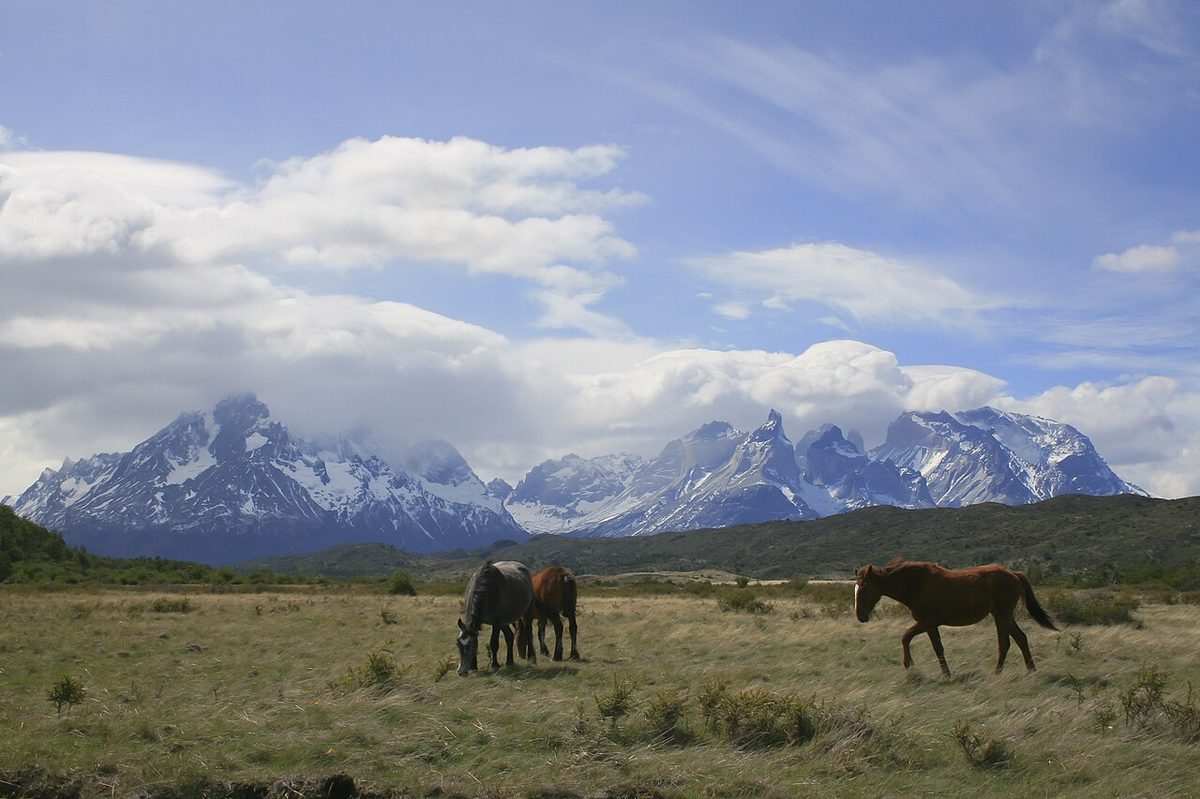
0 — 2 km Fig. 1 · The three granite towers of Torres del Paine, the eastern highlight of any W Trek itinerary · Photo: Murray Foubister / CC BY-SA 2.0 via Wikimedia Commons
The first time I tried to plan the W, I had a dozen browser tabs open and a growing suspicion that everyone was describing a slightly different hike. One blog started at Grey, one started at the towers, the day counts didn’t match, and nobody agreed on how far you actually walk. The route is not complicated once it clicks. It just gets described badly.
So here is the version I wish I’d had: every realistic W Trek itinerary, laid out day by day, with honest distances, honest walking hours, and a clear note on where you sleep each night.
A W Trek itinerary runs roughly 70 km over about 5 days, threading three valleys: the towers, the French Valley, and Grey Glacier. Most people hike it in 4 to 6 days, in either direction, sleeping in a chain of booked refugios or campsites. The 5-day version is the classic. The 4-day is the rushed one. The 6-day is the relaxed one.
This guide is for the hiker who has more or less decided to do the W and now needs the actual route to book against. If you are still weighing the W versus the O Circuit versus day hikes, start with the Torres del Paine W Trek and O Circuit guide first, then come back here to nail down the days. For the bigger picture of fitting the park into a trip, the Torres del Paine travel guide is the place to start.
One thing up front, repeated throughout because it matters: every distance and time below is approximate. Different sources measure these trails differently depending on where they start and which GPS they trust. Treat them as a realistic range, not a promise. And verify all schedules, prices, and rules with CONAF, the operators, and the catamaran company before you book. Patagonia changes its mind a lot.
W Trek Itinerary Options at a Glance
Here is the quick comparison. Pick the row that matches your available nights and your appetite for long days, then read that section in full.
Itinerary
Nights on trail
Total distance
Best for
Main tradeoff
4-day W
3
~55–70 km
Fit hikers, tight schedules, forced availability
Long days; usually skips the Grey sector / suspension bridges; no weather buffer
5-day W (classic)
4
~70–80 km
Most first-time W hikers
The standard; still has two big days
6-day W (relaxed)
5
~70–85 km
Hikers who want a buffer and a full French Valley day
One more scarce, pricey night to book
Swipe to see all columns
Table 1
A few honest notes on this table. The “total distance” ranges look wide because they are; your exact mileage depends on direction, which sectors you actually book, and whether you walk the optional bits (the second Grey suspension bridge, the full push to Mirador Británico). The number of nights is the thing that actually drives your booking and your budget, because each night is a separate reservation in a separate sector, sometimes with a separate operator.
If you take one idea from this whole guide, make it this: your W Trek itinerary is really a chain of reservations. The walking is the easy part to plan. The beds are the hard part, and they often decide your direction for you.
How to Choose Your W Trek Itinerary
The choice comes down to three questions, in this order.
How many nights can you give it? Not days, nights. A 5-day W needs four nights on trail plus, ideally, a night in Puerto Natales before and after. If you only have three trail nights, you are doing the 4-day. If you can spare five, the 6-day is genuinely better, not just longer.
How fit are you, honestly? The W is not technical, but it is consecutive long days on uneven ground in wind, carrying at least a daypack and often a full pack. The Base Torres day and the French Valley day are both 8-to-10-hour efforts. If that sounds like a lot, the 6-day spreads the load. If you eat big days for breakfast, the 4-day is on the table. For a real breakdown of what the trail demands, see how hard the W Trek is.
What can you actually book? This is the one people forget. In peak season the refugios and campsites sell out months ahead, and the available combination of nights may quietly decide both your day count and your direction. I would rather hike a slightly less ideal itinerary that I can actually reserve than chase a perfect plan that doesn’t exist by the time I try to book it.
Two structural facts shape every itinerary below. First, the W is linear, not a loop — you do not finish where you start, which is why transport matters so much. Second, the park’s overnight sectors are split between two operators: the eastern sectors (Central, Chileno, Cuernos, Francés) are run by Las Torres Patagonia, and the western sectors (Paine Grande, Grey) by Vértice. For a full W you coordinate dates and meals across both. The W Trek refugios guide walks through who runs what and how to book each one.
5-Day W Trek Itinerary: Classic East to West
This is the one most people mean when they say “the W.” It covers all three arms without making every single day brutal, and it lines up closely with the route Chile Travel describes as roughly 70 km over 5 days. You start at the towers end and finish at Grey, taking the catamaran out across Lake Pehoé on the last day.
The distances and times below come from a real self-guided trek in this direction. They are approximate, and a fast hiker will beat them comfortably while a tired one in bad weather will not. Plan for the slow version.
Day 1: Puerto Natales to Chileno and Base Torres
Distance: around 14 km. Walking time: around 8 hours. Sleep: Chileno (or Central).
You take an early bus from Puerto Natales, roughly 2 hours to the Laguna Amarga entrance, where everyone gets off to check in. From there a short shuttle covers the last 7 km to the Welcome Centre, which spares you a dusty road walk on what is already a big day.
Then the work starts. You climb the Ascencio Valley to Chileno (around 5 km, about 2 hours), drop your big pack, and push on to the Base Torres lookout (around 4.4 km, about 2 hours) before turning around and coming back down (another 4.4 km, about 2 hours). The final climb to the towers over the boulder moraine is the hardest stretch many people hit all week. It is worth it. The full Base Torres hike guide covers that climb in detail.
Sleeping at Chileno puts you closest to the towers, which is why it books out first. Worth knowing: cooking stoves are not allowed at Chileno, so you take a meal package there whether you like it or not.
Day 2: Chileno to Francés
Distance: around 18 km. Walking time: around 6 hours 45 minutes. Sleep: Francés (or Cuernos).
A gentler day after the towers. You drop back toward Hotel Las Torres, pick up a signposted shortcut, and traverse the shore of Lago Nordenskjöld with the Cuernos rising across the water (around 15 km, about 4.5 hours to Cuernos). There can be a muddy stretch in here that makes you wonder if you’ve gone off-trail; you probably haven’t.
From Cuernos it’s a short, rubbly up-and-down to Francés (around 3 km, about 1.5 hours). You can stay at either Cuernos or Francés tonight. Cuernos gets you in earlier but adds roughly 3 km and an extra 1.5 hours to tomorrow; Francés puts you right at the mouth of the valley for an early start. Often it just comes down to what’s available when you book.
Day 3: Francés to Paine Grande via the French Valley
Distance: around 20 km. Walking time: around 9 hours. Sleep: Paine Grande.
The longest day, and for my money the most spectacular. From Francés it’s a quick leg to the Italiano ranger station (around 2 km, 30 minutes), where you leave your big pack and head up the French Valley with a daypack. Mirador Francés comes first; the full push to Mirador Británico is another grind through boulders, but the amphitheatre of peaks at the top is the view people remember most from the whole trek (roughly 5.4 km and about 3 hours up from Italiano).
Then you retrace your steps to Italiano (about 2 hours down), reclaim your pack, and walk the long, mostly flat-ish stretch to Paine Grande (around 7.5 km, about 2.5 hours). Get on the trail by 8 a.m. if you can. People who leave late end up rushing the best view of the trek.
Distance: around 11 km. Walking time: around 3 hours 45 minutes. Sleep: Grey.
Your shortest walking day. The trail climbs out of Paine Grande and undulates toward Grey, with a lookout about halfway that gives you your first real view of the glacier — a sweep of ice spilling off the Southern Patagonian Ice Field. You arrive at Grey early enough to do something with the afternoon.
That afternoon is the quiet luxury of this itinerary. From Grey you can kayak among the icebergs, do a guided ice hike on the glacier itself, or walk north to the suspension bridges toward Paso (the first is about 30 minutes out; the second about an hour beyond that, so both make a roughly 3-hour round trip). The bridges give you the best glacier views on the trek. If you’ve got the legs, take them.
Day 5: Grey to Paine Grande, then catamaran and bus out
Distance: around 11 km back to Paine Grande. Walking time: around 3 hours 15 minutes. Finish: Puerto Natales.
You retrace the Grey-to-Paine-Grande leg, timed to catch the Lake Pehoé catamaran. The 30-minute crossing to Pudeto is a genuinely lovely finale — you get to look back at the whole mountain wall you just walked under. From Pudeto a bus takes you back to Puerto Natales, usually looping via Laguna Amarga to collect the hikers finishing on the eastern side, roughly 2 hours in total.
There is an alternative to backtracking, which I’ll cover in the direction section below: finishing at Grey itself and taking the Grey Glacier catamaran out the western side instead. It is a great option that a lot of first-timers don’t know exists.
This is the W Trek 5 day itinerary I’d point most people toward. It is the version Las Torres Patagonia sells as its standard product, the version Chile Travel describes, and the version that balances payoff against punishment. If you can only commit to one plan, commit to this one.
5-Day W Trek Itinerary: West to East (Reverse)
Same five days, same distances, same three valleys — walked in the opposite direction. You start in the west at Paine Grande (reached by catamaran on the morning of Day 1) and finish at the towers. A lot of experienced hikers actually prefer this direction, and there are real reasons why.
The walking-day numbers are the mirror image of the classic route, so I’ll give the shape rather than repeating every figure.
Day 1: Puerto Natales to Paine Grande, then Grey
Sleep: Grey. You bus to Laguna Amarga to check in, re-board to Pudeto, and take the catamaran across to Paine Grande. From there it’s the ~11 km leg up to Grey (about 3.75 hours). A relatively gentle first day that eases you in — assuming you make the morning boat.
Day 2: Grey back to Paine Grande
Sleep: Paine Grande. Reverse the Grey leg (~11 km, ~3.25 hours), with the option to fit in a glacier activity or the suspension bridges in the morning before you go. A short day by design.
Day 3: Paine Grande to Francés via the French Valley
Sleep: Francés (or Cuernos). The big French Valley day, tackled from the west: out to Italiano, up to Mirador Británico and back, then on to your Francés-side bed. Around 20 km and the better part of 9 hours if you do the full Británico push.
Day 4: Francés to Chileno
Sleep: Chileno. The Nordenskjöld traverse in reverse, around 18 km and roughly 6.75 hours, finishing at Chileno to set up the towers for the next morning.
Day 5: Base Torres, then out
Finish: Puerto Natales. From Chileno you climb to the Base Torres lookout and back (around 9 km round trip from Chileno, plus the descent to the Welcome Centre), then shuttle and bus back to Puerto Natales. This is the payoff of going this way: the towers as your grand finale, and the option of a sunrise push from Chileno if you’ve got it in you.
The catch with the reverse route is that the catamaran sits at the very start, on Day 1. If your bus is late or you miss the boat, your whole first day wobbles. Going east to west, the catamaran is on Day 5, where a delay is far less stressful. Choose accordingly — and read the self-guided W Trek guide if you’re piecing the logistics together yourself.
4-Day W Trek Itinerary: The Compressed Version
You can do the W in 4 days. It is a real option, sold by operators as the “express” W, and plenty of fit hikers walk it every season. But be clear-eyed about what you’re trading away.
A typical 4-day W looks like this:
Day 1: Bus in, hike Base Torres the same day, sleep Central.
Day 2: Hike to Francés or Cuernos, sleep there.
Day 3: Hike the French Valley, then on to Paine Grande, sleep there.
Day 4: Walk to the first Grey lookout, then catamaran and bus out.
Notice what’s missing. Most 4-day versions go only to the first viewpoint of Grey, not to the Grey sector itself, which means you skip the famous suspension bridges and the close-up glacier views that are some of the best on the whole route. You also do Base Torres on the same day you arrive, which is a brutal opener, and you carry almost no weather buffer. Lose a day to a storm and you’ve lost a third of your trek.
Choose the 4-day W only if you’re genuinely fit, your dates won’t stretch, or availability forces your hand. For a lot of travelers, finding one more night turns a rushed slog into a real trek. If even four days is a stretch, it may be worth comparing this against a couple of strong day hikes instead — the W Trek alternatives guide lays those out.
If you’ve got five trail nights, the 6-day W is the one I’d quietly push you toward. It doesn’t add a whole new region; it adds breathing room to the region you’re already in, and that changes the trip.
The most common way to use the extra day is to give the French Valley its own day. Instead of charging through Francés to Paine Grande in one nine-hour push, you split it: sleep at Cuernos one night and Francés the next (or the reverse), and day-hike up to Mirador Británico with just a daypack, no rush, no late-morning panic about how long you can linger at the best view of the trek.
A relaxed 6-day east-to-west shape:
Day 1: Puerto Natales to Chileno, hike Base Torres. Sleep Chileno.
Day 2: Chileno to Cuernos, an easy day. Sleep Cuernos.
Day 3: Cuernos to Francés, day-hike the French Valley to Británico with a light pack. Sleep Francés.
Day 4: Francés to Paine Grande. Sleep Paine Grande.
Day 5: Paine Grande to Grey, afternoon at the glacier or the suspension bridges. Sleep Grey.
Day 6: Grey back to Paine Grande, catamaran and bus out (or take the Grey Glacier catamaran out the western side).
The only real downside is cost and scarcity: one more night in a sector that is already expensive and books out fast. But if this is your big Patagonia trek, an extra day in the French Valley is almost always worth more than an extra rushed destination crammed in elsewhere. For how this slots into a wider trip, see the Patagonia itinerary planner.
East to West or West to East: Choosing a Direction
People agonize over this, and the honest headline is that the views are identical either way. You hit all three arms regardless. The differences are about wind, finale, crowds, and logistics — and about what you can book.
Hike east to west to get the hardest sections (Base Torres, the French Valley) out of the way early, while your legs are fresh and your enthusiasm is high. Early starts on the Base Torres trail can also be quieter. The catch: Patagonia’s prevailing wind blows from west to east, so going east to west often means walking into a headwind. The upside for nervous planners is that the catamaran lands on your final day, where a delay barely matters.
Hike west to east to ease in gently, keep that wind mostly at your back, and save the towers for a grand finale — with the option of a sunrise hike from Chileno on your last morning. This is the more popular choice for those reasons. The catch is that the catamaran is on Day 1, so a missed morning bus or a cancelled boat can throw off your start.
One quirk worth knowing: if you ever upgrade to the full O Circuit, the back loop only runs anti-clockwise, so you effectively walk the W portion west to east at the end. The standalone W has no such rule — go whichever way the beds and the boat allow.
There’s also a third option that dodges the backtracking entirely. Instead of returning to Paine Grande on your last day, you can finish at Grey and take the Grey Glacier catamaran across iceberg-strewn Lago Grey to Hotel Lago Grey, then bus back to Puerto Natales. It’s a scenic, no-repeat exit. Be aware it drops you at a beach a 45-minute-to-hour walk from the hotel, sailings depend on season and bookings, and the 2026/27 fare runs around CLP 110,000 (roughly USD 125) per adult — verify before you count on it.
My actual advice: decide your direction by availability first, transport second, and personal preference third. Do not fall so in love with an ideal direction that you pass up the only itinerary you can actually reserve.
Buses and the Lake Pehoé Catamaran: Getting the Timing Right
The W is linear, so transport isn’t an afterthought — it’s the spine your itinerary hangs on. Two pieces matter: the bus between Puerto Natales and the park, and the Lake Pehoé catamaran between Pudeto and Paine Grande.
The bus. It’s roughly 2 hours from Puerto Natales to the Laguna Amarga entrance on the eastern side. Departures commonly start early, around 6:45 to 8:45 a.m., with more runs through the day; for a Base Torres Day 1 you want one of the earliest. Everyone gets off at Laguna Amarga to check in, then hikers split: east-starters take the shuttle to the Welcome Centre, west-starters re-board and continue to Pudeto for the catamaran. Buy your return ticket in advance, because popular times sell out. The full transport picture, including which company runs what, is in getting to Torres del Paine.
The catamaran. This little boat is the linchpin of any itinerary that touches Paine Grande. The crossing takes about 30 minutes. As an example of the schedule, in April 2026 the official operator listed Pudeto-to-Paine-Grande sailings at 10:30 and 17:00, and Paine-Grande-to-Pudeto at 11:20 and 17:40, at around CLP 27,000 per segment. Peak summer usually adds a midday sailing and sometimes an extra evening one; shoulder months run fewer. Historically you can’t reserve a seat — you line up and board — and the company is explicit that services can change even when “confirmed,” with weather cancelling sailings outright.
So the rule is simple: build the trek around the boat, not the boat around the trek. Check the current Catamarán Lago Pehoé schedule when you plan, aim to be at the pier at least 30 minutes early, and if you’re going west to east, give yourself margin to catch that first morning crossing. Carry some Chilean pesos for the shuttle and the catamaran; cards aren’t reliable out here.
And remember the CONAF caveat: a notice checked on May 26, 2026 listed the lake navigations on Grey and Pehoé as suspended for route connections during the winter period, alongside guide requirements and circuit closures. Those details are season-specific. In peak summer the boat runs daily; outside it, confirm everything before you build a plan on a connection that may not be operating.
How Your Itinerary Ties to Bookings, Season, and Rules
You can’t separate the route from the reservation system, so here’s how they connect.
Reserve before you arrive. Chile Travel is clear that you must have your refugio and campsite reservations confirmed before you reach the Laguna Amarga entrance, and that you should book months ahead because space is limited. Bookings for the coming October-to-April season often open around April or May, and peak-period beds (December to February) go fast. Decide your day count and direction, then lock the nights — in that order.
Two operators, two websites. Because the eastern sectors run through Las Torres Patagonia and the western sectors through Vértice, a full W means coordinating dates, accommodation type, and meals across both. As a rough current reference, Las Torres lists its 5-day W from around USD 1,640 per person for fully equipped camping and around USD 2,070 for a mountain stay (2026/27, foreign-tourist rates), but prices and inclusions shift, so confirm directly. For the full cost picture across transport, beds, food, and gear, see the full cost breakdown for Patagonia.
Match food and gear to the beds. A full-board refugio W and a self-supported camping W are completely different packing problems, and your stove rules even change by sector (no stoves at Chileno, designated cooking areas elsewhere). Sort your accommodation first, then your food, then your gear — never the reverse. The W Trek food guide and the gear list for five days on the w take it from there.
Mind the season. The self-guided season runs roughly October to April. In winter, about May through September, an accredited guide is mandatory, many services and the catamaran pause, and the “W” becomes guided out-and-back day sections from whichever lodges stay open rather than an end-to-end walk. If you’re even thinking about winter or shoulder dates, check the best time to visit Patagonia and confirm current rules with Pases Parques before committing.
A last logistical kindness to yourself: book a night in Puerto Natales before and after the trek. It’s where you rent gear, buy food, confirm buses, and start rested. Skipping it to save money tends to cost you more in the long run.
W Trek Itinerary FAQ
How many days do you need for the W Trek?
Most people hike the W in 4 to 6 days, with 5 days (four nights on trail) being the classic and most balanced option. Chile Travel describes it as roughly 70 km over 5 days. Four days is possible but compressed and usually skips the Grey sector; six days adds a welcome buffer and a fuller French Valley.
What does a typical W Trek 5 day itinerary look like?
Going east to west: Day 1, bus in and hike Base Torres (~14 km); Day 2, traverse to Francés (~18 km); Day 3, the French Valley to Paine Grande (~20 km, the longest day); Day 4, Paine Grande to Grey (~11 km); Day 5, back to Paine Grande and out by catamaran and bus. Reverse it to finish at the towers.
How far do you walk each day on the W Trek?
It varies by day and direction, but expect roughly 11 to 22 km per day, or about 4 to 10 hours of walking. The Base Torres day and the French Valley day are the longest and hardest, both often 8 to 10 hours. The Grey days are the shortest. All figures are approximate and weather-dependent.
Should you hike the W Trek east to west or west to east?
Either works; the views are the same. East to west gets the hard climbs done early but faces the prevailing headwind, with the catamaran safely on the last day. West to east eases you in with the wind at your back and saves the towers for a finale, but puts the catamaran on Day 1. Let availability decide first.
Where do you sleep each night on the W Trek?
In booked refugios (mountain lodges) or campsites within designated sectors: Central or Chileno near the towers, Cuernos or Francés in the middle, and Paine Grande and Grey in the west. Wild camping isn’t allowed. You must reserve every night before arriving at Laguna Amarga, often months ahead in peak season.
Do you need the catamaran for the W Trek?
If your itinerary starts or ends at Paine Grande, yes — the Lake Pehoé catamaran connects Paine Grande and Pudeto in about 30 minutes. You can avoid it only by hiking out the eastern side both ways or by finishing at Grey and taking the Grey Glacier catamaran instead. Confirm schedules, as the boat doesn’t run in winter.
How hard is the W Trek?
It’s moderately hard to hard for most hikers. It isn’t technical in summer, but it’s consecutive long days over uneven ground in strong wind, carrying at least a daypack. Reasonably fit hikers manage it with preparation. The Base Torres climb and the French Valley push are the toughest sections of the route.
When should you book the W Trek?
As early as you can once your dates are set, especially for December through February. Bookings for the coming October-to-April season often open around April or May, and beds sell out fast. Decide your day count and direction first, then reserve every night across both operators before anything else.
Final Thoughts
The W rewards a plan that’s realistic about three things: how many nights you can book, how strong your legs are, and how much Patagonia loves to rearrange your schedule with weather. Get those right and the route itself is straightforward — three valleys, a handful of sectors, one little boat tying it together.
If I were planning it again, I’d default to the 5-day classic, stretch to 6 if I could spare the night and afford the bed, and only drop to 4 if the calendar forced it. I’d pick my direction by what I could actually reserve, build the whole thing around the catamaran, and pad the start and finish with nights in Puerto Natales. Then I’d stop reading blogs, including this one, and go walk it.
Images are sourced from Wikimedia Commons under their respective licenses (CC BY, CC BY-SA, or public domain). Each photo links to its source page and author on Wikimedia Commons.