Patagonia Trail Etiquette and Leave No Trace Rules
Patagonia trail etiquette is law, not manners: the 2026 expulsions and fines, the drone ban, puma distances in metres, and what to declare at the border.
By Patagonia Tourism Guide · First published 8 Oct 2026 · Updated 20 Nov 2026
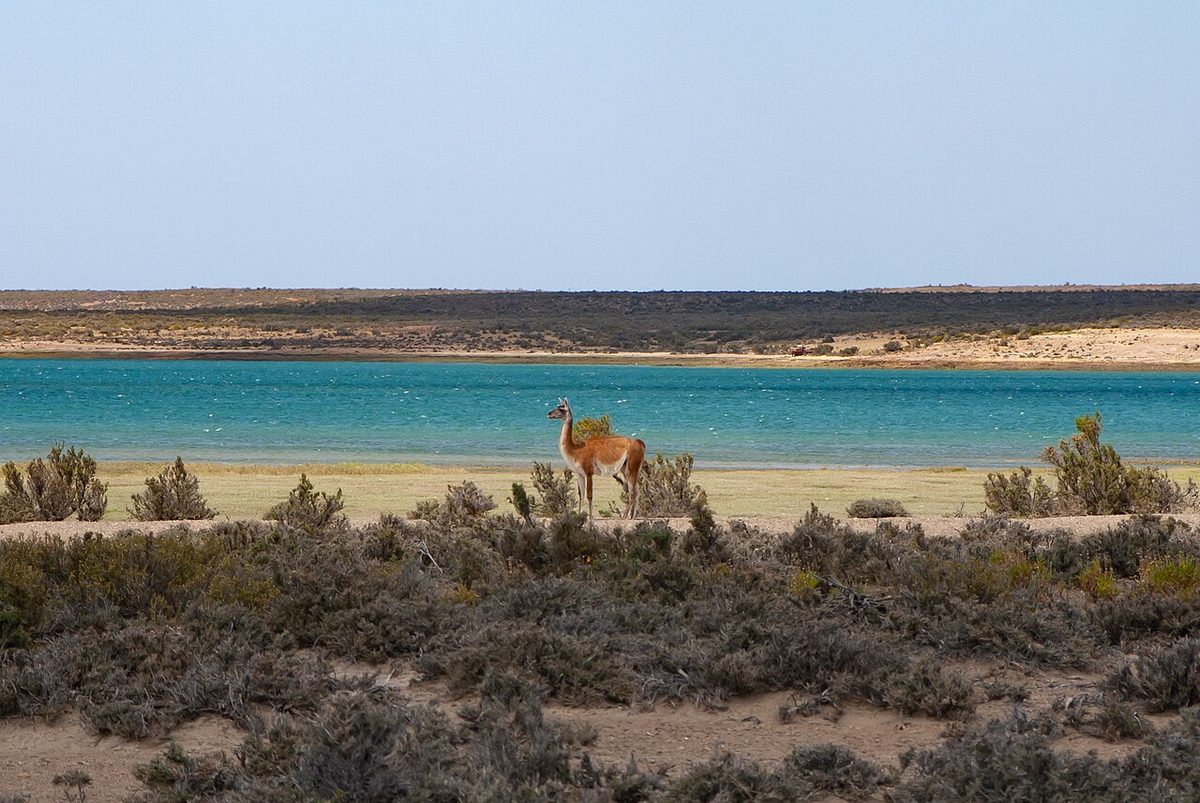
0 — 2 km Fig. 1 · A guanaco on open grassland in Torres del Paine, one of the animals Patagonia trail etiquette asks you to watch from a minimum of 50 metres away · A guanaco grazes on open grassland in Torres del Paine, an animal trail etiquette asks you to watch from at least 50 metres away. Photo: Francisco Paez / CC BY-SA 2.0 via Wikimedia Commons
This article contains advertising. Booking links on this site can be turned into paid links automatically by our partner Travelpayouts: if you book through one, we earn a commission from the provider, at no extra cost to you. It never affects what we recommend. Affiliate disclosure
Patagonia trail etiquette is not a code of manners. In Chile especially it is law, with named statutes, published fine bands and patrols that work alongside the national police. Between 1 January and 19 February 2026, CONAF expelled 50 visitors from Torres del Paine — 40 for smoking, 10 for lighting a camping stove outside a designated sector. Tourists paid CLP 1 million to 5 million as donations to local fire brigades and were banned from entering Chile for three years. Nobody was building a bonfire. They were doing ordinary hiker things on the wrong square metre of ground.
That gap — etiquette written as morality, enforced as statute — is why this page exists. Most pages ranking for this question reprint the Leave No Trace principles with no Chilean or Argentine content at all; the best-localised of them still says to keep 100 m from bears. South America has no bears.
Patagonia trail etiquette, translated: Leave No Trace under local law
The short version, before any philosophy: no fire or heat source outside designated areas in a Chilean protected area, no drone in either country, everything packed out including used toilet paper, never burn that paper, stay on the marked trail in daylight, 50 m from a puma or guanaco, no speakers, and declare your food at the border.
The Leave No Trace Center for Outdoor Ethics publishes seven principles. They are correct, and they are a floor. Here is what each becomes here.
LNT principle
What it becomes here
Plan Ahead & Prepare
Reservations and registration are compulsory: every Torres del Paine night booked before entry, registration at every ranger station.
Travel & Camp on Durable Surfaces
“Salir de los senderos” is a listed prohibition; wild camping is illegal in Chilean protected areas.
Dispose of Waste Properly
Ley 21.123: fines are set in UTM. El Chaltén’s camps are zero-waste — no bins, no collection.
Leave What You Find
Picking alpine flowers and disturbing archaeological material are serious offences in both countries.
Minimize Campfire Impacts
LNT says “small, contained, and legal”. In Chile there is no legal fire at all.
Respect Wildlife
A distance in metres: 50 m stationary, 100 m moving for pumas.
Be Considerate of Others
Speakers not permitted; “ruidos molestos” prohibited.
Swipe to see all columns
Table 1
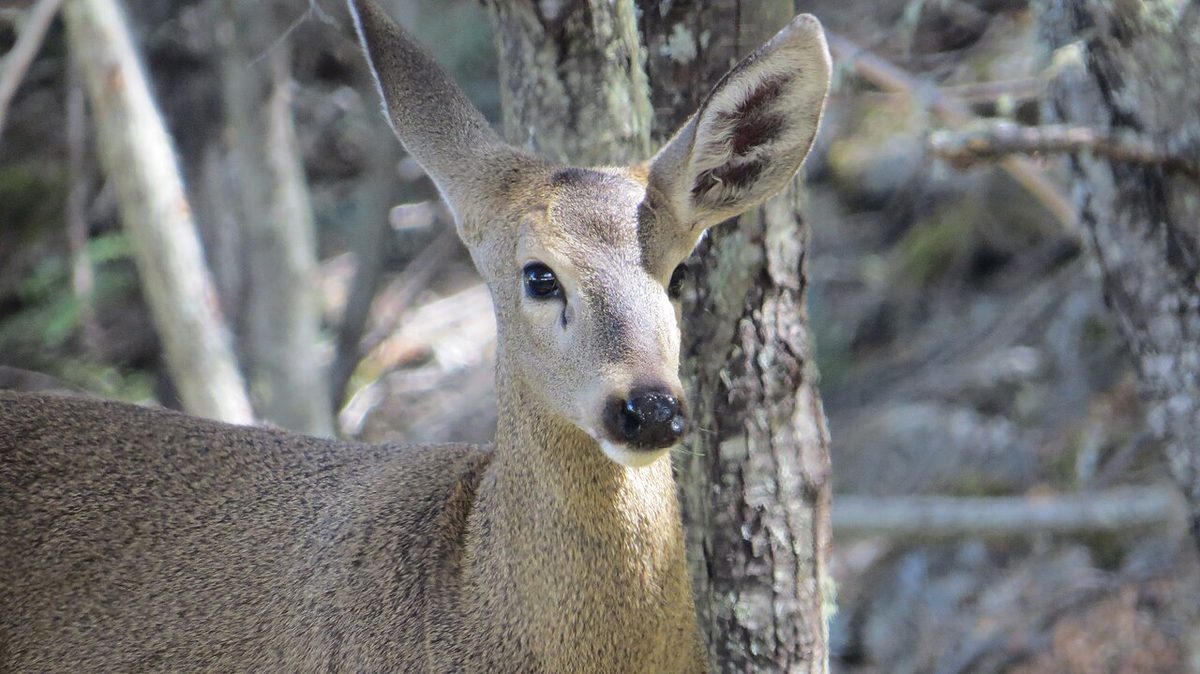
Fig. 2 · A huemul, the south Andean deer declared an Argentine Monumento Natural Nacional in 1996, of which only about 600 remain. Photo: Felipe.alarcon / CC BY-SA 3.0 via Wikimedia Commons
Fire: there is no version of “small and careful”
In Chile, inside protected areas, every heat source is banned:“El uso de cualquier fuente de calor al interior del Parque Nacional está prohibido.” Open fire, fire rings, burning waste, smoking, candles.
The only permitted cooking is with “cocinillas que no usen material vegetal como combustible” — stoves that do not burn plant material — and only inside enabled camping or designated areas. Machine translations of that clause circulate inverted, so read the Spanish: a gas canister stove is legal in the right place, while a BioLite-type wood-burning stove is illegal anywhere because its fuel is vegetal. Nothing between camps on the W or the O is legal for cooking, so plan cold lunches — see Patagonia camping and the packing checklist for the w.
Argentina is conditional rather than absolute. In Los Glaciares, “Sólo se puede hacer fuego en los fogones habilitados” — built fire rings only, with your own firewood. Around El Chaltén and in Tierra del Fuego, no fire at all: gas stoves in authorised camping areas. Los Alerces permits fire only where marked, after you check the day’s fire-risk index.
So: in Chile the question is “am I in an authorised area?” In Argentina it is “is it authorised today?”
The arithmetic of putting one out
CONAF’s restoration release of 6 June 2024 explains why the park is merciless. It names three major fires — 1985, 2005 and 2011 — and puts the total burned area at 39,000 hectares, of which 6,500 ha were lenga and ñirre forest. Twenty years of work restored 418 hectares and planted 1,137,000 lenga seedlings; that release announces the programme’s conclusion, with roughly 6,000 hectares of burned forest still unaddressed.
418 ha is about 1% of the burned total and 6% of the burned forest — roughly 21 hectares a year, my division on CONAF’s figures. Native lenga takes about 200 years to reach maturity. Two decades of funded effort, recovering a fraction of one fire’s ground, against a tree that will not be adult until the 2220s. That is why a ranger’s reaction to a lit cigarette feels disproportionate to a visitor and does not to anyone who lives here.
The individual fires come from other sources than CONAF’s aggregate. The 2005 fire, about 15,000 ha, started when a tourist knocked over a gas camping stove in an unauthorised camping area; a smaller February 2011 fire began with a campfire in an unauthorised area, and the tourist was expelled; the 2011-12 fire, 17,606 ha between 27 December and 8 March, is attributed to a tourist burning toilet paper in a prohibited location. 1985 is usually given as ~14,000 ha from a visitor’s cigarette, but that rests on Spanish Wikipedia alone — unconfirmed.
Two cautions. Those per-fire figures total 46,606 ha, more than CONAF’s 39,000 ha aggregate: they come from separate sources and are not a breakdown of it, so for a single authoritative figure use CONAF’s 39,000 ha. And CONAF publishes hectares, not causes — attributing all three fires to visitors comes from secondary reporting, most clearly Horizon Guides. CONAF does note 99.7% of Chile’s forest fires are human-caused (2018).
The legal tail matters too. Criminal charges against the visitor blamed for the 2011-12 fire were withdrawn and he paid CLP 4,850,000 to CONAF. Then on 4 August 2015 the Third Chamber of Chile’s Supreme Court upheld his civil liability for environmental damage. There was no 2015 fire in Torres del Paine — that date is a court ruling, and it makes the more useful point: a visitor can be pursued financially years after flying home. Nor is this Chile-only: a Greenpeace report of 13 May 2025 found 31,722 hectares burned in Patagonian protected areas in 2024/25, four times the previous year, 95% human-caused.
What breaking the rules actually costs
Offence, statute, maximum, and what tourists actually paid. Figures as of July 2026.
Offence
Statute
Maximum on the books
What was actually imposed
Any heat source in a Chilean protected area — smoking, candles, a stove outside a designated spot
Ley 20.653 (art. 22)
61 days to 3 years’ imprisonment, or 11–50 UTM; the park’s own site states it as up to CLP 2,000,000 or three years
Expulsion, CLP 1–5 million as donations to local fire brigades, a 3-year ban on entering Chile, referral to Carabineros
Starting a forest fire with ecological damage
Same regime
5 years and 1 day to 20 years, plus expulsion from the country for foreign nationals
2011-12: charges withdrawn, CLP 4,850,000 paid to CONAF, civil liability upheld in 2015
Littering in a Chilean protected area
Ley 21.123
Fine set in UTM
—
Recreational drone flight in Torres del Paine
Park rules, Ley 21.600, DAN 151
Expulsion from the park and referral to the DGAC
—
Drone flight in an Argentine national park
APN blanket prohibition
Fines, confiscation, up to seven years’ disqualification from APN-authorised activities
A drone was confiscated from tourists near Bariloche; APN’s last peso figures are from 2023
Failing to declare food or agricultural products entering Chile
SAG sworn declaration
A sanction “que puede alcanzar los US$4.500 (valor referencial de acuerdo a la ley)”
—
Swipe to see all columns
Table 2
Four notes keep those numbers honest. UTM is re-indexed monthly: CONAF’s 17 February 2026 release cites a December 2025 UTM of CLP 69,542, putting 11–50 UTM near CLP 765,000 to 3.48 million — my conversion, and it drifts. The count depends on the basis: the 50 through 19 February 2026 comes from La Tercera reporting CONAF on 23 February, against 38 in all of 2025; a count published 21 March 2026 gave 34 on a different basis. Not in dispute: Torres del Paine accounted for 92.6% of every expulsion from a Chilean protected area in that window. SAG’s US$4,500 is referential, not a fixed fine. And Ley 21.600 (SBAP, 2023) prohibits fire, drones, pets and harming fauna, but its sanctions regime is still being implemented and no fine figures are published.
Enforcement is coordinated — CONAF sweeps with Carabineros de Chile and SERNATUR during hot spells — and the prohibited list holds surprises: alcohol, swimming, paragliding and skydiving, and cycling on the W and Macizo Paine trails, allowed on vehicle roads only and never alone, because of puma risk.
Drones: the honest answer is no, in both countries
Chile. Ley 21.600 lists drone flight among prohibited activities in national parks, reserves and natural monuments, and CONAF’s Torres del Paine page says “Está prohibido el uso de drones”, with exceptions only for authorised research or professional filming. The park spells out the consequence: expulsion plus referral to the DGAC.
The civil-aviation rules point the same way. Chile’s drone regulation was reissued as DAN 151, Edition 4, dated 24 March 2026 and published in April 2026. The clause that settles the question is 151.101(a)(6): to overfly state-protected wilderness areas the operator must attach “una autorización del administrador del área correspondiente” — the area administrator’s written authorisation. There is no recreational path around it. It applies expressly to “toda persona natural o jurídica, nacional o extranjero”, and requires DGAC aircraft registration, a remote-pilot credential (30 hours of theory, five practical, an exam, minimum age 18), liability insurance, a 400 ft ceiling and a duty to avoid “fauna y el terreno”. A visitor arriving with a drone in a daypack meets none of those conditions.
Argentina. APN’s rule is a blanket ban, stated flatly on its own Los Glaciares page: “Está prohibido el uso de drones” — not zone-dependent, not weight-dependent. Consequences are fines, confiscation on the spot and up to seven years’ disqualification from APN-authorised activities. The peso figures APN last made public — ARS 40,000, rising to ARS 120,000 where environmental damage is verified — date from May 2023 and are meaningless after Argentine inflation, so weigh the confiscation and disqualification instead. Outside the parks, Resolución ANAC 550/2025 allows the open category under 25 kg without a licence but requires a free online course and digital declaration, caps altitude at 122 m — and still requires the relevant agency’s authorisation for protected areas.
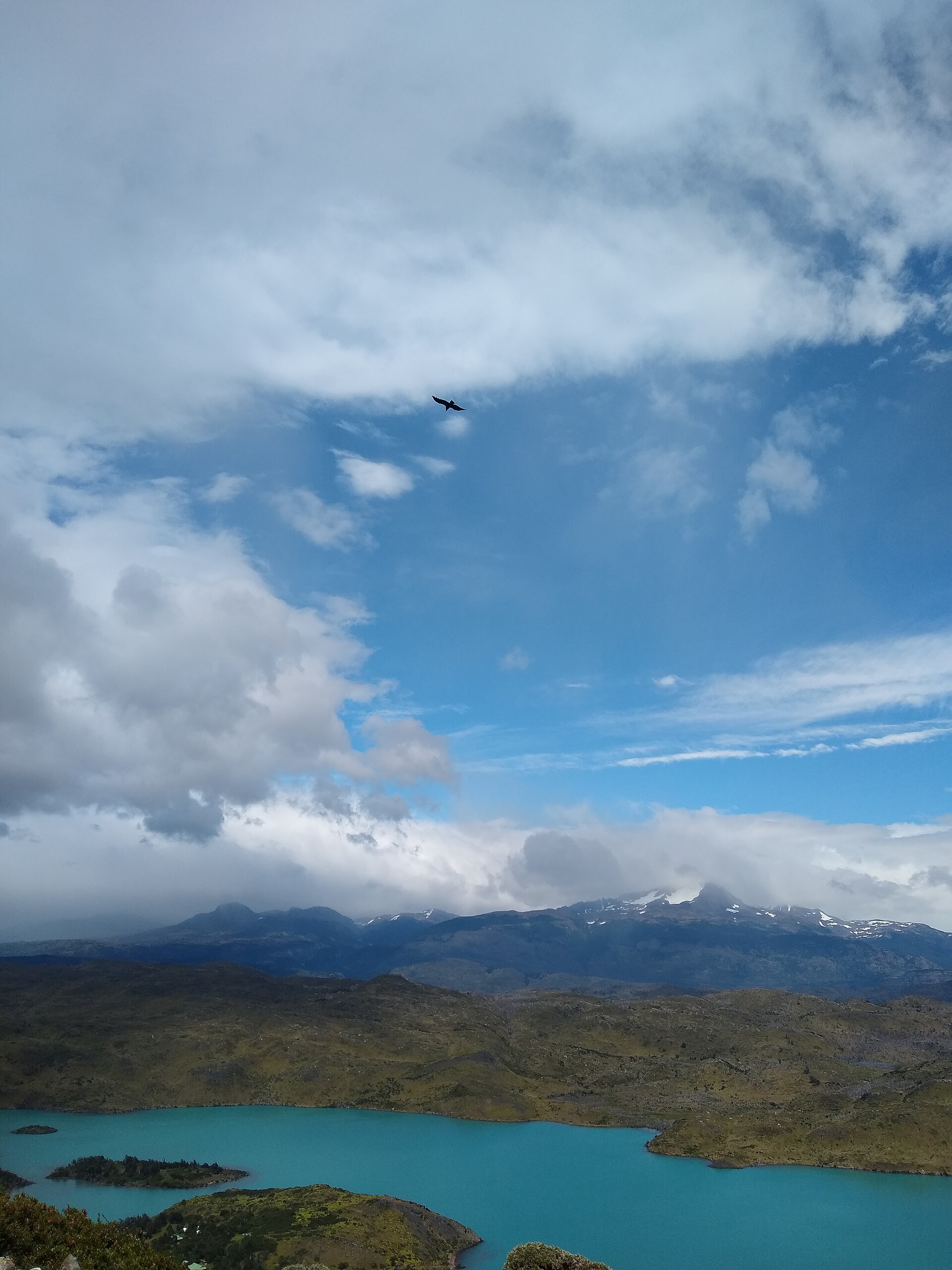
Fig. 3 · A condor shares the open skies above Lago Pehoé with the mountain landscape of Torres del Paine. Photo: amanderson2 / CC BY 2.0 via Wikimedia Commons
Flat-out banned: Torres del Paine; every Chilean park, reserve and natural monument; Los Glaciares, both zones; Nahuel Huapi; Los Alerces; Tierra del Fuego; any Argentine zona intangible. Assume there is nowhere you actually want to film where you may legally fly.
Wildlife: the distances that are published, and the ones that aren’t
Pumas: 50 metres standing, 100 metres moving
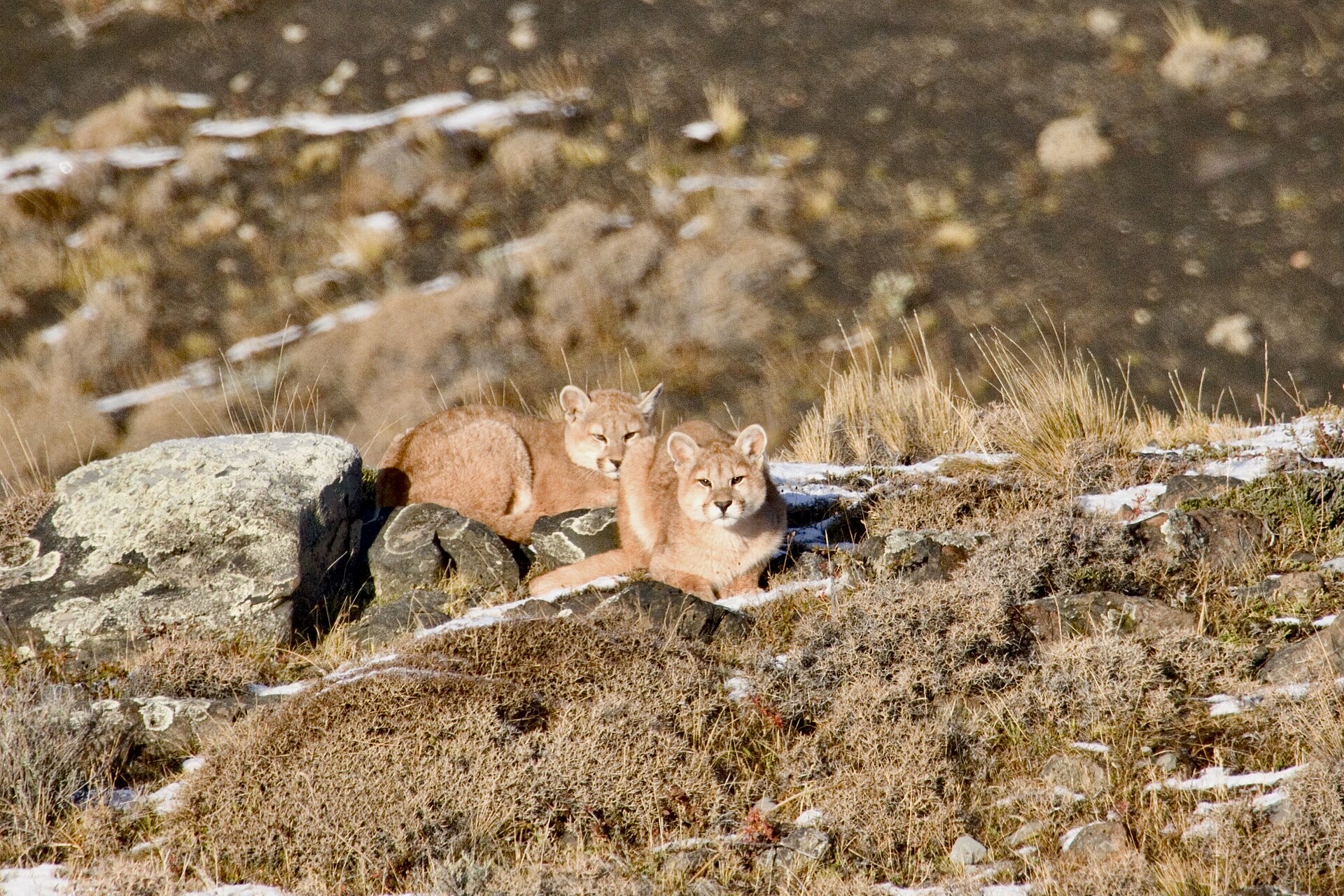
The Municipality of Torres del Paine’s puma-watching safety protocol of August 2025 carries the most citable wildlife number in Patagonia: 50 m when the animal is stationary — “cincuenta metros” — and 100 m“si el animal está en movimiento”. It also requires operator registration, mandatory briefings, maximum observation times and authorised sectors only, on the stated grounds that nearly half of large-carnivore attacks involve preventable risk behaviour. If a sighting is the point of your trip, book it via puma tracking in Patagonia.
If you meet one, the park’s own wording is the script: “mantenga la calma. No se acerque, no corra y retroceda lentamente mirándolo a los ojos.” Stay calm, do not approach, do not run, back away slowly keeping eye contact. Stand tall, look larger, be loud and firm, and pick children up immediately. Do not turn your back, block its escape route or close in for a photo. If it turns aggressive: noise, thrown objects, fight back. Running activates the pursuit instinct — which is also why a lone, fast cyclist is the wrong silhouette here.
Fig. 4 · Two young pumas rest together among rocks and grasses in Torres del Paine. Photo: Naturedata / CC0 via Wikimedia Commons
Guanaco and huemul
Operator guidance in the park applies the same 50 m minimum to guanaco and huemul. Binoculars or a zoom lens; do not block the animal’s path or follow it. Guanaco move in herds and are often standing exactly where you want to walk; wait, or go round at distance. The huemul, the south Andean deer, is the one to take seriously — a protected national symbol in Argentina, declared Monumento Natural Nacional in 1996 by Ley 24.702, with roughly 600 individuals left in Argentine territory. Its protocol is the opposite of the puma one: “Déjele una vía de escape, quédese quieto, sáquele fotografías” — leave it an escape route, stay still, photograph it — and report the sighting, which APN actively wants, as do route databases for trails like Laguna de los Tres.
Dogs are the huemul’s historic killer, which justifies the no-pets rule better than any generic appeal: hunting packs took the adults, and “las crías eran las víctimas preferidas de las jaurías”. Chile’s Manual de Buenas Prácticas para la Conservación del Huemul (MMA/FAO, 2022) adds two rules worth memorising: “Observe a la fauna desde lejos”, and “no abra nuevas rutas.”
Feeding, and the fox at your tent
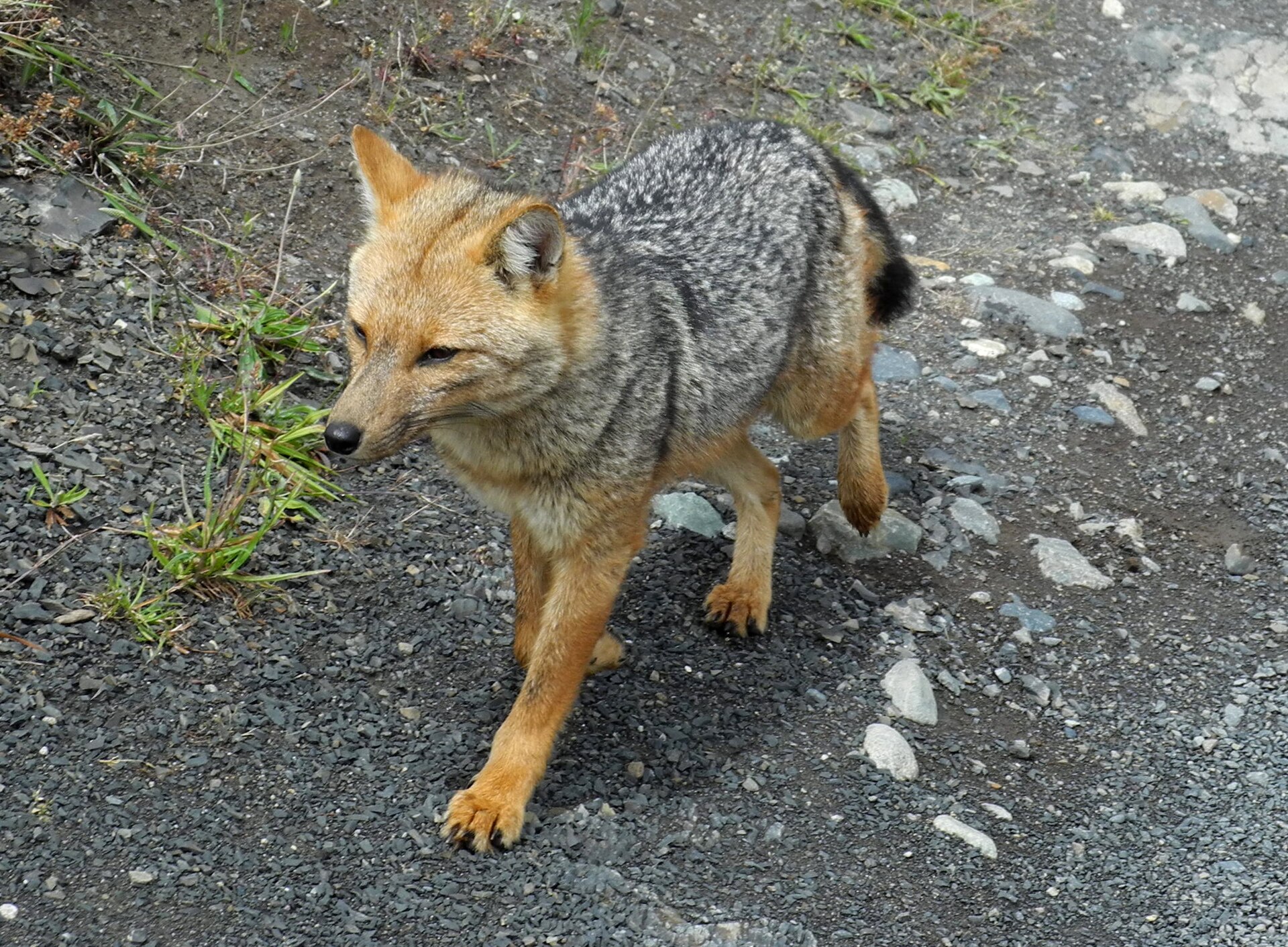
Both countries prohibit feeding outright — Torres del Paine: “No lo toque y jamás lo alimente”; APN: “Está prohibido alimentar a la fauna silvestre.” Fed animals lose the ability to find natural food, become bold, then aggressive, and end up being removed. No authority publishes a fox-specific rule, so treat this as field practice: zorros culpeo work campsites at dusk and dawn, so nothing edible or scented stays outside your tent and rubbish goes in a sealed bag inside it.
Fig. 5 · A culpeo walks along a visitor path in Torres del Paine National Park. Photo: LBM1948 / CC BY-SA 4.0 via Wikimedia Commons
Condors and nesting birds
No Chilean or Argentine authority I could reach publishes a minimum distance or nesting buffer for the Andean condor, so I will not invent one — distrust any page quoting a metre figure without a source. What is documented is more useful: APN bans drones outright because of interference with native birds’ flight routes and fledgling development, and INIBIOMA researchers have found that repeated drone disturbance makes animals abandon sites including “los nidos con huevos o pichones” — nests with eggs or chicks. A cachaña, the austral parakeet, was found dead after colliding with a drone.
A condor pair raising a single chick on a ledge is exactly the case that ban is written for, so the guidance is behavioural: fly nothing, play no sound, stay off cliff edges. El Chaltén’s Mirador de los Cóndores exists so you do not have to — see responsible wildlife watching and the El Chaltén and Fitz Roy hiking guide.
Waste, toilets and washing water
In Chile every piece of rubbish leaves the park, organic waste included.“Botar basura” is on the prohibited list, and littering is fined under Ley 21.123, with the amount set in UTM rather than as a fixed peso figure. In Argentina:“La basura fuera del Parque: regresá con tus residuos.” El Chaltén’s three trekking camps run explicit zero-waste: no bins, no collection, nothing sold on site.
Toilets, honestly. Every operating Torres del Paine campsite has flush toilets; there are none between camps on the W or the O, and El Chaltén’s camps have dry latrines.
Where there is no toilet: a cathole 15–20 cm (6–8 in) deep and 10–15 cm across, at least 60 m (200 ft) from water, camp and trail, covered and disguised, with toilet paper and hygiene products packed out. Not buried, not burned. Both distances in circulation are real — LNT and Chilean guidance use 200 ft / 60 m, APN’s El Chaltén guidance 30 m from water — so use 60 m, which satisfies both.
Why “never burn it” is not fussiness: LNT’s own guidance says “burning toilet paper is not recommended, as this practice can result in wildfires.” In a Chilean protected area the flame is independently illegal. And the 17,606-hectare 2011-12 fire is reported to have started exactly that way — one person being tidy for thirty seconds. Carry a trowel, a dedicated opaque ziplock for used paper, and a dry bag as a rubbish sack (what to pack for Patagonia).
Wash away from the water, not in it. Carry water 60 m from streams and lakes to wash yourself or your dishes, then scatter the strained dishwater — Chile’s huemul manual independently uses 60 m as its minimum camping distance from water. Minimise soap rather than substituting it: LNT is explicit that biodegradable soap still affects water quality, and the cooking shelters on the W have sinks.
Collect upstream, never downstream — never below a camp, refugio, ranger station, horse trail or grazing land. Las Torres advises secondary streams over the main rivers, which are bordered by trails, campsites and ranger stations, and a documented giardia case on the W came from a small high stream that looked pristine (what to do if the weather turns covers filtration). The park also prohibits swimming in every body of water, so the post-hike dip is a listed prohibition.
The Base Torres trail shows what volume does: 1,000 hikers in a single day in high season, per Sustainable Travel International, whose restoration project with CONAF and AMA Torres del Paine attributes degradation to that traffic plus harsh climate and steep grades. Add an eight-hour round trip and no toilet between the last campsite and the mirador, and guides who run trail cleanups report the result — “tons of toilet paper and feminine products left exposed on the ground” at high-use bathroom stops. Their instruction is the plainest available: “No dejes tu papel higiénico en la tierra. Tráelo contigo y ponlo en un contenedor.” Plan the Base Torres hike accordingly.
Staying on the trail: a prohibition, not a preference
In Chile this is listed, not advised.“Salir de los senderos” sits on Torres del Paine’s prohibited list alongside fire and drones, and hiking is permitted only on marked trails, in daylight. The park pairs it with the argument that lands hardest: “Casi todos los accidentes fatales en el parque se producen fuera de las rutas autorizadas” — almost every fatal accident happens off the authorised routes. Argentina’s wording is just as flat:“Caminá sólo por los senderos habilitados.”
Walk single file down the middle of the trail, even when it is wet and muddy. Stepping around a puddle is how a 60 cm trail becomes a three-metre braid; given Patagonian rainfall the muddy centre line is the correct line. That is what boots and gaiters are for — see packing for Patagonia and Patagonia gear rental.
The ground is unusually unforgiving: thin organic horizons over glacial gravel, short growing seasons, and wind that strips exposed soil once vegetation breaks. The recovery clock is the one from the fire section. A shortcut scar across a switchback does not heal in a season.
The place to hold your line is the final climb to Laguna de los Tres. From Camping Poincenot it gains roughly 390 m in about 2.5 km to a 1,178 m viewpoint in tight zigzags, and above roughly 1,090 m the vegetation stops entirely — bare rock and moraine, extraordinarily heavily trafficked from December to early March. Steep zigzags, nothing growing to stop you, a queue ahead and the summit in sight is the exact recipe for cutting a corner.
There is no published erosion survey for that climb, so I will not invent a number. What is on the record is APN’s reason for introducing paid trail access at El Chaltén, a pilot from 21 October 2024 and now standing policy: “regular el flujo de turistas y mejorar la conservación de los entornos naturales.” That is the park service saying its own trails are under pressure from visitor volume (how much park tickets cost in 2026).
Sharing the trail: right of way, breaks and noise
On right of way and group size neither CONAF nor APN publishes a rule. Everything presented elsewhere as Patagonian etiquette on those points is imported convention. Follow it anyway; it is what guides enforce.
Uphill walkers have right of way — the climber has the rhythm and the narrower field of view. Cyclists yield to hikers and riders, and everyone yields to people using assistive devices.
Take breaks fully off the tread, never on the vegetated edge of a switchback.
Pack horses supply the refugios, and no park page publishes a hiker-yields-to-horses rule, so treat this as best practice: step off downhill, stand still, speak calmly. And no numeric group-size limit is published for independent trekkers in either country — the only group rules I verified govern commercial puma-watching.
On noise there is local law, and it is stricter than most travellers expect. Torres del Paine: “No está permitido reproducir música con altavoces”, and “generar ruidos molestos” is prohibited. Los Glaciares: “La música de los parlantes y celulares produce contaminación sonora” — APN classes it as pollution. LNT offers the compromise if you want music: wear one earbud. Two adjacent rules — Los Glaciares’ park road limit is 40 km/h, and Torres del Paine restricts wildlife photography to official trails in daylight, because dawn and dusk off-trail movement disturbs animals most. Hiking Patagonia without a guide covers the rest of that gap.
The border: the etiquette item hiding in your food bag
This is where a model trail citizen most often gets sanctioned. The classic route — Torres del Paine to El Calafate to El Chaltén, or the reverse — crosses at Cerro Castillo/Cancha Carrera, Río Don Guillermo, Paso Integración Austral or Huemules, often twice: two to four biosecurity declarations, each landing at the moment your food bag is half-eaten.
Entering Chile — SAG. A sworn declaration is compulsory for every person over 18, filed individually and under oath, free, online at dj.sag.gob.cl. Declarable regardless of quantity or packaging: plant and animal products, subproducts and parts — including handicrafts — plus agricultural chemicals, veterinary products and animal feed. That wooden or seed souvenir from El Calafate is declarable. SAG’s border page puts the sanction at up to US$4,500, a referential value under the law.
Entering Argentina — SENASA. Not permitted in baggage: fresh fruit and vegetables; garden, ornamental and forestry plants; “vegetales y sus partes (semillas, raíces, yemas, etc.)” — seeds named explicitly; meat, cured meats and dairy; honey and all bee products; homemade or unlabelled foods; animal feed and veterinary products. Staff may seize them.
The practical rule: finish it or bin it before the border — and declare everything. Declaring costs nothing; not declaring is the offence. Neither agency publishes a boot-cleaning requirement on the pages I read, so I will not claim one — but soil and seeds on boots, gaiters and pegs are the exact vector both exist to stop, and knocking the mud off takes five minutes. See Chile–Argentina border crossings in Patagonia and passport and visa rules for Patagonia.
Estancia country, gates, and the towns that staff the parks
The landscape you are photographing as wilderness was sheep country two generations ago. From about 1900 the Torres del Paine area was colonised for livestock and subdivided into twelve properties of 600 to over 10,000 hectares; the park’s creation let ranched land recover. Grazing still borders the trekking areas — the park’s own drinking-water guidance warns about still water near cattle. Visitors went from 128,396 in 2007 to more than 280,000 a year: a pastoral landscape absorbing a city’s worth of walkers each season.
Gates: leave every one exactly as you found it, open or closed. Neither park service publishes a gate rule; this is countryside convention, and it is correct. I could not verify the widely repeated claim that the W trek crosses private estancia land, so I am not asserting it — walk the marked route and respect fences and signage.
Leave what you find has a local edge too: Patagonia holds Kawésqar, Aónikenk/Tehuelche and Yámana archaeological material, including shell middens in Tierra del Fuego. The refugios are staffed from Puerto Natales, El Chaltén and El Calafate, where the park is the economy — Erratic Rock hostel in Puerto Natales runs a free trekking briefing at 3 p.m. daily (Puerto Natales travel guide, responsible travel).
Chile vs Argentina: the differences that change your behaviour
Rule
Chile (Torres del Paine as the model)
Argentina (APN)
Fire
Absolute ban on any heat source; gas or liquid-fuel stoves in designated areas only
Conditional: fogones habilitados where they exist; Los Alerces requires the day’s fire-risk index; El Chaltén and Tierra del Fuego are gas stoves in camping areas
Smoking
Prohibited and enforced — 40 of 50 expulsions in early 2026
Not found as a published park-wide prohibition; assume the fire rules cover it
Drones
Banned under Ley 21.600; expulsion plus DGAC referral; DAN 151 ED 4 requires the administrator’s authorisation
Blanket ban; fines, on-the-spot confiscation, up to 7 years’ disqualification
Wild camping
Illegal in protected areas, full stop
Legal only at named acampe libre / agreste sites
Guides
27 April – 15 September 2026: an accredited specialised guide was required on the W circuit and Base Torres. From 16 September 2026 no guide is needed there, but microcrampons and trekking poles remain required
Optional on most marked trails; poles and crampons compulsory May–September at El Chaltén
Distance from water
60 m (LNT and the huemul manual)
30 m per APN’s El Chaltén guidance — use 60 m anyway
Enforcement style
Expulsion, referral to Carabineros and DGAC, criminal exposure, 3-year entry ban
Fines, confiscation, disqualification from park activities
Biosecurity on entry
SAG sworn declaration over 18; up to US$4,500 (referential)
Seasonal notices rotate. The accredited-guide requirement on the W and Base Torres ended on 16 September 2026, the W mountain trail was closed 1 June to 31 July 2026 (exceptional permits only), and the Macizo Paine (O) circuit was closed until at least 31 October 2026, with reopening subject to a park weather and safety evaluation. Check conaf.cl and the daily report on parquetorresdelpaine.cl in the week you travel, not any article. See also comparing Argentine and Chilean Patagonia and how Patagonia’s seasons break down.
Frequently asked questions
Can you have a campfire in Patagonia?
Not in a Chilean protected area — no fire, no fire pit, no candles, no smoking, no stove burning plant material. The only legal cooking is a gas or liquid-fuel stove inside a designated area. Argentina is conditional: fire only in built fogones where they exist, gas stoves only around El Chaltén and in Tierra del Fuego camping areas, and Los Alerces wants the day’s fire-risk index checked.
Can you fly a drone in Torres del Paine?
No. Drones are prohibited in Chilean national parks under Ley 21.600, and the park’s rules state offenders face expulsion plus referral to the DGAC. Chile’s DAN 151 Edition 4 of March 2026 separately requires the protected-area administrator’s written authorisation to overfly, plus aircraft registration and a licensed pilot. Argentina applies a blanket ban with on-the-spot confiscation.
What happens if you break the rules in Torres del Paine?
Expulsion, usually. Between 1 January and 19 February 2026 CONAF expelled 50 visitors — 40 for smoking, 10 for stove use outside a designated sector — per La Tercera on 23 February 2026. Those tourists paid CLP 1–5 million as donations to local fire brigades and got a three-year ban on entering Chile. Starting a fire escalates to criminal exposure.
How close can you get to a puma in Torres del Paine?
The Municipality of Torres del Paine’s August 2025 protocol sets 50 metres minimum when the animal is stationary, 100 metres when it is moving. If you meet one: stay calm, do not approach, do not run, back away slowly keeping eye contact, look larger, be loud and firm, and pick children up immediately.
Final thoughts
The etiquette most of us grew up with is a set of habits you adopt to whatever degree suits you. This is not that. In Chilean Patagonia the same list is a statute with named laws, fine bands, coordinated patrols and a three-year entry ban; in Argentina it is a gentler regime of confiscation and multi-year disqualification.
The behaviour that costs the most is never dramatic: a stove set down where stoves are not allowed, paper set alight to be tidy, a corner cut on a switchback. Twenty years and 418 hectares is what the repair side of that ledger looks like.