Where to Stay in El Chalten: Town Center, Trailheads, Hotels and Hostels
Which end of El Chaltén to sleep in for the hike you came for, which hotels and hostels open when, how far ahead to book, and the cash rules.
By Patagonia Tourism Guide · First published 11 Oct 2026
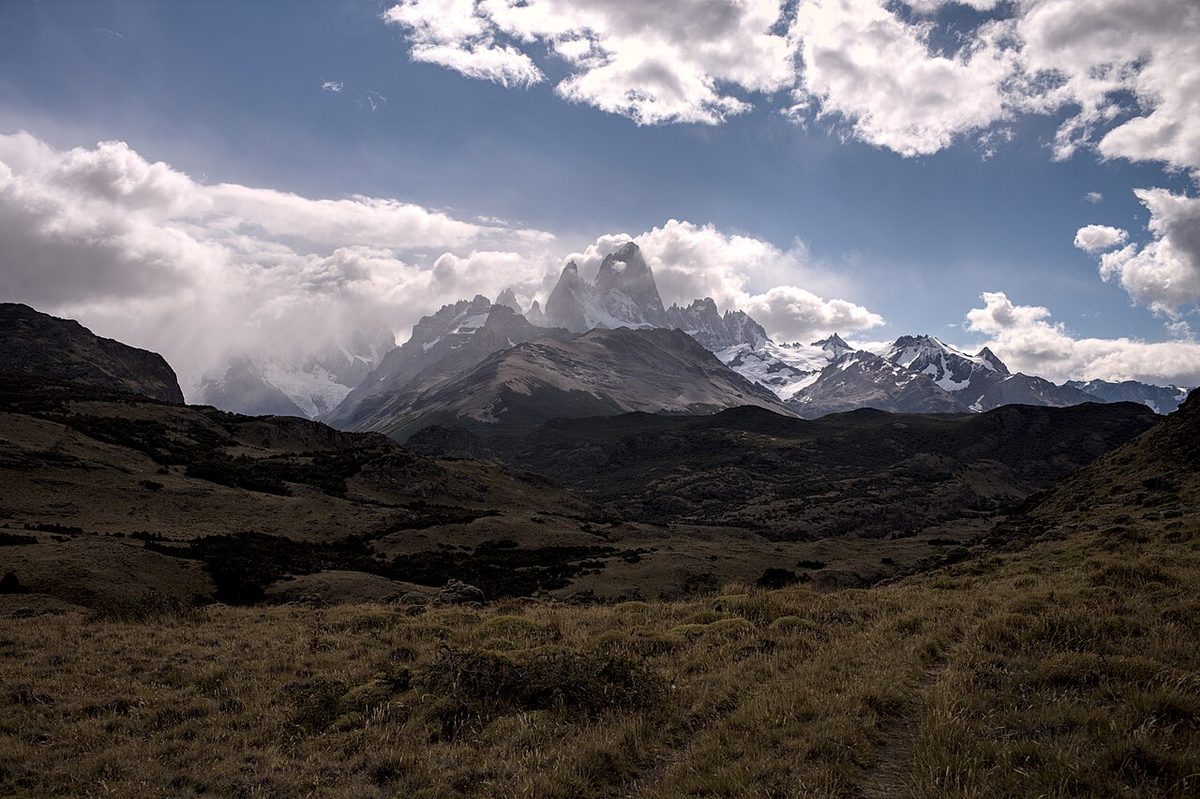
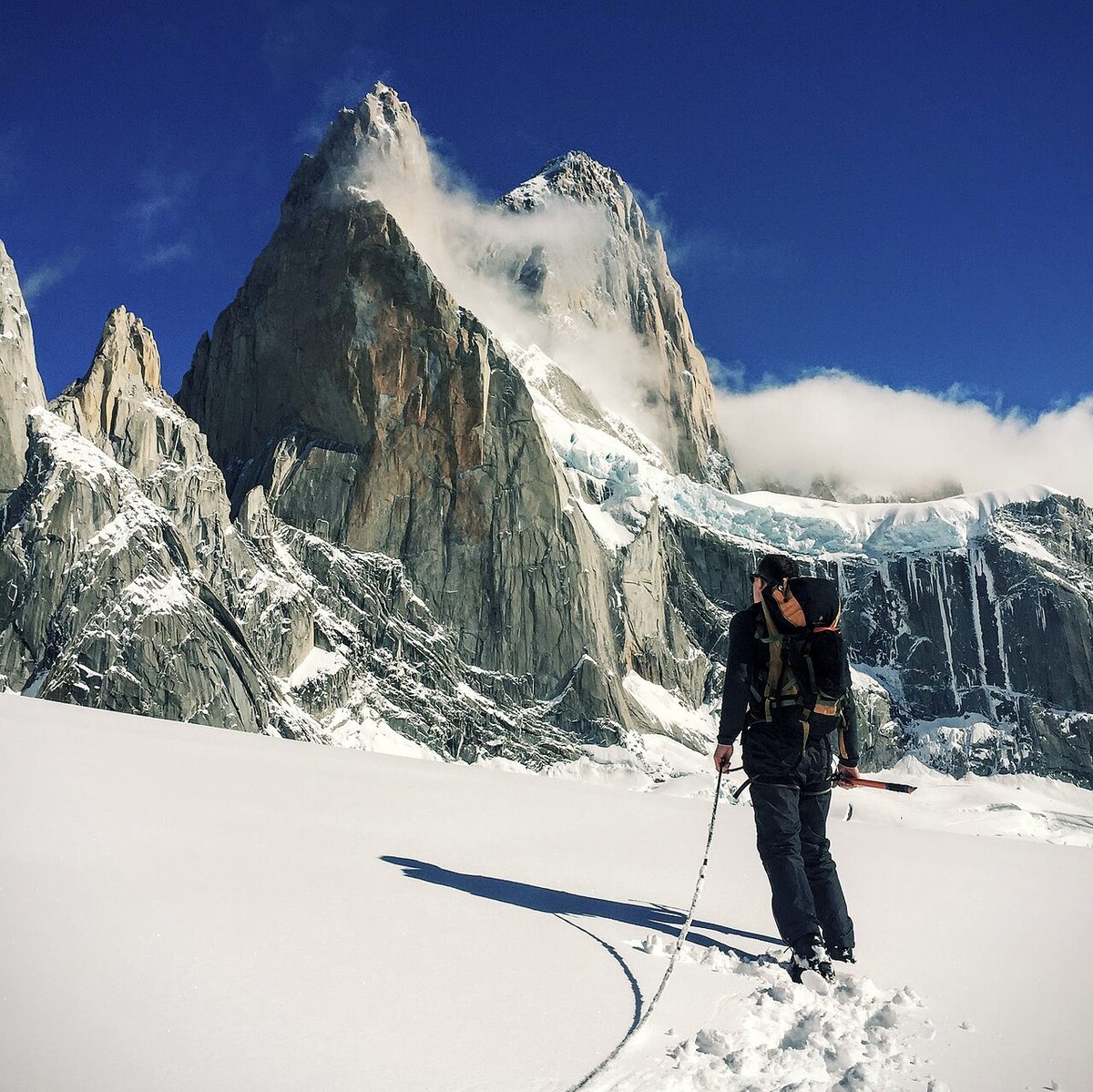
0 — 2 km Fig. 1 · Cloud lifting off the Fitz Roy massif above the dark steppe near El Chaltén · Photo: Gedankenstuecke / CC BY-SA 4.0 via Wikimedia Commons
Deciding where to stay in El Chalten comes down to one question: which end of town do you need to walk out of at dawn? The village is small enough to cross on foot in about 15 minutes, according to the local accommodation directory, so nowhere is truly far. But the Fitz Roy trailhead sits at the north end of Avenida San Martín and the bus terminal sits at the south end, and on the two mornings that matter (the early start for Laguna de los Tres and the day you haul a pack onto a bus) those 15 minutes feel longer than they should.
The short version: sleep at the north end if Laguna de los Tres is the reason you came; sleep in the centre for a first visit with a mix of hikes; sleep near the terminal for a one-night stop or an early bus; and sleep out along Ruta Provincial 41 if you want silence and have a way to get around. Book three to six months ahead for December to February, arrive with pesos, and choose a place licensed by the municipality.
Season dates, prices and rules here were checked in October 2026 against the properties’ own pages, the national parks service and the municipality. The big in-town hotels with published dates open from 1 October; the out-of-town refuges and Hostería El Pilar open on 1 November.
This page sits under the wider guide to where to stay in Patagonia. It deliberately stays off the trails themselves, which have their own El Chaltén hiking guide, and off camping, which has the El Chaltén camping guide. What follows is about beds: where they are, what kind, when they open, and what to check before you pay for one.
How El Chaltén is laid out, from a sleeping point of view
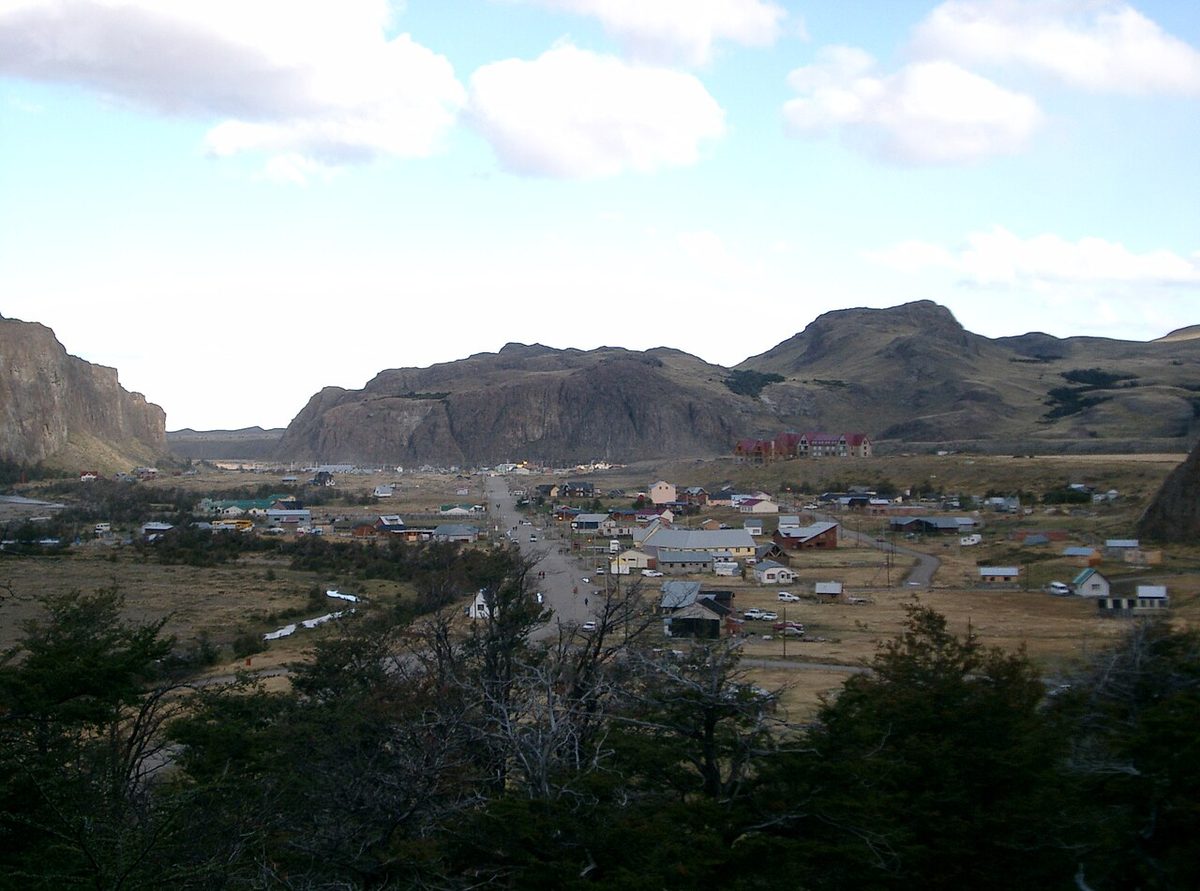
Picture a short grid of streets on a flat between two rivers, with one main spine, Avenida San Martín, running from the southern entrance of town up to its northern edge. Almost everything a visitor needs (bakeries, supermarkets, gear rental, restaurants, most hotels) is on San Martín or within a block or two of it.
Three things anchor the map for anyone choosing a bed:
The Fitz Roy trailhead is at the north end of Avenida San Martín, where the houses stop. This is where you start for Laguna de los Tres, Laguna Capri and Chorrillo del Salto, and it is part of what the national tourism board calls Portal Base Fitz Roy, which also covers the Cerro Torre trails.
The bus terminal is at the southern, entrance end of town. This is where you arrive and leave with luggage, and where Taqsa, Cal Tur and Chaltén Travel have their counters.
Portal Los Cóndores, the start for Mirador de Los Cóndores and Las Águilas, Loma del Pliegue Tumbado and Laguna Toro, is just before the town itself, so it is closest to the southern end.
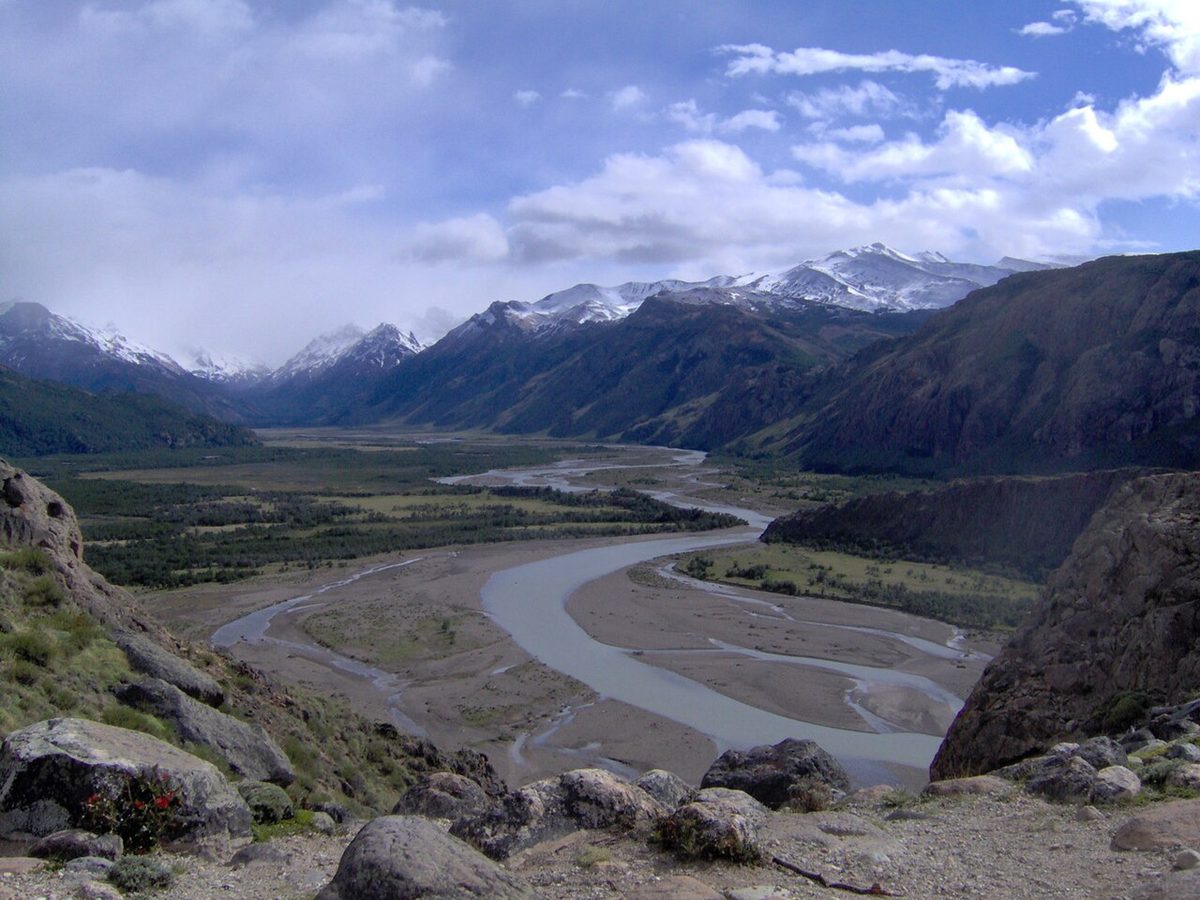
Then there is a fourth area that is not in town at all: the valley of the Río de las Vueltas, followed by Ruta Provincial 41 north toward Lago del Desierto. The national tourism board puts Portal Río Eléctrico, the other way into Laguna de los Tres and the start for Piedra del Fraile, about 16 km up that road. The lodges, estancias, eco-containers and mountain refuges are out there.
The Laguna Torre trail also leaves from town on foot; the Laguna Torre hike page has the exact start. For a stay of several nights, the honest answer is that any bed in town works for Torre. Where you sleep matters most for Laguna de los Tres, because it is a long day and the one people most want to start early.
Where to stay in El Chalten, end by end
Here is how the four areas compare before getting into the detail.
Area
Best for
Main trade-off
Nearest starts
North end (upper San Martín)
Laguna de los Tres, pre-dawn starts, hikers heading to the Poincenot or Capri camps
Longest walk from the bus with luggage
Fitz Roy trailhead
Centre (mid San Martín, Lionel Terray and nearby streets)
First visits, couples, a mix of hikes, restaurants on the doorstep
Busier streets in January
Everything within a short walk
South end (near the bus terminal)
One-night stops, early or late buses, budget stays
Longest walk to the Fitz Roy trailhead
Portal Los Cóndores, the bus
Out of town along RP41
Quiet, views, full-board stays, starting from Río Eléctrico
Transfers, shorter seasons, weaker connectivity
Portal Río Eléctrico
Swipe to see all columns
Table 1
The north end: sleep at the Fitz Roy trailhead
If the whole trip is built around standing at Laguna de los Tres, this is the end to sleep at. The appeal is simple. You leave the door, walk up the avenue past the last houses and you are on the trail, without adding a cross-town walk in the dark to a day that is already long. Hikers going up to camp at Poincenot or Laguna Capri get the same benefit in reverse: on the way down, tired, the bed is the first thing you reach.
Two properties with their own published details sit on the higher stretch of San Martín toward the trailhead:
Hotel Poincenot, 668 Avenida San Martín. Its page gives a season of 1 October to 30 April, a 24-hour reception, check-in at 3pm and check-out at 10:00. The 24-hour desk is a quiet advantage for a hiker: someone is there when you slip out before dawn and when you stumble in after dark.
Rancho Grande Hostel, 724 Avenida San Martín, a little further along the same avenue. Shared rooms, private doubles and family rooms, a shared kitchen, lockers in each room, a common room for guests’ luggage, packed lunches and a restaurant that its page says is open 24 hours a day. Check-in from 2pm, check-out until 10:00. The page gives no season, so ask before booking outside the summer months.
The trade-off is the bus. From the terminal at the far end you are carrying everything the full length of town, uphill in feel if not much in fact, often into a headwind. On a dry afternoon that is a stroll. On arrival at night in rain with a 70-litre pack, it is a reason to ask the property, before you travel, how other guests get from the terminal to the door.
The centre: the default that rarely goes wrong
For a first visit, the middle of town is the safe choice. You are a short walk from both ends, from the supermarkets and bakeries you will raid for trail food, from the gear-rental shops, and from dinner. If the weather shuts down Fitz Roy and you pivot to Torre or a short hike, nothing about your base needs to change.
Examples with their own published details:
Destino Sur Hotel & Spa, 370 Lionel Terray, one block off San Martín. Season 1 October to 30 April, check-in at 3pm, check-out at 10:00. Its page lists an indoor heated pool and, unusually for El Chaltén, currency exchange as a guest service, though it is worth confirming with the hotel before relying on it in a town without exchange offices.
Hostel Familia de Campo, 86 Iñaki Coussirat. Season 1 October to 30 April, two kitchens, and no breakfast included, which suits a hiker who would rather cook porridge at 5am than wait for a breakfast room to open.
The centre’s only real downside is noise and bustle in high summer, and even that is relative: this is a village, and the late-night soundtrack is mostly people discussing tomorrow’s weather forecast.
The south end: near the bus terminal
This is the practical end. If you arrive on an evening bus, leave on an early one, or are only stopping one night on the way north toward Lago del Desierto, sleeping a few hundred metres from the terminal makes everything easier. It is also the closest end to Portal Los Cóndores, so the short climb to the Los Cóndores viewpoint for sunset, or the long day on Loma del Pliegue Tumbado, starts near your door.
Los Viajeros Hostel, 256 Avenida Lago del Desierto, which its page puts 340 m from the bus terminal. Dorms for 4 and 6, private rooms, a full kitchen, luggage storage, capacity for 58 guests, and payment by card or in Argentine pesos, US dollars, euros or Chilean pesos. Check-in after 2pm, check-out until 10:00. Again, no season on the page, so confirm your dates.
The trade-off mirrors the north end. The Fitz Roy trailhead is now the far end of town, adding the full length of San Martín to the start and finish of the Laguna de los Tres day. For a fit hiker that is 15 minutes each way. For someone who plans to start at 4am to catch first light on the peaks, it is 15 minutes of sleep lost and 15 more at the end of a very long day.
Out of town along RP41: the valley lodges
North of town, Ruta Provincial 41 follows the Río de las Vueltas toward Lago del Desierto, and this is where the lodges, estancias, eco-containers and two mountain refuges sit.
Staying out here trades convenience for space. You get views, quiet and, from some places, the chance to start Laguna de los Tres from the Río Eléctrico side instead of town. You also get a transfer every time you want a restaurant, a supermarket or the bus, and seasons that are often shorter than those in town. The next section covers this area properly.
Staying outside town: lodges, estancias and refuges on the road to Lago del Desierto
The properties along the valley vary from a ten-room inn to refuges you can only reach on foot. Here are the ones whose own pages give enough detail to plan around.
Hostería El Pilar is the name most people searching this area already know. Its own site gives the address as Ruta Provincial 41 at km 17, ten rooms, check-in from 3pm, check-out until 10:00, and a season of 1 November to 31 March. The site does not attach a year to those dates, so email the hostería at [email protected] to confirm the 2026/27 season before you build a trip around it. With only ten rooms, it is also the kind of place that fills early in January. Its position near the Río Eléctrico side makes it a natural base for anyone who wants to walk toward Piedra del Fraile or approach Laguna de los Tres from the north rather than from town.
Aizeder EcoContainer is a small eco-container stay about 16 km from El Chaltén, which its page puts 1 km from the Río Eléctrico bridge trail start and 500 m from El Pilar. Its season is 10 October to 1 April, so it opens before El Pilar and the refuges.
Estancia La Quinta is listed on the local directory’s mountain-lodges page; ask the estancia directly about its season and transfers.
Aguas Arriba Lodge, out toward Lago del Desierto, states on its own page that it is “open from October to April”. Ask the lodge directly for rates, how guests reach it, and any minimum stay.
Explora El Chaltén sits outside town too. Explora’s own page describes a land route of about three hours (137 miles) from El Calafate airport and a transfer calendar “between October and April”. For season dates, programmes and minimum stays, ask Explora directly.
Then there are the two refuges, which are a different kind of bed altogether:
Refugio Piedra del Fraile: open 1 November to 6 April, reached by a walk of about two hours from the Río Eléctrico bridge, which is 17 km from town on RP41. Dorm rooms for 4 and 6, and you bring your own sleeping bag. It is cash only, so carry pesos up the valley.
Puesto Cagliero, inside the Estancia Los Huemules reserve: open 1 November to 6 April, reached by a walk of about two and a half hours from a start 17 km from town. Six rooms for four, each with a private bathroom, and half board.
Three practical realities apply to the whole valley:
You need a plan for getting around. A rental car makes the valley easy; without one, budget for transfers each time you want town. See the notes on a Patagonia rental car before you commit to gravel roads.
Seasons are shorter. El Pilar and the refuges open on 1 November, a month after the town hotels. A late-October trip will find the town open and the valley refuges still shut.
Connectivity drops off. The local directory’s own FAQ notes that Wi-Fi speed can vary “at more remote properties”. Ask each lodge how guests can contact the outside world before you assume you can check a bus booking or a forecast from your room.
Hotels, hosterías, hostels, cabins or a lodge? Lodging types explained
The local directory, which lists only properties licensed by the municipality, gave these counts in October 2026. They describe what that directory lists, not every bed in town, but they show the shape of the market clearly.
Type (directory category)
Listings, Oct 2026
High-season guide price (directory)
Apartments and houses
127
Cabins or apartments: USD 100-300+, depending on capacity
Hotels and inns
35
Mid-range hotel or inn: USD 100-250
Cabins and tiny houses
29
Included in the cabins and apartments band above
Hostels
26
Dorm bed: USD 20-50 per person
Bed and breakfasts, guesthouses
11
Ask the property
Campsites
9
See the camping guide
Mountain lodges
4
Lodges, glamping and luxury: USD 250-600+
Glamping and eco-containers
4
Included in the lodges band above
Mountain refuges
3
Ask the refuge
Swipe to see all columns
Table 2
The price column is the directory’s rough high-season guide, not a quote. Use it to sense which category fits your budget, then check the property’s own price for your dates, including taxes, breakfast and the cancellation terms. For the bigger budget picture, see is Patagonia expensive.
The number that jumps out is 127. Self-catering apartments and houses are by far the biggest category on that list, and for a hiker that is good news. A kitchen means breakfast at whatever hour you set the alarm, a packed lunch made the night before, and a cheap dinner on the evening you are too tired to sit in a restaurant.
What the Spanish category names mean in practice:
Hostería or posada. Close to a hotel, usually smaller and simpler, often run by its owners, and normally with breakfast. Many are excellent; the label tells you about scale, not quality.
Hotel. Standard rooms and more services: a proper breakfast, a reception desk, sometimes a restaurant, a spa or a pool, as at Destino Sur.
Cabaña (cabin) and apart (apartment). Your own kitchen and front door. Best for families, groups and anyone staying several nights. In winter, this is the category most likely to have something open.
Hostel. Dorms plus private rooms, almost always a shared kitchen, often lockers and luggage storage. Good for solo travellers and for anyone who wants trail information from people who walked it yesterday.
B&B or guesthouse. Private rooms in a family-run house, breakfast usually included, often no guest kitchen.
Mountain lodge or estancia. Out of town, often with meals and activities, and with longer transfers.
Refugio. Bunk rooms out on the trail network, sometimes with meals. You walk to them.
When things are open: the El Chaltén accommodation calendar
This is the table no booking site shows you. The dates come from each property’s own page, read in October 2026. Where a property gives no dates, it is not listed here, which means ask, not that it is open all year.
Property
Area
Season stated on its own page
Hotel Poincenot
North end, San Martín
1 October to 30 April
Destino Sur Hotel & Spa
Centre
1 October to 30 April
Hostel Familia de Campo
Centre
1 October to 30 April
Aizeder EcoContainer
RP41 valley
10 October to 1 April
Aguas Arriba Lodge
Toward Lago del Desierto
October to April
Hostería El Pilar
RP41, km 17
1 November to 31 March (no year given; confirm by email)
Refugio Piedra del Fraile
Río Eléctrico valley
1 November to 6 April
Puesto Cagliero
Estancia Los Huemules
1 November to 6 April
Swipe to see all columns
Table 3
Read the table as three waves. The town hotels with published dates open on 1 October. A handful of valley stays follow in October. The refuges and El Pilar wait until 1 November. At the other end, the valley places close first: El Pilar at the end of March, the eco-container on 1 April, the refuges on 6 April, while the town hotels above run to 30 April.
What about winter?
From May to September, El Chaltén gets quieter, colder and snowier, and many businesses close. The local directory answers the winter question directly: accommodation is open, “though options are more limited: mainly cabins, a few hostels, apartments, and a handful of hotels.” Restaurants and excursions also cut back.
The practical conclusion for a winter trip: book a cabin or an apartment. They are the category most likely to be open, and they come with the kitchen you will need when half the restaurants have their shutters down. For any property, message before you book and ask plainly: “¿Están abiertos en julio?” (are you open in July?). For what winter actually feels like on the ground, see Patagonia in winter and the El Chaltén weather guide.
And the shoulder months?
October and April are when the calendar above matters most. In early October, the town is open but some valley properties are not. Late April is the reverse problem: the valley has shut, and some town businesses wind down too. If you are travelling in the first or last weeks of the season, the guide to Patagonia in October explains what else changes.
How far ahead to book
El Chaltén is a small town with a short, intense season, and the best-located beds go first. The local directory’s guidance, updated in October 2026, is the sensible baseline:
December to February: book three to six months ahead, and more for boutique hotels, lodges and glamping.
October to November and March to April: one to three months ahead is usually enough.
Winter: fewer places are open, but it is easier to find a bed among those that are.
Three things change the maths:
Book flexible where you can. Fitz Roy is famous for hiding. A trip with one or two spare nights can wait out a bad day; a trip with a non-refundable bed for exactly the nights you planned cannot. If you are unsure how much buffer to build in, see how many days you need in El Chaltén before you lock in dates.
A bed in town is not a camp booking. The three trekking camps inside the park (Poincenot, De Agostini and Laguna Capri) are booked separately and in advance with the Asociación Amigos del Parque Nacional Los Glaciares, at ARS 30,000 per person per night on the association’s own page, so check the current fee when you book. That camp fee is non-refundable and the date cannot be changed. If your plan is town, camp, town, you are making three bookings, and the camp one is the inflexible one. Book the town nights around it with care.
Small places fill first. A ten-room inn like El Pilar, or a refuge with a handful of bunk rooms, has far less room for late bookers than a 58-bed hostel.
The local directory’s practical advice for visitors is blunt. El Chaltén’s ATMs (Banco Santa Cruz and the Red LINK network) can be out of order or run out of cash, there are no currency exchange offices, and the best plan is to withdraw money in El Calafate before you travel. Treat that as the rule: arrive with the pesos you expect to need for cash-only purchases.
Foreign cards add another layer. The Canadian government’s travel advice for Argentina notes that ATM withdrawals on foreign cards come with low per-withdrawal and daily limits and can carry substantial service charges, and that you may be asked for photo ID when paying by card.
Where payment rules catch people out in both directions:
Park trail tickets are bought online through the national parks system before you hike. The day pass for the El Chaltén zone of Los Glaciares is ARS 50,000 for non-resident foreigners on the tariffs in force from 1 June 2026, with a three-day Flexipass at ARS 100,000. See Patagonia park fees for the full table.
Refugio Piedra del Fraile is cash only.
Hostels vary. Los Viajeros takes cards and four currencies; Destino Sur lists currency exchange as a service. Ask each property how it prefers to be paid, and whether the price changes with the method.
The full picture on cards, cash and dollars is in the guide to money in Patagonia.
Wi-Fi and phone signal
Expect Wi-Fi in town and expect it to be imperfect. The local directory’s FAQ puts it fairly: available “almost everywhere, though speed can vary on very windy days or at more remote properties.” Rancho Grande, for one, advertises free high-speed Wi-Fi throughout the property.
Two habits save trouble. First, before you leave your room for the trail, download what you need: offline maps, your park ticket, your camp voucher, your bus ticket. The park camps have no phone signal, as the Amigos del Parque page makes clear. Second, if you are staying out along RP41, ask the property before booking how good its connection is. A lodge that is perfect for switching off is less perfect if you need to rebook a flight.
Booking sites list thread counts and pillow menus. Hikers need different information. Before you pay for a bed in El Chaltén, run through these:
Luggage storage. Check-out at the properties above is 10:00, and an afternoon bus to El Calafate can leave hours later (check the bus company’s own timetable). If you plan to camp a night at Poincenot or De Agostini, you also need somewhere to leave the gear you are not carrying. Rancho Grande and Los Viajeros list luggage storage; ask any other property directly.
A kitchen, or an early breakfast. Ask what time breakfast starts and whether the property can pack a breakfast or a lunch (a “vianda”) for a pre-dawn start. Rancho Grande lists packed lunches. If the answer is vague, choose a hostel, cabin or apartment with a kitchen.
Somewhere to dry wet gear. No property in this guide advertises a drying room, so ask. Good heating in the room is usually what guests rely on.
Lockers and a 24-hour desk. Useful for pre-dawn exits and late bus arrivals. Poincenot has a 24-hour reception; Rancho Grande puts lockers in each room.
The check-in window. Evening buses arrive late. Make sure someone will be there to let you in, and tell the property your bus.
Licensed status. Choose accommodation licensed by the municipality. The local directory says it lists only licensed properties, and the municipality’s site notes a single accommodation register (Padrón Único de Alojamientos) being compiled by its tourism department. It also matters for the day-visitor charge below.
Parking, if you are driving. The directory notes that some places have free parking of their own, but most do not and you park on the street.
Payment method and currency. See the money section above.
Cancellation terms. A weather-dependent trip needs flexibility somewhere.
Gear. If you are renting boots, poles or a tent in town, a central bed puts you closest to the rental shops. See Patagonia gear rental.
The day-visitor charge, and why to sleep in a licensed place
Since early March 2026, El Chaltén has charged a municipal Tasa de Uso Urbano (an urban-use fee) to visitors who come for the day without staying overnight. The details come from press reports, not a municipal page, so treat them as a guide and confirm locally.
Amount: Infobae reported on 3 March 2026 that the fee started at 3,000 pesos per person at launch on 3 March 2026, indexed to the price of two litres of YPF super petrol, and collected by the municipality by QR code at the town’s access points, under Ordenanza 253.
Who is exempt: Infobae reported that passengers on regular scheduled buses are exempt because the fee is included in their terminal ticket. MDZ reported on 5 March 2026 that people who can show licensed accommodation in town are also exempt, with registered hotels, hosterías and cabañas serving as proof, and that a visitor without a registered accommodation booking pays.
What this means for where you stay: sleeping in town, in a licensed property, is the straightforward way to avoid the charge. What exactly counts as proof, and whether an unlicensed rental counts, are questions for the municipality. Ask at the tourist information centre in the bus terminal (the municipality’s site gives its hours as 7:00 to 21:00, Monday to Sunday) or ask your host when you book, and check the current amount there too.
Camping instead of a bed
If you would rather sleep under canvas, El Chaltén has both options: private campsites in and around town, which the local directory counts at nine campgrounds, and the three trekking camps inside the park. The park camps (Poincenot, De Agostini and Laguna Capri) must be booked and paid in advance with Amigos del Parque, and their check-out is 11:00. They have dry toilets but no showers, kitchen, electricity or phone signal.
Everything else about camping, from which camp suits which hike to the town campsites with hot showers, is in the El Chaltén camping guide. The point here is only that camping and a town bed combine well: a night or two up at Poincenot, sandwiched between nights in town with your luggage stored.
El Calafate or El Chaltén as a base?
If you have come to hike, sleep in El Chaltén. The two towns are about 215 km apart, and a day trip from El Calafate means two long road journeys around a single day on the trail, with no margin if the weather is wrong. Since March 2026, a day visitor who arrives by car or tour rather than on a scheduled bus also faces the urban-use fee described above.
The exception is a traveller whose priority is the Perito Moreno Glacier and who wants only a glimpse of Fitz Roy. For them, El Calafate is the base and the guide to where to stay in El Calafate is the one to read. For the road between them, see the bus from El Calafate. If you are still deciding between bases across the whole region, the comparison of the best towns in Patagonia helps.
Generic advice only goes so far. Here is how the choice usually plays out.
The Laguna de los Tres hiker, three nights. Sleep at the north end. The long day starts and ends at your door, and the spare days absorb a weather wait. If you want sunrise at the lagoon, either camp at Poincenot the night before or start very early from the north end; both are covered on the Laguna de los Tres hike page.
The first-timer with four or five nights and a mix of hikes. Sleep in the centre. You will walk to both ends of town several times, and the centre shortens every one of those walks. Add a day on the short hikes around El Chaltén for the windy afternoon.
The one-night stopover, or the early bus out. Sleep near the terminal. Los Viajeros, 340 m from the terminal, is the kind of place that makes an early departure painless.
The couple or family who wants quiet. Sleep out along RP41 if you have a car, or in a cabin or apartment in town if you do not. A kitchen and a separate bedroom matter more on a family trip than being a block closer to a trailhead; the Patagonia family trip guide has more on pacing.
The honeymoon or splurge. Look at the valley lodges and Explora, check their seasons and minimum stays directly, and build in transfers. The Patagonia honeymoon itinerary and the guide to Patagonia luxury travel costs put those prices in context.
Solo travellers on a budget should look first at the hostels, where kitchens, lockers and other hikers’ trail reports come as standard; the Patagonia budget itinerary and solo travel in Patagonia guides cover the rest of the trip.
Mistakes that cost people a good trip
A few patterns recur every season.
Booking a valley lodge for late October without checking its season. The refuges and El Pilar open on 1 November. A non-refundable booking made through a third party for 25 October is a problem waiting to happen.
Booking exactly the nights of the hike and nothing else. One cloudy day and the reason for the trip is gone. Spare nights are the cheapest insurance in Patagonia.
Arriving without pesos. If the ATMs are empty the evening you arrive, a cash-only purchase becomes a long walk round town. Withdraw in El Calafate.
Forgetting the gap between check-out and the bus. With check-out at 10:00 and an afternoon departure, you need somewhere to leave bags and somewhere to sit. Ask about storage and a common room when you book.
Assuming a town bed covers the camps. It does not. Poincenot, De Agostini and Laguna Capri are separate, non-refundable bookings.
What is the best area to stay in El Chaltén for hiking to Fitz Roy?
The north end of town, on or near the upper stretch of Avenida San Martín, because the Fitz Roy trailhead for Laguna de los Tres is at the end of that avenue. The centre is a close second and is more convenient for everything else.
How far in advance should I book accommodation in El Chaltén?
The local directory recommends three to six months ahead for December to February, and more for boutique hotels, lodges and glamping. For October, November, March and April, one to three months is usually enough. Small properties such as Hostería El Pilar, with ten rooms, fill earlier.
Are hotels in El Chaltén open in winter?
Some are. The local directory says winter options are “mainly cabins, a few hostels, apartments, and a handful of hotels”. Several hotels with published dates, including Poincenot and Destino Sur, run from 1 October to 30 April. For May to September, message the property and ask whether it is open for your dates.
Is there an ATM in El Chaltén?
Yes, but do not rely on it. The local directory warns that the ATMs can be out of order or run out of cash and that there are no exchange offices, and advises withdrawing money in El Calafate first. Bring the pesos you need.
Is there Wi-Fi in El Chaltén?
Most accommodation in town has Wi-Fi, though the local directory notes that speed can vary on very windy days and at more remote properties. The park camps have no phone signal, so download tickets and maps before you leave your room.
Do I have to pay to enter El Chaltén?
Entering the town is free for overnight visitors. The national parks trail ticket is separate and is bought online. Since March 2026, press reports describe a municipal day-visitor fee for people who do not stay overnight, with exemptions for scheduled-bus passengers and guests in licensed accommodation. Check the current rules at the tourist information centre in the bus terminal.
Is Hostería El Pilar open, and when?
Its own site gives a season of 1 November to 31 March, without naming a year, and lists the address as Ruta Provincial 41 at km 17. Email [email protected] to confirm the 2026/27 dates before booking.
Can I leave my luggage at my hotel while I camp at Poincenot?
Many properties offer luggage storage; Rancho Grande and Los Viajeros, for example, list it. Ask your property when you book, and confirm whether storage is free and whether it covers a night when you are not a guest.
Final thoughts
El Chaltén rewards a little forethought about geography. Match the end of town to the hike you care about most, check the property’s own season dates against your travel dates, and book with enough flexibility to wait out the weather. Then bring cash, choose a licensed place, and leave your bags somewhere safe while you are on the trail. For the next stops on a southern Patagonia route, the guides to where to stay in Puerto Natales, where to stay in Torres del Paine and where to stay in Ushuaia pick up from here.