Patagonia Refugios Explained: What They Are, How They Work and Who Should Book Them
Patagonia refugios explained: Torres del Paine dorm lodges, Bariloche club huts and Perito Moreno shared huts, with 2026-27 bed prices and booking rules.
By Patagonia Tourism Guide · First published 15 Oct 2026
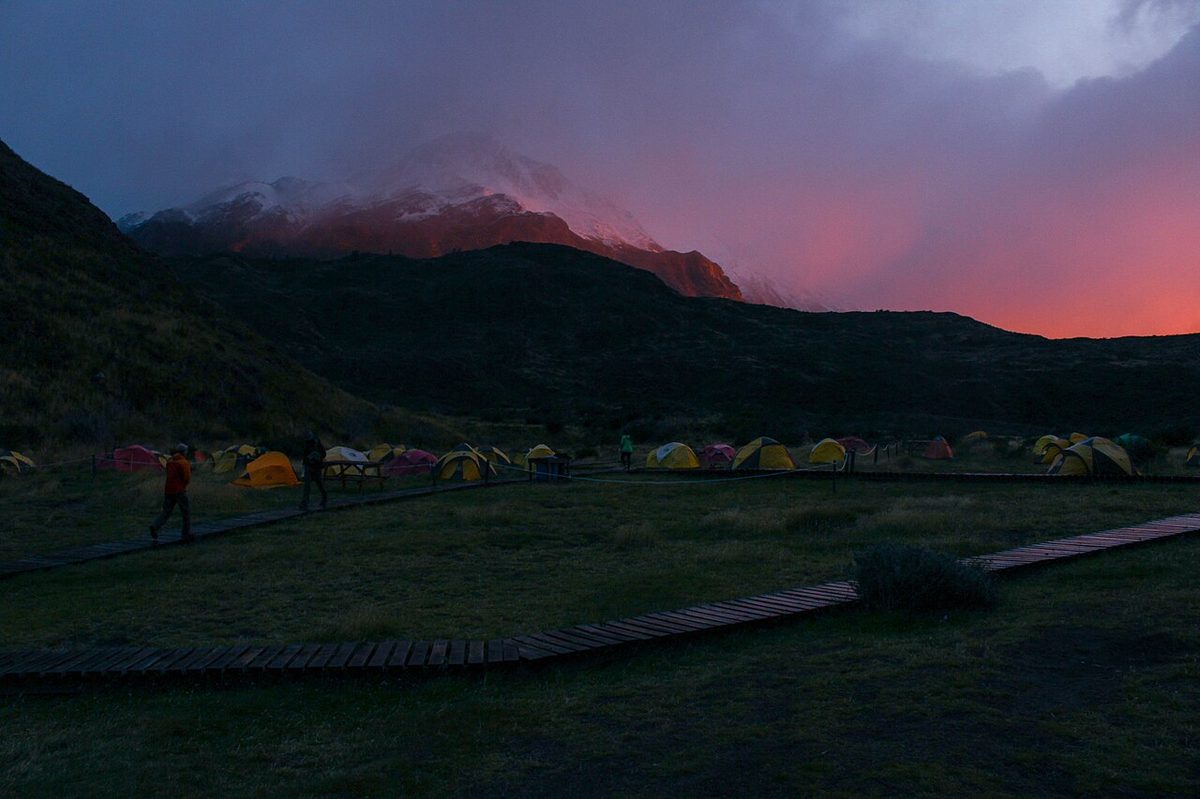
0 — 2 km Fig. 1 · Tents and the boardwalk at the Paine Grande campsite at dusk, with red light on the clouds over the Paine massif · Photo: Alexis Alvarez / CC BY-SA 4.0 via Wikimedia Commons
Patagonia refugios are staffed or semi-staffed mountain huts where hikers sleep in shared bunk rooms instead of carrying a tent. That much is true everywhere. Almost everything else changes depending on which side of the border you are on and who runs the hut. In Torres del Paine a refugio is a catered dorm lodge priced in US dollars and booked months ahead. Around Bariloche it is a club-owned hut where you bring a sleeping bag and often book only days ahead. In Argentina’s remote Perito Moreno National Park it is a basic shared shelter where you carry everything you would carry for camping.
So “refugio” is a word, not a standard. Before you pay for one, work out which of those three things you are buying, what the bed actually includes, and whether a tent would serve you better. That is what this page sets out, with the 2026-27 rates the operators publish themselves.
Prices, seasons and rules here were checked in October 2026 against the operators’ and park services’ own pages.
The closest comparison is an Alpine hut, not a hostel. A refugio sits on or near a trail, often hours from the nearest road, and exists so you can walk a multi-day route without hauling a tent, stove and a week of food. You get a bunk in a shared room, toilets, and usually a dining room. Some sell full meals and hot showers; some sell nothing at all.
What a refugio is not:
Not a hostel. You cannot wander in from the street. Most are reached only on foot (CONAF lists Paine Grande, Grey, Los Perros and Dickson as refugios without vehicle access), so the walk in is part of the booking.
Not a lodge. Rooms are mixed dorms. Privacy is a curtain, if that. In Torres del Paine, Las Torres’ mountain stays put six beds in each room; Vertice’s Grey sleeps up to 60 guests in shared mixed bunk rooms.
Not a dome or an equipped tent. Torres del Paine also sells pre-pitched tents with mats and sleeping bags, and domes at the Francés sector. People lump these together as “refugio nights” on a W itinerary, but they are separate products with separate prices.
Not always warm. Vertice says plainly that Grey’s rooms are not heated; the corridors and common areas are, with slow-combustion wood stoves. Assume the dorm will be cold and pack a warm layer to sleep in.
The appeal is obvious once you have carried a full camping load across Patagonian wind. A refugio pack is smaller and lighter, a hot dinner arrives without you cooking it, and you sleep out of the weather. The cost, as you will see below, is money, flexibility and the need to commit early.
Three kinds of Patagonia refugios
The single most useful thing to understand is that a refugio in Chile’s most famous park and a refugio in Argentina’s lake district are different animals. Here is the side-by-side.
Torres del Paine (Chile)
Bariloche, Nahuel Huapi NP (Argentina)
Perito Moreno NP, Santa Cruz (Argentina)
Who runs it
Two private operators: Vertice and Las Torres Patagonia
Huts of the Club Andino Bariloche, each run by its own provider
Fundación Banco de Bosques, under national parks (APN) authorisation
What you sleep in
Bunks in shared mixed dorms
Bunks in shared rooms
Bivouac-type (vivac) huts, shared with whoever else booked
Bedding
Depends on the product you buy (see below)
Bring a sleeping bag; Frey rents them
Carry a full sleeping kit
Food
Restaurant meals, full or half board, box lunches
Meals sold at the hut; no guest kitchen
None; carry food and a portable stove
Currency
US dollars for foreign visitors
Argentine pesos
Argentine pesos
How far ahead
Months
Days to weeks (Frey: only the next 7 days)
Online, during the 1 October to 30 April season
Where to book
lastorres.com and vertice.travel, separately
Each hut’s own site or contact
trekkingperitomoreno.com or the Banco de Bosques reservations email
Swipe to see all columns
Table 1
Two of those columns changed in 2026 in ways most older articles have not caught up with. Las Torres’ own help centre now lists its Chileno sector as campsite only, and Perito Moreno National Park’s huts are now booked through a Banco de Bosques concession. Both are covered below.
Torres del Paine refugios: two operators, two systems
Torres del Paine is where most people first meet the word, because the park makes it unavoidable. The park’s reservations page says that if you are trekking the W or the Macizo Paine circuit (the O), you must hold accommodation reservations in the refugios and campsites, and without them you cannot enter the mountain area. The named booking channels are lastorres.com, vertice.travel, Sernatur’s services portal and accredited agencies. Day-only trail access and the roadside Camping Serrano and Camping Pehoé sit outside that rule.
There is no combined booking system. The park’s lodging is split between two concessionaires, and a full W almost always means at least two separate bookings, two sets of terms and two confirmation emails.
Who runs what, from the operators’ own pages:
Vertice runs Paine Grande (refuge and camping), Grey (refuge and camping), Dickson (refuge and camping) and Los Perros, mostly on the western half of the W and the back of the O.
Las Torres Patagonia runs the eastern sectors. Its help centre lists Central (Hotel Las Torres, a mountain hostel and a campsite), Chileno (campsite only), Cuernos (mountain cabins, a mountain hostel and a campsite), Francés (domes and a campsite) and Serón (campsite only).
That Chileno line matters. Plenty of older guides and itineraries still describe a “Refugio Chileno” with dorm beds below the Base Torres viewpoint. Las Torres’ current sector list gives Chileno a campsite and no beds. CONAF’s trail signage still uses “Refugio Chileno” as the name of the place, so you will see it on distance tables; just don’t plan to sleep in a bunk there. If you want a bed on the Base Torres side, the mountain hostel at Central is the one Las Torres sells.
Vertice’s checkout vocabulary is the single most expensive misunderstanding in Patagonian trip planning, because the cheapest bed does not include anything to sleep under.
Per Vertice’s own property pages for the 2026-2027 season:
A single bed comes with a mattress cover, a pillow and a pillowcase. You bring your own sleeping bag.
An armed bed (cama armada) comes with a mattress cover, sheets, a pillow with cover and a blanket.
A bedding kit is sold separately, per person per night.
Treat these as separate products on the checkout page rather than doing arithmetic on them. The rates below apply to foreign visitors not resident in Chile who show a passport and valid entry card at check-in; without those documents, tax is added.
Vertice 2026-27, USD per person per night
Paine Grande
Grey
Dickson
Single bed (bring your own sleeping bag)
66
46
46
Armed bed (sheets, pillow, blanket)
114
114
114
Bedding kit
48
68
68
Campsite
13
11
11
Full board (dinner, breakfast, lunch or box lunch)
110
110
110
Half board (dinner and breakfast)
76
76
76
Breakfast / lunch or box lunch / dinner
34 / 36 / 53
34 / 36 / 53
34 / 36 / 53
Swipe to see all columns
Table 2
The practical takeaway: if you are willing to carry a sleeping bag, a Vertice dorm bed costs USD 46 at Grey and Dickson and USD 66 at Paine Grande, against USD 114 for the made-up bed. Over several nights that gap pays for a good chunk of the trip’s food.
A few house rules from Vertice’s pages that shape the day. Check-in is from 13:00 and check-out is 09:30, and at Grey the rooms are cleaned between 09:30 and 13:00, so you cannot get back into them in that window. Grey asks you to reserve dinner before 15:00. Power runs from 06:00 to midnight at Grey and is off overnight, so a headlamp is not optional. Vertice states there is no cell signal in the park; Grey sells Wi-Fi at reception. Showers at Grey run 07:00 to 09:00 and 14:00 to 22:00. Paine Grande has room for 100 guests in shared bunk rooms and lockers in the rooms, so bring a small padlock.
On seasons: Vertice says Grey is open all year round and Dickson opens from October to April, weather permitting. Paine Grande’s page gives no season, so check Vertice’s booking calendar and CONAF’s notices before you build a plan around it.
Las Torres: mountain stays, cabins, domes and equipped camps
Las Torres prices its dorm beds very differently. Its Central and Cuernos mountain stays publish the same 2026-27 rates:
Las Torres 2026-27, USD per person
Rate
Single bed in a shared six-bed mixed room, November 2026 to March 2027
from 230 per night
Same bed, late October 2026 (2026-27 rates valid from 26 October) and April 2027
from 200 per night
Full board (breakfast, box lunch, dinner)
140
Half board
90
Full / half board over Christmas and New Year
190 / 140
Breakfast / box lunch / dinner
40 / 40 / 70
Swipe to see all columns
Table 3
These are “from” rates, so the live price varies by date. Rooms have shared bathrooms and hot showers. Cooking is not permitted inside the mountain hostel, vegetarian meals must be booked in advance, and Las Torres notes that its food service is limited in capacity, which is a polite way of saying you should book meals with the bed rather than hoping to buy dinner on the day. At Central you can rent tents, sleeping bags and sleeping mats when you book, and there is Wi-Fi.
The bedding question is the one to settle before you pack. Las Torres’ help centre confirms that a pillow is included at the hostels. It does not say whether sheets, blankets or a duvet come with the bed. So ask Las Torres when you book whether the bed is made up, and if the answer is anything less than a clear yes, either carry your sleeping bag or add a rental at Central.
Las Torres also sells pre-pitched camping at Central for people who want a lighter pack without a dorm. Its 2026-27 Central Camp rates, per person sharing a tent, start at USD 160 for a fully equipped tent (raised tent, sleeping bag, foam mat and pillow) and USD 120 for a semi-equipped one (tent and mat) from November to March. Bringing your own tent to an individual pitch starts at USD 50 per person in the same months. Las Torres allows portable stoves only in the designated shelters at Central, Serón and Francés, and bans them in the Chileno sector because of fire risk.
At Francés, Las Torres’ accommodation is domes and a campsite; at Cuernos it also sells mountain cabins. For those, and for the hotels and lodges in and around the park, see where to stay in Torres del Paine.
Meal plans: when to take them and when to skip
Both operators sell meals by the night: full board (dinner, breakfast and a lunch or box lunch for the trail) or half board (dinner and breakfast). Las Torres charges USD 140 and USD 90; Vertice charges USD 110 and USD 76.
There is no guest kitchen in either operator’s refugios. If you skip the meal plan, you cook outside in the camping area’s designated shelter like a camper, which means carrying a stove, fuel and food anyway. That is why the hybrid that works best for most people is a refugio bed with half board, plus your own trail lunches and snacks. Packed lunches from a hut kitchen tend to be simple, and a bag of your own food is often more useful on a long day. The W Trek food guide covers what to carry.
Book special diets when you book the meals. Vertice and Las Torres both ask for vegetarian requests in advance.
Booking, payment and what happens if a trail closes
Chile’s national tourism board advises booking all W refugios and campsites six months or more ahead. In practice that means the peak months of December to February should be booked as soon as the operators open sales, and Las Torres’ higher meal rates over Christmas and New Year tell you which nights go first. If the nights you want are gone, keep checking both operators’ booking pages through the spring rather than rebuilding the whole trip. The booking timeline for Patagonia puts refugios alongside flights and buses.
Vertice’s published commercial conditions for the 2026/27 season (written for its programmes) require full payment to confirm, allow changes only if requested at least 75 calendar days before the start, refund 95% on cancellations made 75 or more days out, and give no refund inside 70 days or for no-shows. Bookings are in the traveller’s name and not transferable. Read the terms attached to your own booking, because the document is written for programmes. The same conditions include what Vertice calls a habitability commitment: if CONAF closes a trail for 24 to 48 hours and you need an extra night, Vertice guarantees you a campsite at no cost; for longer closures it guarantees a campsite and credits what you have paid.
For Las Torres, read the payment and cancellation terms shown at checkout for 2026-27 before you pay, and screenshot them.
Two more things catch people out. First, an operator’s booking engine may sell you a night for a date when CONAF has not yet opened that trail, so check CONAF’s notices against your dates; CONAF has said the O stays closed from May, initially until 31 October 2026. Second, park entry is separate from your beds and is sold online only through Pases Parques; see Torres del Paine tickets. Vertice’s help centre also advises leaving the CONAF-run campsites out of your plans, saying they have been closed since 2018. There is no free refugio and no free campsite on the W.
Argentina’s refugios: Club Andino huts around Bariloche
Cross the border to Bariloche and the word “refugio” means something much closer to a European mountain hut. Club Andino Bariloche’s classic huts stand in the mountains above the city, inside Nahuel Huapi National Park. Each is run by its own provider, and prices come from the hut, not the club: check each hut’s own rate card. So there is no single Bariloche refugio booking site. You book hut by hut, on each hut’s own site or through the contact the club lists.
The club’s providers page is blunt about it: places are limited for members and non-members alike, and booking ahead is mandatory, without exception, by contacting each provider directly. It lists staffed huts including Refugio Emilio Frey, Refugio General San Martín (better known as Jakob), Refugio Italia Manfredo Segre at Laguna Negra, Refugio Agostino Rocca at Paso de las Nubes, Refugio Otto Meiling on Tronador, Berghof on Cerro Otto, Laguna Ilón and Neumeyer. It also lists two unstaffed bivouac shelters, Vivac Velco and Vivac Manuel Ojeda Cancino, which are always open and offer basic amenities only.
Three rules apply to all of them:
Register your trek. Club Andino says trekking registration is obligatory. Trails marked “SENDA CERRADA” on its status page are closed for safety, and trails not on its list are not enabled.
Bring a sleeping bag. These are bunk-and-mattress dorms. Refugio Frey rents sleeping bags; elsewhere, ask the hut.
Don’t plan to cook inside. Frey does not allow cooking in the refugio and bans portable stoves indoors; Jakob says its kitchen is not open to the public. Either buy the hut’s meals or cook on your own stove outside where permitted. Frey bans fire outright and does not allow dogs.
Park entry is separate: Nahuel Huapi’s daily pass for foreign visitors is ARS 35,000 from 1 June 2026, per the national parks tariff page. The Patagonia park fees guide has the passes and discounts.
Which huts are open: the Club Andino status board
Club Andino keeps a live status page, and it is the first thing to check before booking anything. In early October 2026 it showed:
Hut or camp
Status on Club Andino’s page, early October 2026
Refugio Emilio Frey
Open
Refugio General San Martín (Jakob)
Open
Camping Laguna Ilón, Los Rápidos, Los Vuriloches
Open
Refugio Agostino Rocca
Listed as coming soon
Refugio Italia Manfredo Segre (Laguna Negra)
Listed as coming soon
Refugio Otto Meiling
Listed as coming soon
Swipe to see all columns
Table 4
For the “coming soon” huts, check the club’s page and the hut’s own site for the date before you commit to a route that depends on them.
Refugio Frey: the 7-day booking window
Frey sits by Laguna Toncek below the Catedral spires and is the hut most visitors meet first. In winter the hut’s reservations page lists skis or snowshoes, waterproofs, poles and gloves as compulsory kit. The detail that trips people up is the booking window: Frey’s reservations page says bookings are open only for the next 7 days. You cannot lock in a Frey bed from home months in advance, so build a Bariloche hut trip with some slack and book as soon as your dates come into range. Large groups contact the hut directly. You can book either a bed (pernocte) or a camping place (acampe), and the hut offers vegetarian and vegan options. Its rate card, in pesos, is on its site.
Refugio Jakob: book the bed, order meals on arrival
Refugio General San Martín, universally called Jakob, says it is open all year. Reservation is compulsory for both the hut and its campsite. Rooms are mostly four bunks and are assigned on arrival. You book only the bed; meals are ordered at the hut, and coeliac guests should message ahead. You can change dates or cancel up to 48 hours before, but deposits are not refunded, and the hut notes that booking ahead does not freeze the price. Its tariffs page lists beds, meals, camping and discounts in pesos.
Peso prices move quickly, so treat any figure you have seen elsewhere as a guide and check the hut’s own page the week you go. Carry enough pesos for meals and drinks, and ask the hut how it takes payment before you rely on a card.
A popular hut-to-hut route links Frey, Jakob and Laguna Negra across the mountains behind the city. The route, its harder sections and the shorter day hikes to each hut are on the Bariloche hiking guide, and town bases are on where to stay in Bariloche.
El Bolsón: the other hut country
South of Bariloche, the mountains above El Bolsón hold a network of mountain huts. Many are private or family-run, and several sit inside the provincial protected area known as ANPRALE. The Río Negro provincial government says registration before entering the area is mandatory, through the form at anprale.com, which it uses to apply per-circuit capacity limits and close areas during weather alerts. After the summer 2025 fire, the province says some sectors remain restricted or closed, so check anprale.com for which circuits are open before choosing a hut. The El Bolsón guide covers the town and the valley.
Southern Argentina: Perito Moreno NP’s shared huts and El Chaltén’s private refugios
Perito Moreno National Park (Santa Cruz, not the glacier)
This is the remote park off Ruta 40 in northwest Santa Cruz, not the Perito Moreno Glacier near El Calafate. It has some of the most basic refugios in this guide and the biggest recent change.
Fundación Banco de Bosques launched the park’s trekking and refuge reservation system on 17 July 2026 under a concession from Argentina’s national parks administration; Noticias Ambientales described it as the first non-profit tourism concession in the national park system. Check current prices on the booking engine at reservas.trekkingperitomoreno.com, or email the reservations desk at [email protected], which the APN’s own visitor page gives as the booking contact for refugios, domes and campsites.
What you are booking, per trekkingperitomoreno.com, is one of 10 bivouac-type (vivac) refugios: Archipiélago, Azara, Caleta Huala, Dos Bahías, Gilberto, Kris & Doug Tompkins, La Angostura, Playa Quetro, René Negro and Tucúquere. All except Caleta Huala have camping plots beside them. Two further camping areas on the long trails can only be reached on foot, and there you must carry a tent and a stove.
The APN’s “Planeá tu visita” page sets the ground rules:
The park is open to the public from 1 October to 30 April each year, which can vary with road conditions.
Use of the refugios and domes is shared: you share the hut with whoever else has booked.
After booking, registering your mountain activity is compulsory, and you must register your visit at the Centro Operativo Clemente Onelli (09:00 to 19:00).
Plan to reach your hut or campsite in daylight.
The booking engine’s rules page adds that most sites allow a maximum of one night per person or group, with exceptions at Tucúquere and San Lorenzo; that open fire is prohibited throughout the park; and that pets, speakers and drones are not allowed. Treat these huts as a roof over your camping kit: bring a sleeping bag, a mat, a stove and all your food. Getting there means long stretches of gravel, so read the Ruta 40 and border crossings guide before you commit.
El Chaltén: camps on the main trails, private refugios on the edges
El Chaltén’s famous trails to Laguna de los Tres and Laguna Torre are served by three bookable camps, Poincenot, De Agostini and Laguna Capri, rather than huts. Those camps cost ARS 30,000 per adult per night, must be reserved and paid before the hike, and offer dry toilets and camp hosts but no showers or kitchen. The El Chaltén camping guide has the details, and the El Chaltén hiking guide covers the trails.
The refugios are out along Ruta Provincial 41, north of town:
Puesto Cagliero, inside Estancia (Reserva) Los Huemules, is about a 2.5-hour walk on an easy trail from a start 17 km from El Chaltén. It has six rooms for four with bunks, each with a private bathroom and hot water, towels and bed linen provided. The rate includes half board (welcome coffee with pancakes, dinner and breakfast) and entry to the reserve; lunch and drinks are extra, and lunch can be pre-booked. It opens from 1 November to 6 April, check-in runs from 10:00 to 16:00 and pets are not allowed. Prices come on request through the property’s enquiry form, so ask when you book.
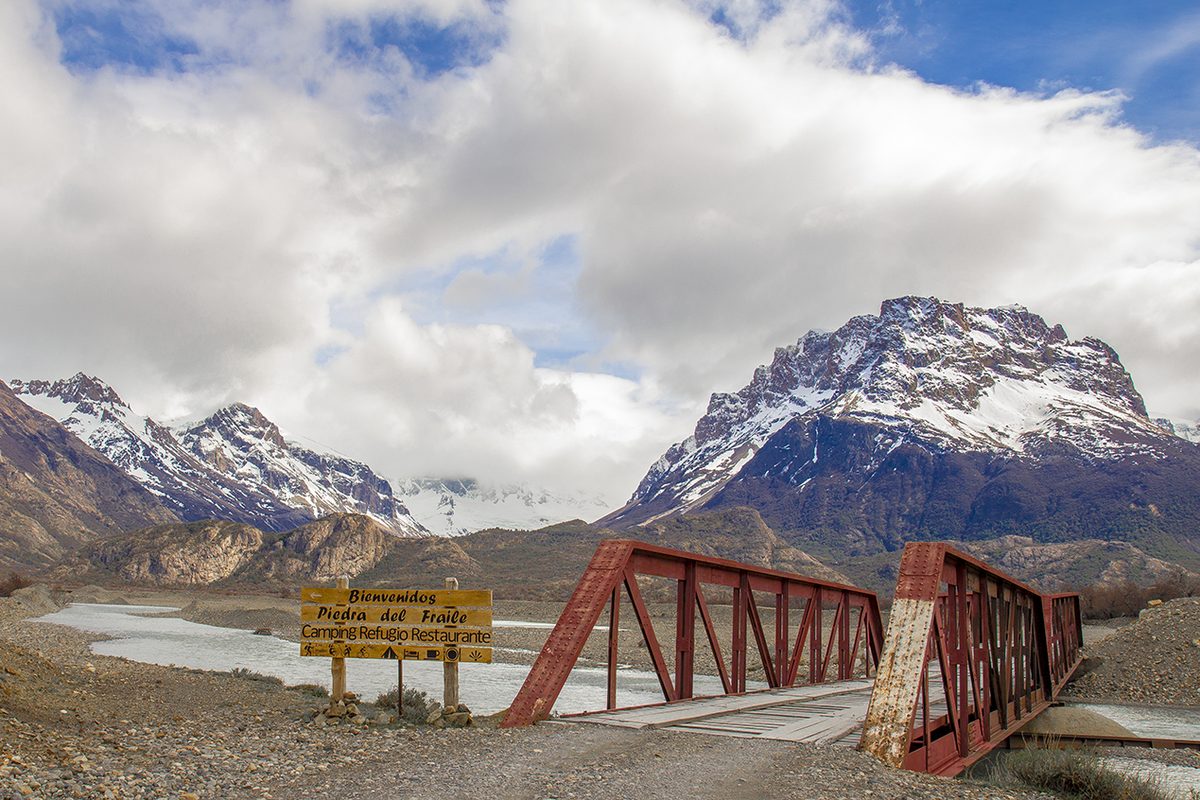
Refugio Piedra del Fraile, in the Río Eléctrico valley, is about a two-hour walk from the Río Eléctrico bridge, 17 km from town on RP41. It opens from 1 November to 6 April and is cash only.
Both get busy in midsummer, so enquire early for December to March. For beds in town, see where to stay in El Chaltén.
Readers often assume huts exist on every famous Patagonian trek. Several of the big ones are tent country, and planning around a refugio that is not there wastes time.
Dientes de Navarino (Isla Navarino, Chile). Chile’s national tourism board describes it as a highly demanding four- to five-day trek and lists a tent and a good sleeping bag in the kit. It also says registering the start and end of your trek with Carabineros is mandatory. Plan it as a self-sufficient camping trip.
El Chaltén’s main trails. Camps, not huts, as above.
Torres del Paine’s CONAF campsites. Closed since 2018, according to Vertice; every overnight on the W and O is with Vertice or Las Torres.
Torres del Paine is where the money goes, so these worked examples use the operators’ 2026-27 rates for foreign visitors, per person for one night, before park entry.
Night
What you buy
USD
Vertice Grey, budget refugio
Single bed (own sleeping bag) + half board
46 + 76 = 122
Vertice Paine Grande, comfortable refugio
Armed bed + full board
114 + 110 = 224
Las Torres Cuernos or Central, peak
Dorm bed from 230 + full board 140
from 370
Las Torres Central, own tent
Individual pitch, sharing, November to March
from 50
Vertice Grey, camping
Campsite, own tent and food
11
Swipe to see all columns
Table 6
The spread is the story. The same night of sleep in a shared dorm runs from USD 46 to USD 230 or more depending on whose sector you are in and what bedding you buy. Add meals, and a four-night W done entirely in Las Torres and Vertice dorms with full board comes to several times the cost of the same route camped with your own food. The W Trek cost breakdown puts the whole trip together, including transport and park entry.
In Argentina the sums are in pesos and change faster than any table can keep up with. Club Andino huts and Perito Moreno NP post their prices on their own pages, Puesto Cagliero quotes on request, and El Chaltén’s camps are ARS 30,000 per adult per night. Check each one the week you book.
How far ahead to book Patagonia refugios
Lead times run from six months down to a week, which is the second biggest surprise after bedding.
Place
How far ahead
How you book
Changes and refunds
Torres del Paine, both operators
6 months or more for summer, per Chile’s tourism board
Online, separately with Vertice and Las Torres
Vertice: changes at least 75 days out; see each booking’s terms
Refugio Frey
Only within the next 7 days
Frey’s own site
Check the hut’s terms
Refugio Jakob
Reservation compulsory
Jakob’s own site
Change or cancel up to 48 hours before; deposit not refunded
Other Club Andino huts
Once the hut opens for the season
The provider listed by Club Andino
Ask the hut
Perito Moreno NP
Within the 1 October to 30 April season
trekkingperitomoreno.com or the Banco de Bosques email
Free change or cancellation within 10 days of purchase with at least 24 hours’ notice, per the booking site
Puesto Cagliero
Early for December to March
Enquiry form or WhatsApp on its page
Ask when booking
El Chaltén camps (not refugios)
Up to the day before
amigospnlosglaciares.org
Non-refundable; date cannot be changed
Swipe to see all columns
Table 7
Who should book a refugio, and who should camp?
A refugio is the right call for a specific kind of trip. Here is how to tell.
You are…
Book a refugio?
Why
A first-time multi-day hiker doing the W
Yes, at least for some nights
Lighter pack, hot dinner, no tent to pitch in wind
Travelling solo
Often yes
A dorm bunk avoids the cost of a whole tent, and the dining room is sociable
A couple on a comfortable budget
Yes, with meals
The time and weight saved make the walking days easier
A budget backpacker
Mostly camp
In Torres del Paine a campsite costs a fraction of a bed
Doing the O circuit
Some nights
Serón is campsite only, and every night needs a reservation
Hiking in October or April
Lean towards a refugio
Long cold evenings are easier with a heated dining room
Unable to fix dates months ahead
Camp, or go to Bariloche
Torres del Paine beds sell early; Frey books only days out
Heading to Navarino, El Chaltén’s main trails or Perito Moreno NP
You will be camping or carrying full kit
The choice is mostly made for you
Swipe to see all columns
Table 8
Three scenarios make it concrete.
A couple doing their first big trek in January should book refugio beds with half board on the W as early as they can, carry trail lunches, and confirm the bedding situation on each night. If one operator’s nights sell out, a pre-pitched equipped tent on that night is a sensible fallback rather than abandoning the plan.
A solo backpacker watching every dollar should camp most of the W with their own food, and maybe buy one single bed at Grey or Dickson for a night out of the wind. With a sleeping bag already in the pack, that night is USD 46 rather than USD 114.
A hiker who wants huts but hates committing early should look at Bariloche. Frey’s 7-day window rewards exactly the traveller who books Torres del Paine too late, and the Club Andino status page tells you what is open before you set off. If you are travelling alone, the Patagonia solo travel guide has more on dorm life and safety.
Torres del Paine: Las Torres reopened for the season on 1 October 2026, according to TravelExtra. Vertice lists Grey as open all year and Dickson from October to April. CONAF said the O stays closed from May, initially until 31 October 2026. Check Las Torres’ help centre for each sector’s closing date, and CONAF and Pases Parques for trail notices and the O’s reopening date before you travel.
Bariloche: Frey and Jakob open; Rocca, Laguna Negra and Meiling listed by Club Andino as coming soon in early October.
Perito Moreno NP: season runs 1 October to 30 April, roads permitting.
El Chaltén refuges: Puesto Cagliero and Piedra del Fraile open on 1 November.
FAQ
What is a refugio in Patagonia?
A mountain hut on or near a trail with shared bunk rooms and toilets, built so hikers can walk multi-day routes without carrying a tent. In Torres del Paine they are catered dorm lodges with meals and showers; around Bariloche they are club-owned huts where you bring a sleeping bag; in Perito Moreno National Park they are basic shared shelters.
Do I need a sleeping bag in a refugio?
In Bariloche, yes, unless you rent one at Frey. At Vertice’s huts in Torres del Paine, not if you book an armed bed or a bedding kit, but yes if you book the cheaper single bed. At Las Torres, the operator confirms a pillow; ask when you book whether sheets and blankets are included, and rent a sleeping bag at Central if in doubt. In Perito Moreno National Park, bring a full sleeping kit.
How much does a refugio cost in Torres del Paine?
For 2026-27, Vertice’s dorm beds cost USD 46 to 66 for a single bed and USD 114 for an armed bed, with full board USD 110. Las Torres’ Central and Cuernos dorm beds start from USD 230 from November to March and from USD 200 in late October and April, with full board USD 140. Those rates are for foreign visitors showing a passport and entry card.
Do I have to book refugios in advance?
In Torres del Paine, yes: trekkers on the W and O must hold accommodation reservations in the refugios and campsites or they cannot enter the mountain area. Chile’s tourism board advises booking six months or more ahead. Around Bariloche, Club Andino says booking ahead is mandatory, but Refugio Frey only accepts bookings for the next 7 days.
Are there free refugios in Patagonia?
Not in Torres del Paine. Perito Moreno National Park’s huts are booked through Banco de Bosques, so check its reservations page for current terms. Club Andino lists two unstaffed bivouac shelters near Bariloche, Vivac Velco and Vivac Manuel Ojeda Cancino, as always open with basic amenities only.
Can you cook in a refugio?
Generally no. Las Torres and Vertice don’t allow cooking inside their refugios; campers cook in designated shelters, and stoves are banned in Las Torres’ Chileno sector. Frey bans cooking and stoves inside, and Jakob’s kitchen is not open to guests. Buy the hut’s meals or cook on your own stove outside where permitted.
Is there a refugio at Chileno in Torres del Paine?
Not with beds. Las Torres’ help centre lists the Chileno sector as campsite only. The name “Refugio Chileno” survives on CONAF’s trail sections as a landmark. For a bed near the Base Torres trail, Las Torres sells its mountain hostel at Central.
What happens if weather closes the trail and I miss my refugio night?
Vertice’s 2026/27 commercial conditions guarantee a campsite at no cost if CONAF closes a trail for 24 to 48 hours and you need an extra night, and a campsite plus credit for closures longer than that. For Las Torres, check the terms on your booking. Travel insurance that covers weather delays is the real safety net.
Final thoughts
Book a refugio when the trek, the season and your budget all point that way, and know which kind you are buying. In Torres del Paine, decide early, pick your bed type deliberately, and confirm what it includes. In Bariloche, register, bring a sleeping bag and book days, not months, ahead. In Perito Moreno National Park, treat the hut as shelter for your camping kit. And on Navarino and El Chaltén’s main trails, pack the tent.